The gala chair said his name and the spotlight moved.
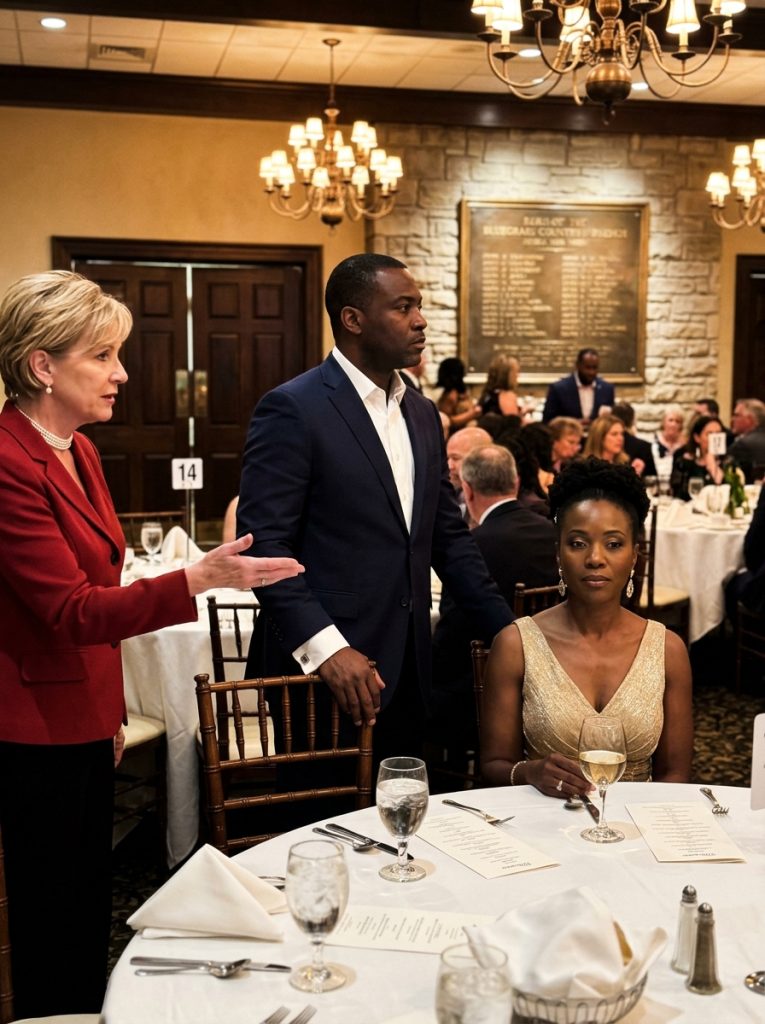
It swung from the stage to the back corner of the room — to table 14, near the service door, where Marcus and Diana Osei were seated in the half-light that Helen Vance had chosen for them.
Marcus stood slowly. He buttoned his jacket with one hand. Diana rose beside him. Gold gown. Spine straight. The chandelier light caught her updo and made her look like she was standing in her own private sun.
The room turned.
I watched from table 22 as three hundred people pivoted in their chairs. I watched the silence build — not the polite silence of an introduction, but the charged silence of a room realizing it has made a mistake.
The gala chair continued: “Marcus and Diana Osei have generously donated two point four million dollars to fund the construction of this pavilion — the very room we are celebrating in tonight. Marcus, Diana — we are honored.”
Helen Vance was seated at table 2. I could see her profile from where I sat. Her face did not move.
Marcus walked to the podium. He did not rush. Diana stayed standing at table 14, watching him cross the room. Every person he passed turned to follow him. He climbed the three steps to the stage, shook the gala chair’s hand, and stood behind the microphone.
He did not smile.
“Thank you,” he said. His voice was measured, low, the kind of calm that comes from having thought about what you are going to say for a very long time.
“Diana and I are honored to be here tonight. We built this fund because we believe in community. We believe in the idea that a club like this one — a place where people gather, where relationships are made, where business is done over dinner — should reflect the best of what Lexington can be.”
He paused.
“We donated to build a room that would welcome everyone.”
The room was silent.
“Tonight, my wife and I were seated at table 14. Near the service door.”
I heard someone at my table inhale.
“We were not introduced to anyone at the front tables. We were not offered a cocktail by the gala volunteers. We were directed — politely, graciously — to a table in the back corner of the room we paid for.”
He let that sit.
“I want to be clear that I am not angry. I am disappointed. And I am making a decision tonight that I want this room to hear.”
The board chair, a man named Douglas Fairley, 63, stood up at table 1. His face was white.
“Effective tonight,” Marcus continued, “the Osei Family Foundation is suspending all future pledges to the Bluegrass Country Club until a formal review of the membership and seating policies is completed — by an independent committee, not the current board.”
The room erupted. Not with applause. With the sound of three hundred people talking at once — the sharp hiss of whispered shock, the scrape of chairs, the clink of glasses being set down too hard.
Douglas Fairley moved toward the stage. Helen Vance had not moved from her seat. Her hands were in her lap. Her face was fixed in an expression I recognized from eleven years of watching her — the expression of someone whose control has just been removed without warning.
Fairley reached the stage. He took the microphone from Marcus — not roughly, but with urgency.
“I want to address this directly,” he said. His voice was shaking. “The seating arrangement tonight was not approved by the board. It was handled by the membership committee chair, Helen Vance, and it does not reflect the values of this institution.”
He turned to Helen.
“Helen. Your position is terminated effective immediately. Please see me in the office after the event.”
Helen Vance stood up. She did not speak. She picked up her clutch from the table, turned, and walked toward the side exit. Her pearl choker caught the light as she moved through the door.
No one stopped her.
Marcus stepped back from the podium. He walked back across the ballroom floor to table 14, where Diana was still standing. He took her hand. They sat down.
The gala continued. But the air in the room had changed.
I stayed in my seat for a long time after that. My phone was in my hand but I had stopped recording. I was thinking about the eleven years I had spent at this club — the things I had seen, the arrangements I had noticed, the patterns I had learned not to name.
Marcus Osei had named them in four minutes.
After the program, I walked over to table 14. I introduced myself. I told Marcus and Diana that I had been watching from across the room and that I was grateful for what they had done.
Diana looked at me and said, “How long have you been a member?”
I said eleven years.
She said, “And tonight is the first time you’ve walked over to this table.”
She wasn’t accusing. She was stating a fact.
I nodded.
“Then you know what needs to change,” she said. “It’s not just Helen.”
She was right. I knew that. I had always known it. But it had taken someone else — someone willing to stand at a podium and say it out loud — for me to walk twenty feet across a ballroom floor and sit down at a table I had been avoiding for over a decade.
The independent review committee was formed four weeks later. I was one of the first volunteers. The new seating policy was implemented by February. Membership demographics shifted for the first time in the club’s history by the following fall.
The independent review committee found what I already knew — that the seating had not been random. Helen Vance had maintained a private spreadsheet, color-coded, that sorted members into categories. The categories were not labeled by donation level. They were labeled by what Helen considered “fit.” The spreadsheet was on her club-issued laptop, which she returned the night she was fired.
The review resulted in three policy changes. First: seating at all club events would be randomized or self-selected. Second: membership applications would be reviewed blind — no photographs, no references from current members, no “character interviews” that were, in practice, demographic screenings. Third: the board would include at least two community-appointed members who were not existing club members.
Marcus and Diana reinstated their pledge in March, after the new policies were ratified by the full membership vote. The vote was 287 to 4.
I voted yes. Obviously.
But I also did something else. The following fall, when the gala invitations went out, I called the club office and asked to be seated at table 14. The same table. Near the service door.
Not as a protest. Not as a statement.
Because I wanted to remember what it felt like to sit there. To feel the draft from the kitchen. To hear the clatter of trays. To know what it is to be placed at a table that tells you, without words, that you are less than.
I never want to forget that feeling.
Because forgetting it is how Helen Vance happened in the first place — a room full of people who had forgotten what it felt like to be the one near the door, because they had been at the front tables for so long.
The plaque on the pavilion wall still reads: Donated by the Osei Family Foundation, 2019.
But now, when the gala happens, Marcus and Diana sit at table 1.
Not because they demanded it.
Because the room finally understood what it meant that they had built it.
And because one night, a man in a dark suit with silver cufflinks stood at a podium and said out loud what everyone else had been too comfortable to name.
That’s all it took.
One person. One microphone. One truth.
And a plaque that had been on the wall the whole time — waiting for someone to read it.