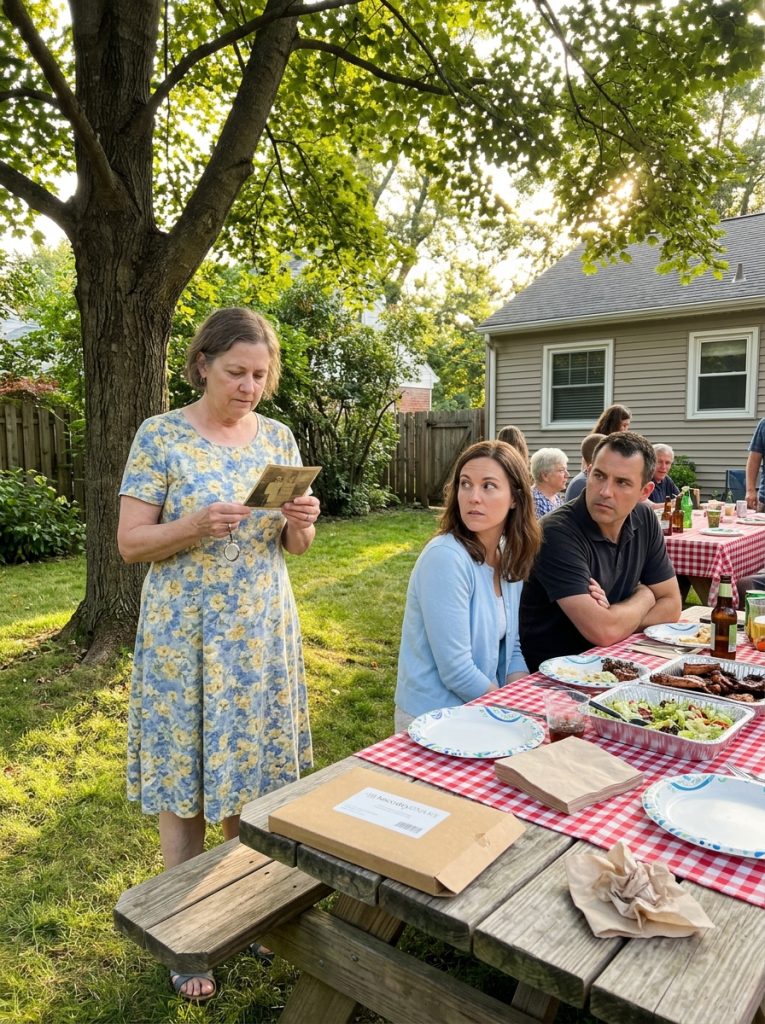
I opened the envelope with everyone watching.
Inside was a single page from the testing service — the kind with the percentages and the little relationship labels. My aunt had quietly mailed in a sample weeks earlier, she admitted later, after Lorraine had reached out to her in private and begged for one chance to prove she wasn’t a stranger.
I read the line at the top. Then I read it again, because the words rearranged everything I thought I knew about my own life.
Parent. Ninety-nine point nine percent.
Lorraine Pierce, the woman we’d whispered about for three summers, the woman my brother was sure was after our money, was our mother.
The backyard was completely silent. Carl had gone gray. My aunt had her hand over her mouth. And by the maple tree, Lorraine stood very still, the locket pressed to her chest, waiting — the way she’d been waiting, I would learn, for thirty years.
I want to tell you the truth she told us that afternoon, because it’s the part the whispering never imagined.
Our mother did not die in a car accident when I was four. That was the story our grandfather built and made everyone repeat. The truth is that our father — his son — was a violent man. The kind whose violence escalated. The kind a young mother of two finally understood was going to get one of them killed.
Lorraine was twenty-six. She had no money, no family of her own, and a husband who’d promised that if she ever tried to leave with the kids, he’d find her, and she believed him because he’d already shown her what he was capable of.
So she made the worst trade a mother can make. She went to our grandfather — her father-in-law, a hard man but not a cruel one — and she asked him to take us. To raise us safe, away from his own son. And in exchange she would disappear. Completely. No letters, no calls, no birthday cards that could be traced, nothing that might lead our father back to us through her.
Our grandfather agreed on one condition: that the story would be that she had died. He thought it would be cleaner for us. Easier than knowing our mother had left. He told us about the accident. He told the whole family. And Lorraine let him, because a dead mother couldn’t be followed home.
She left so that we could be safe. And then she stayed away for thirty years, because staying away was the safety.
Our father died eleven years ago. By then we were grown, scattered, settled. Lorraine found out through an old acquaintance. And she told us, sitting at that picnic table, that the day she learned he was gone was the first day in three decades she let herself imagine seeing us again.
But how do you walk back into the lives of children who were told you were dead? Children who’d grieved you, built around the hole you left, made peace with a headstone?
She didn’t know how. So she started small. She found out about the reunion. She came and stood by the fence, too afraid to approach, just to see our faces. The first year she couldn’t even speak. The second year my cousin asked her to leave. This third year she’d brought the locket — with our baby pictures inside, the only two photographs she’d allowed herself to keep — and the DNA test, because she’d run out of other ways to say I am not a stranger and I never stopped.
Here’s where I have to be honest, because this is not a story where everyone hugs and the band plays.
Carl didn’t accept it that day. My brother was nine when she “died.” He has older memories than I do — real ones, of her, and then of the grief. He stood up from the table and said the cruelest true thing: “You let us bury you. You let us cry at a grave with nobody in it. I don’t care why.” And he walked into the house.
I understood him. I still understand him. Thirty years is a wound that having a good reason doesn’t close.
But I was four. I don’t have her in my memory the way Carl does. What I have is a hole shaped like a mother, and a woman standing by a maple tree who’d spent her whole life keeping a promise that cost her everything, including us.
I walked over to her. I didn’t run. I didn’t fall into her arms. But I walked over, and I looked at the locket — my own four-year-old face, my brother’s nine-year-old face, worn soft from thirty years of a thumb opening and closing it — and I said the only true thing I had.
“I don’t know how to do this. But I don’t want you standing by the fence anymore. Come sit at the table.”
She cried so hard she couldn’t walk for a minute. I held her arm and walked her over and sat her down at the picnic table with the terrible potato salad, and my aunt sat on her other side, and for the rest of that long afternoon she got to be at the table instead of at the fence.
That was a year ago.
I want to tell you about the conversation we had later that evening, after most of the family had gone home and it was just Lorraine, my aunt, and me on the back porch with the citronella candle burning down.
I asked her the question I couldn’t ask in front of everyone. “Did you ever come close? In thirty years. Did you ever almost knock on the door?”
She was quiet for a while. Then she told me about a day, maybe fifteen years back, when she’d driven to my college town. She’d found out where I went to school — she wouldn’t say how — and she’d parked across from the campus coffee shop where I worked, and she’d watched me through the window for an hour, wiping tables, laughing with a coworker.
“You had paint on your sleeve,” she said. “You were always making something, even then. I sat in that car and I had my hand on the door handle for an hour.” She looked at her hands. “And then I thought about your father, and whether he could still find a way to follow me to you, and I took my hand off the handle and I drove home. That was the closest I came. Watching you wipe a table with paint on your sleeve.”
I didn’t know what to do with that. I still don’t, entirely. The image of my mother sitting in a car across the street, hand on the handle, choosing my safety over her own arms one more time — it lives in me now.
“I’m sorry,” she said. “Not for leaving. I’d do that again to keep you alive. I’m sorry for the cost. I’m sorry there was a cost at all.”
Here is where I have to be honest, because this is not a story where everyone hugs and the band plays.
Carl still hasn’t fully accepted it, and he may never. He says maybe someday and I’ve learned not to push. My aunt and I are slowly piecing together the years — Lorraine kept a box, it turns out, of things she couldn’t send. Birthday cards she wrote and never mailed. Thirty years of them. One for each of us, every year, sealed and dated and never sent because a postmark could be followed.
She gave me mine. Thirty-two cards. I read one a week, in order, so I don’t drown.
The cards are not a substitute for a childhood. Nothing is. That’s the bittersweet center of this whole thing: there’s no version where we get the years back. She protected us by erasing herself, and the protection worked, and the cost was the protection itself. We were safe and motherless. She was free and childless. The good reason doesn’t undo the loss. It just explains it.
But I have her now. Imperfectly, slowly, with my brother’s empty chair at the table and thirty years we can’t refill. I have a mother who loved us enough to let us think she was dead so that we could grow up alive.
She comes to the reunion every year now. She sits at the table.
And she doesn’t stand by the fence anymore. That part, at least, is finished.