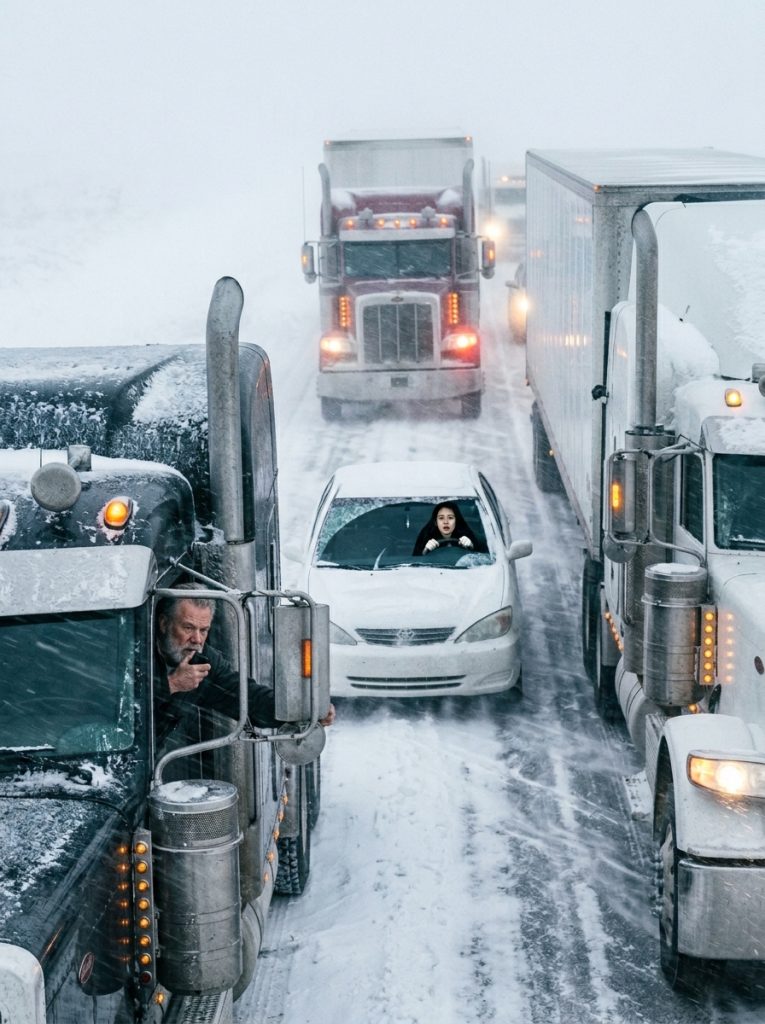
Elena Park reached the NOAA field station three hours late that day.
Her supervisor, Dr. Kenji Tanaka, was standing at the entrance when she pulled in.
“We thought you went off the road,” he said.
“Almost did.”
She told him the story over reheated coffee in the observation room. The whiteout. The drifting. The moment she lost all sense of direction and started whispering prayers to a windshield she couldn’t see through.
And then — the trucks.
“They just appeared,” she said. “One ahead. Two beside me. Like a formation. Like they planned it.”
“Did you talk to them?”
“After. At the rest stop. Three guys. Long-haul truckers. They bought me lunch and told me it was nothing.”
Kenji shook his head. “It wasn’t nothing.”
“I know.”
Elena threw herself into work after that. The field station monitored atmospheric conditions across the northern Great Plains — wind patterns, barometric shifts, ice accumulation data that fed into the National Weather Service’s warning system.
She was good at her job.
Better than good.
She had a gift for reading weather models the way some people read music — seeing patterns before they materialized, hearing signals in the data before the alarms triggered.
But the experience on I-90 had changed something in her.
Before that day, weather was abstract. Data points. Probability curves. Alert categories.
After that day, weather was personal.
Weather was a woman alone in a sedan with no weight and no visibility, drifting toward the shoulder at forty miles an hour in a wind that could flip a car without trying.
Weather was three truckers who chose to slow down, form up, and hold a stranger safe for forty miles in conditions that could have killed all of them.
Weather was human.
And it haunted her.
Not in the dramatic, nightmarish way. Not flashbacks or cold sweats. Just a quiet insistence every time she looked at the models — a voice reminding her that behind every data point was a person. Behind every alert was a windshield. Behind every probability curve was someone gripping a steering wheel, alone, wondering if they were going to make it.
She started tracking I-90 conditions obsessively. Not just the official readings. She subscribed to trucker forums. CB radio streams. State highway department updates. She wanted to know what the road felt like from inside a cab — not what the satellite said from above.
She learned the language. “Hammer lane.” “Chicken lights.” “Bear in the air.” She learned which miles were treacherous and which curves claimed a truck every winter.
She learned that the men who drove those roads didn’t call themselves heroes.
They just drove.
They just helped.
And then they kept driving.
Six months passed.
Late November.
Elena was reviewing long-range models at 4:30 in the morning when something caught her eye.
A pressure system building over the Rockies. Cold air mass descending from Canada. Jet stream dipping unusually far south.
She ran the models twice.
Then three times.
The convergence pointed to a catastrophic ice event on the same corridor — I-90 through South Dakota — within seventy-two hours. Not a whiteout this time. Worse. Freezing rain on top of black ice. The kind of conditions that turned highways into skating rinks and eighteen-wheelers into sideways missiles.
The automated alert system would trigger eventually.
But eventually might mean twelve hours before impact.
Twelve hours wasn’t enough for the people who drove that road every day.
Elena picked up her phone.
She didn’t call the alert desk first.
She called directory assistance for Rapid City, South Dakota.
“I need the number for a long-haul dispatch service. Any of them. All of them.”
It took her forty minutes and six calls.
But on the seventh call, she reached a dispatcher named Linda at Great Plains Freight out of Mitchell, South Dakota.
“I’m looking for a driver named Ray Dawson. Runs a Peterbilt on I-90.”
“May I ask who’s calling?”
“My name is Dr. Elena Park. I’m a meteorologist with NOAA. And I need to talk to Ray about something that’s going to happen on his route in less than three days.”
Linda paused.
“Hold on, honey. Let me patch you through.”
Ray answered on the third ring. His voice was road-rough. “This is Dawson.”
“Ray, this is Elena Park. I don’t know if you remember—”
“The sedan.” His voice shifted. Softened. “Of course I remember. You okay?”
“I’m fine. But I’m calling about something else. I need you to listen carefully.”
She told him about the ice event. About the models. About the convergence pattern she’d identified three days before any public warning would go out.
“I’m issuing my internal advisory tonight,” she said. “But by the time it becomes a public alert, a lot of people will already be on that road. Including you. Including Tommy and Hank.”
“You remember their names?”
“I remember everything about that day.”
Ray was quiet for a moment.
“What do you need me to do?”
Advertisement
“Get off the road. Reroute south through Nebraska if you can. And call every driver you know on that corridor and tell them the same thing. The ice is going to hit Wednesday night and it’s going to be catastrophic. I’m talking sixty-car pileups. I’m talking fatalities.”
“You sure about this?”
“I’m sure.”
Ray didn’t hesitate.
“I’ll make the calls.”
Over the next forty-eight hours, Ray Dawson personally contacted seventeen drivers. Tommy Okafor reached another twelve through his contacts in Omaha. Hank Muñoz called three trucking companies directly and spoke to their safety directors.
Thirty-eight trucks rerouted off I-90 before the public alert went live.
When the ice hit Wednesday night at 11:40 p.m., it was every bit as devastating as Elena predicted.
A twenty-six vehicle pileup near Chamberlain, South Dakota blocked both lanes for nine hours. Four people were hospitalized with critical injuries. Two flatbed trailers jackknifed. A fuel tanker overturned.
But thirty-eight trucks — and their drivers — were safely south of the corridor when it happened.
Not one of them was in that pileup.
Not one.
Ray called Elena the morning after.
His voice was rough. Quiet.
“You saved us, Doc.”
Elena leaned back in her station chair. The morning sun was rising over the plains outside her window.
“No,” she said. “You saved me first. This was just the road giving it back.”
Ray was quiet for a long time.
Then he said: “Next time you’re on I-90 in a storm — you call Channel 19. We’ll be there.”
Elena smiled.
“I know you will.”
She hung up.
Outside, a hawk circled the winter sky. The roads were clear today. Tomorrow they would be clear too. But somewhere on every corridor, someone was driving alone — and somewhere else, someone was watching out for them.
And for the first time since that whiteout in June — for the first time since she white-knuckled a steering wheel while three strangers shielded her with eighty tons of steel — she felt like the debt was settled.
Not because she owed them.
But because the road had proven what she always suspected.
That kindness isn’t a one-time event.
It’s a frequency.
And once you’re tuned into it, it keeps coming back.