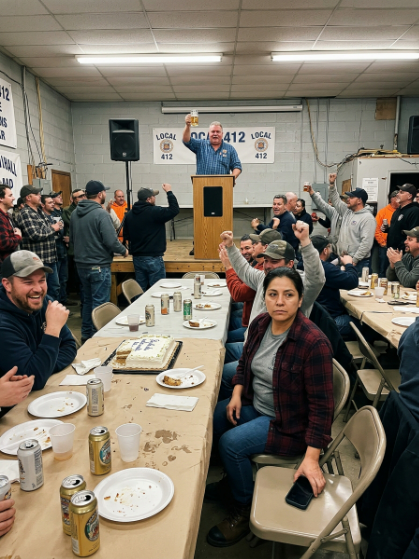
I walked toward the stage, and the room turned with me, forty faces swiveling from Frank’s raised stein to the woman crossing the floor of Local 412 with a phone in her hand.
Frank’s grin held for a second too long. He’d been president twelve years; he knew how to run a room. “Rosa,” he said, warm, expansive, playing to the crowd. “Rosa, come on, we’re celebrating. Whatever it is, it can wait till Monday.”
“It can’t,” I said.
There’s a cable on the side of that little wooden stage that runs into the hall’s PA system. We use it for retirement speeches and the occasional funeral. I’d checked, earlier in the night, that my phone would reach it. My hands had been shaking for an hour. They weren’t shaking now. That’s a strange thing about finally doing the hard thing — the fear is all in the part before.
I plugged in the phone.
“Everybody’s about to drink to trusting our leadership,” I said. “I think you should hear what our leadership actually agreed to. In his own voice. Six weeks ago. Behind a closed door.”
Frank’s face changed then. The president-grin slid off and something underneath it came up — not anger, not yet. Calculation. He was trying to remember which door, which afternoon, which words.
I pressed play.
His voice came through the PA loud and clear, because a union hall PA is built to be heard over power tools. It filled the room. It was Frank, unmistakable, in a negotiation session none of us were supposed to know happened. And the company’s negotiator, and then Frank again, saying the thing I’d listened to so many times it had worn a groove in me:
“Drop the pension match to four percent and I’ll sign. Nobody on the floor reads that part anyway. And my consulting fee — that starts January first, the day after I retire. We’re agreed on that?”
And the company man saying: “We’re agreed.”
You have never heard a room go so quiet so fast. The cheering didn’t fade. It died, mid-breath, all at once. Somebody set a beer down on a folding table and the clink of it was the loudest thing in the hall.
Four percent. We’d just ratified a contract most of the room thought protected our pension. What Frank had actually done was trade away the company’s contribution — tens of thousands of dollars out of every worker’s retirement over a career — in exchange for a cushy “consulting” job for himself the day he walked out the door. They bought him. And he sold six hundred of us, quietly, in a sentence, betting that nobody reads that part anyway.
He lunged for the human thing first. “Rosa. Rosa, you don’t understand the full context, those negotiations are complicated, you take one piece out of—”
“Play the rest, Frank?” I said. “There’s forty minutes. It doesn’t get better for you.”
He stopped.
Danny — three years from retirement, sitting at the front table — stood up slowly. “Frank,” he said. “Is that real? Is that your voice?” And Frank didn’t answer, and not answering was the answer, and Danny sat back down like his legs had gone out from under him. He’d been counting on that pension. We all had. Danny had a number in his head for the day he could finally stop, and Frank had quietly moved that number years further away so he could golf on the company’s dime.
I want to tell you I felt triumphant. I didn’t. The man whose voice was filling that hall had sat with me at the hospital when my husband got hurt, before I was even off my shift. He’d stood on picket lines in the snow. He’d carried this local for twelve years. Loving him and exposing him turned out to be the same night, and it tore something in me that hasn’t fully healed.
I should tell you how I got the recording, because it matters, and because I don’t want anyone thinking I went looking to take Frank down.
Six months back, I got put on a nothing committee — scheduling, room bookings, the kind of thing they hand the person who keeps showing up. It meant I was around the office during the contract negotiations. One afternoon I was waiting outside a closed door for a meeting that had run long, sitting on a folding chair with my lunch, and I heard Frank’s voice through the wall. He didn’t know anyone was out there. And what I heard didn’t sound like a man fighting for us. It sounded like a man cutting a deal for himself.
I started recording on my phone right there. Not because I had a plan. Because I couldn’t believe my own ears and I wanted proof that I wasn’t inventing it. Then it happened again the next session, and again. Over six months I caught enough to understand the whole shape of it: Frank softening our pension demand, the company dangling a post-retirement “consulting” contract, the two of them treating six hundred people’s retirements like chips on a table.
I carried that phone around for six months knowing I could end a man’s career with one tap. Knowing that man had sat with me at the hospital. That’s the part nobody tells you about doing the right thing — it doesn’t feel righteous while you’re holding it. It feels like a stone in your chest. I prayed I was wrong. I listened to the recordings late at night hoping I’d hear context that made it innocent. There wasn’t any. There never is, with the clean ones. Frank said the quiet part in full sentences, the same way the worst of them always do.
But here’s the thing I’d worked out, lying awake those six months. My loyalty was never supposed to be to Frank. My father taught me that, decades ago. A union isn’t a man. A union is a promise working people make to each other — that none of us faces the boss alone, that none of us faces old age broke. Frank wasn’t just breaking a contract. He was breaking the promise. And the promise was bigger than the friendship. It had to be, or it was nothing.
The local called an emergency meeting that week. By the bylaws, members can move to remove an officer for malfeasance, and this — recorded, in his own voice, a private side deal against the membership’s interest — was about as clear a case as the hall had ever seen. The vote wasn’t close. Frank was removed.
His consulting contract with the company evaporated the moment it became public; no business wants its name attached to that recording either. The ratified contract got sent back. With Frank gone and the side deal exposed, the bargaining committee reopened the pension article and got the contribution match restored — not to four percent, but to where it should have been all along. Six hundred retirements, pulled back from a quiet little fire most of those workers never knew was burning.
They asked me to serve as interim president. I almost said no. I’m an electrician, not a politician; I like a clean panel and a job that ends when the lights come on. But Danny found me after the vote, and he didn’t make a speech. He just shook my hand with both of his and held it a second too long, and I understood that saying no would be its own kind of walking away.
So I said yes.
I think about Frank. I do. I think it’s possible to have genuinely loved this local and still convinced yourself you’d earned a soft landing, that twelve hard years entitled you to take a little off the top of everyone else’s. People don’t betray you in a single dramatic moment. They do it in one sentence, behind one door, betting nobody reads that part.
I read that part.
I sat in the back of that hall with the phone face-down on my knee for one reason, in the end. Not to destroy a man I’d loved. To keep a promise my father believed in and six hundred people were counting on without even knowing it was at risk.
A union is a promise. I just made sure ours still meant something.