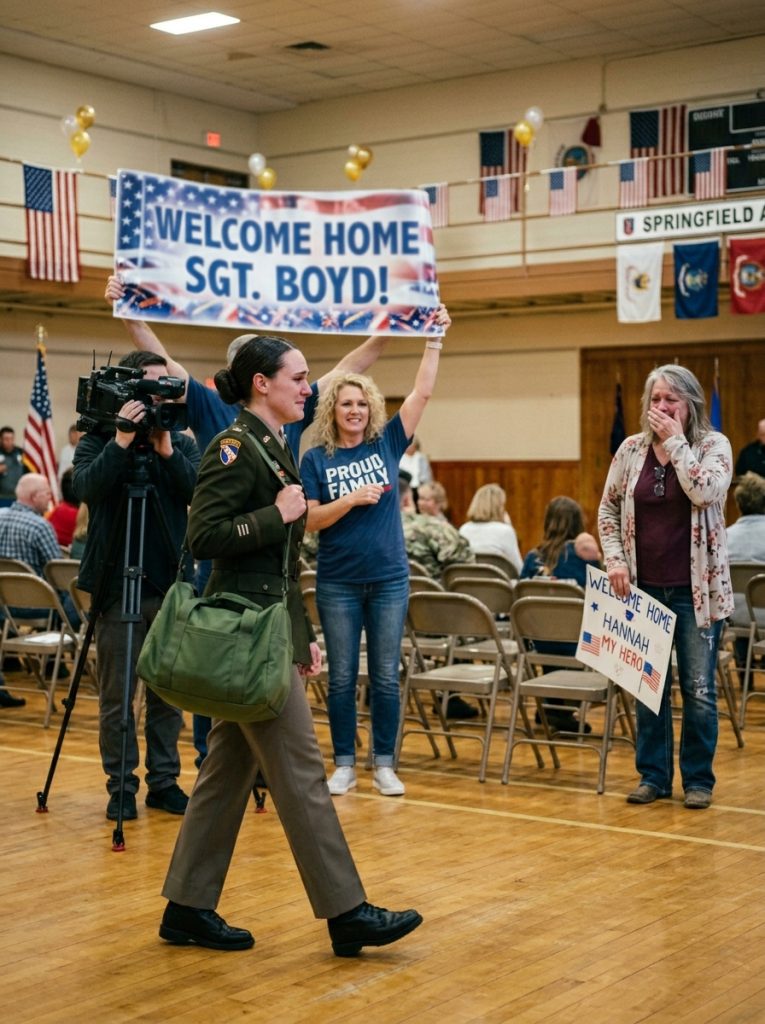
I turned my back on the cameras.
That’s the part nobody in that gym was ready for. The reporter had her shot framed — the prodigal soldier folding into the arms of her tearful parents under ten feet of glossy vinyl. It was going to be the feel-good clip on the six o’clock news.
I gave her my shoulder instead.
I walked past Roy with his arms still spread. Past Denise reaching for me, her face already arranged into grief she hadn’t earned. Past the banner with my own face smiling down like a stranger’s.
The gym went quiet the way a room does when it realizes it read the situation wrong.
I crossed all the way to the back wall, to the woman in the floral cardigan who had lowered her little hand-lettered sign because she didn’t think she had the right to hold it up that high.
“Hi, Mom,” I said.
Carol made a sound I’d only heard her make once before — the day I shipped out. She pressed both hands over her mouth.
I set down my duffel. I wrapped her up. She was shaking. She kept saying “you’re home, you’re home” into my shoulder like she still didn’t believe it.
Behind me, I heard Roy clear his throat. Trying to recover the moment.
“Hannah, sweetheart,” he called, working the room with his voice. “Come on now. Come take a picture with your mother and me.”
That word. Mother. From him.
I turned around. I kept one arm around Carol.
“There’s a microphone on that podium,” I said to the room. “Do you mind if I use it?”
The base family-readiness officer, bless her, practically ran it over to me.
I’d given speeches before. Promotion boards, briefings. My hands never shook for any of those.
They shook for this.
“Most of you know me,” I started. “A lot of you watched me grow up here. So I want to introduce you to somebody, in case you’ve got the story wrong tonight.”
I looked at Roy and Denise, standing under their banner.
“Those two are my biological parents. I was seven the last time they lived under the same roof as me. I want to be fair, so I’ll just tell you the facts and let you do the math.”
The room was dead silent. Even the band kid stopped fidgeting.
“When they left, a thirty-three-year-old woman with a one-bedroom apartment and a job in the hospital laundry took in a grieving little girl who wasn’t hers to take. She gave me her bedroom and slept on a couch for four years. She learned to braid hair off a library DVD. She worked doubles and never missed a recital.”
I felt Carol grip the back of my jacket.
“When I enlisted, she cried in the car so I wouldn’t see it. Then she drove eleven hours to my graduation and stood in the bleachers with a sign. And for the nine months I was deployed, she mailed me a care package every single week. Coffee. Socks. A note in every one.” My voice cracked, and I let it. “She signed those notes ‘Mom.’ Because that’s what she is. That’s the only thing she’s ever been.”
I turned toward the banner.
“I came home today and somebody had made a beautiful sign. Front and center, right where the camera could see it. And the woman who actually raised me had been moved to the back of the room.”
Roy’s working smile had gone to wax.
“I’m not angry,” I said, and I mostly meant it. “You don’t get to be in this picture because you printed a shirt. You get to be in it because you showed up — every day, for years, when it was hard and boring and there was no camera. By that standard, there’s exactly one parent in this gym.”
I held out my hand to Carol.
“So if we’re taking a photo tonight,” I said, “it’s going to be of her.”
The reporter — to her enormous credit — swung that lens away from the banner and onto a stunned fifty-eight-year-old woman in a floral cardigan.
And the gym, my hometown gym full of people who’d watched all of this happen in slow motion over nineteen years, stood up and clapped.
Not polite clapping. The real kind. The kind that goes on too long and gets loud and makes a quiet woman cry into her hands.
A staff sergeant from my unit — a guy who’d carried sixty pounds up a mountain beside me — leaned in as the noise crested and said, “That’s the bravest thing I’ve watched you do, Boyd. And I’ve watched you do a few.”
I told him the truth. Fear is fear. Walking across that gym scared me worse than anything overseas ever did.
The news ran the clip that night. Not the version they’d planned in advance. The anchor introduced it as “a homecoming with a twist,” and by morning it had been shared around our county more times than anything our little town had ever put online.
The comments weren’t really about me. They were full of people naming the Carols in their own lives. The aunt. The grandmother. The foster mom. The neighbor who showed up when blood didn’t.
Roy and Denise didn’t stay for the applause. They rolled up their banner — I’ll give them that, they took it with them — and slipped out the side door while the room was still on its feet. I heard later that Denise told someone in the parking lot that I’d “humiliated my own family.” I think she actually believed it.
Here’s what mattered more.
That night, back at Carol’s place — the two-bedroom she finally has now — she pulled a shoebox down from the closet. Inside were the nine months of letters I’d sent back. Every one. Read so many times the creases had gone soft.
“I kept them in order,” she said, a little embarrassed. “So when it got quiet I could pretend you were just telling me about your week.”
I’d had no idea.
I sat at her table and read my own handwriting back to myself. Half of it was me complaining about the food and the heat and a sergeant I couldn’t stand. She’d kept every page like scripture anyway.
Three weeks later, I did one more thing.
I’d been putting paperwork together quietly for a while, but I finished it after I got home. There’s a line on certain Army records and benefits forms for the people who matter most to a soldier. Next of kin. Emergency contact. The person notified first.
For nineteen years, by habit, my forms had still listed Roy — because a form somewhere had been filled out when I was a kid and nobody ever changed it.
I changed all of them.
Every document that asked who my family was, I wrote one name. Carol Boyd. Mother.
I drove the copies over and put them in her hands at her kitchen table.
She read the word “Mother” next to her own name, on a government form, in official ink. And my aunt — the woman who taught me to tie my shoes, who slept on a couch for four years, who never once asked for credit — finally let herself cry like the proud parent she’d always been and never been allowed to be.
“It was always you,” I told her. “Every form. Every box. The whole time. It just took the Army a while to catch up to what I already knew.”
She asked me, careful, if Roy had tried to reach out since the homecoming. He had. Once. A text that said we “should sit down and talk as a family.”
I didn’t answer it.
Family isn’t a word you get to claim at a podium because a camera finally showed up. It’s a word you earn at 2 a.m. with a feverish kid and no sleep and no thanks. Carol earned it ten thousand times over. Roy never tried even once.
These days the banner is long gone.
But there’s a framed photo on Carol’s wall now, from that homecoming — a soldier and the woman who raised her, the rest of the gym a blur of flags and gold balloons behind them.
She points it out to everybody who comes over. “That’s my daughter,” she says. “She came all the way across that gym just for me.”
She did, I tell them. And I’d do it again.