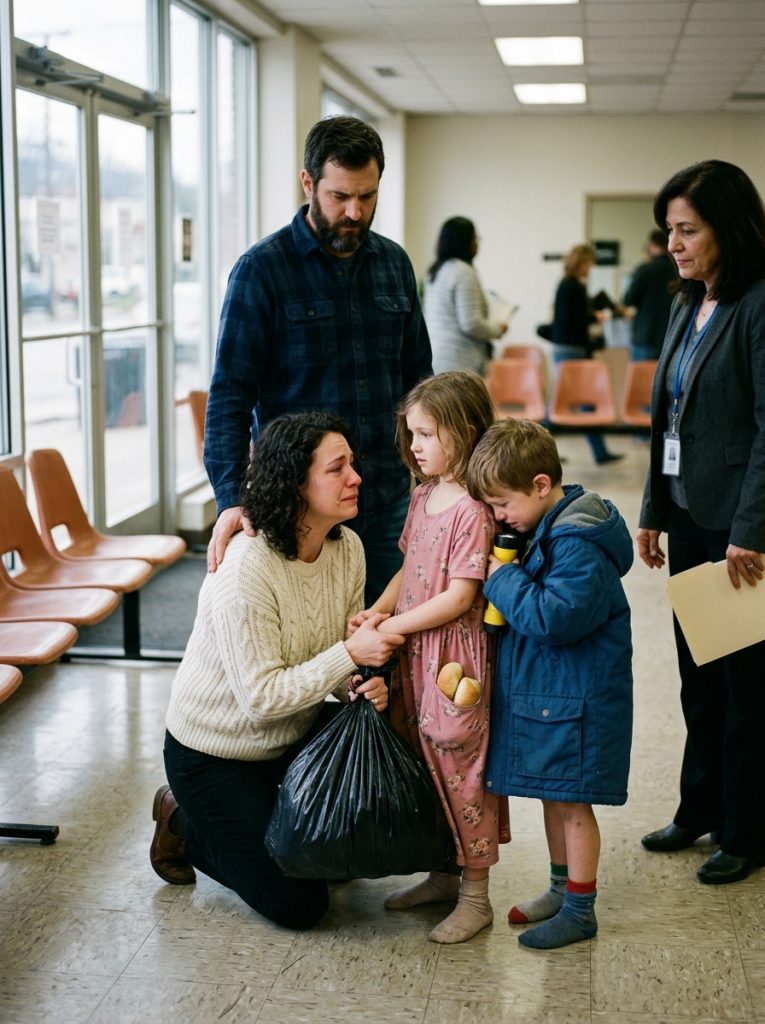
The clerk made a phone call. Then she made another one. And somewhere in the second call her bored Monday-morning voice changed, dropped lower, and I heard her say the words “emergency motion” and “the foster parents are refusing to relinquish.”
Refusing to relinquish. That was us now. That was the family I had checked a box to avoid becoming.
They put us in a small room to wait. Caleb held Micah on his lap and let the kid click the flashlight on and off, on and off, while Lila sat very straight beside me with her hands folded, doing the thing she does where she watches the adults’ faces for the first sign that the floor is about to disappear. I kept my voice light. I told her we were just going to talk to a judge, that nobody was going anywhere right this minute. She nodded like she believed me. She’s very good at nodding like she believes you.
Ms. Delgado found us at ten. She’d driven over the moment the office called her. She crouched in front of me, this woman who has seen a thousand Mondays worse than mine, and she said something I’m going to carry for the rest of my life. She said, “Naomi, I have to tell you the truth. Judges don’t love it when respite parents do this. It looks impulsive. It looks like you got attached to two cute kids over a weekend and you’re not thinking about what it actually takes. If you walk into that courtroom, you have to be ready to be more than a feeling.”
And that’s when I told her. The thing I hadn’t told Caleb. The thing I’d never said out loud in a county building because county buildings were where it happened to me.
I told her I aged out of foster care at eighteen with a trash bag of my own. That I’d been the kid who hoarded bread. That I’d been split from my little brother at seven and didn’t find him again until we were both adults and most of the way to strangers. I told her I checked the “weekend only” box not because I wasn’t ready, but because I was terrified that if I let myself love a child the system could move, I’d shatter the same way I’d watched my own foster mothers refuse to shatter. I’d confused their self-protection for the right way to do it. I’d thought keeping my heart out of it was the responsible, adult choice.
“And then a seven-year-old slept with a flashlight on so the dark couldn’t take him by surprise,” I said, “and I understood that I’d had it exactly backwards.”
Ms. Delgado was quiet for a moment. Then she stood up, smoothed her blazer, and said, “Okay. Say that. Say exactly that to the judge. Don’t dress it up.” She paused at the door. “And for what it’s worth — I’ve had this case file open for six weeks looking for a miracle. I didn’t think it would walk in checking the weekend box.”
The hearing was nothing like television. It was a tired courtroom with fluorescent lights and a judge named Honorable R. Petersen who had reading glasses and the air of a woman who had heard every excuse a human can make. The county’s representative laid out the situation flatly: placement collapsed, two siblings, separate emergency beds available in separate counties, respite parents declining to return the minors.
Then the judge looked at me over her glasses and said, “Mrs. Brandt. You signed a two-night agreement. Tell me why I’m hearing your name on a Monday.”
So I said exactly that. I didn’t dress it up.
I told her about the trash bag. I told her about my brother, and the county that split us, and the eighteen years it cost us to find our way back to a phone call that still felt like talking across a canyon. I told her that I checked the weekend box out of fear and that I was standing here because I had watched these two children take care of each other for seventy-two hours in a way no child should have to, and that the system was about to do to them the precise thing that was done to me, and I could not be a person who lets that happen twice in one lifetime when I have a spare bedroom and a husband holding the little one right now.
I said, “I’m not asking you to believe I’m ready. Nobody’s ready. I’m asking you not to split them up while everyone figures out what ready means.”
The judge took her glasses off. She asked to speak with Lila.
I almost said no. Every protective nerve in my body lit up. But Lila stood, smoothed her too-big pink dress, walked to the front like she’d been doing it her whole life, and answered the judge’s questions in that flat, careful, grown-up voice.
The judge asked her if she felt safe at our house. Lila said yes. The judge asked her how she knew. And Lila — nine years old, dinner rolls still in her pockets — said, “Because the lady saw me put bread in my pocket and she didn’t take it out. She just started leaving extra on the counter so I wouldn’t have to be sneaky about it.”
I have replayed that sentence ten thousand times since. I hadn’t said a word about the bread. I thought I’d been subtle. She’d clocked every bit of it. She’d understood that being seen and not punished was a kind of safety, and she explained it to a judge better than I explained anything in my entire testimony.
The judge granted the emergency placement. Both children. Together. With us, pending a full home study and the long, unglamorous road of actual foster certification beyond respite. She looked at Caleb and me and said, “This is the beginning of something very hard. Do you understand that I’m not giving you a happy ending. I’m giving you a starting line.”
We said we understood.
Here’s the part the caption couldn’t hold, the part that keeps it from being a tidy fairy tale. Three weeks into the placement, their birth mother called the agency. She is twenty-six. She had these two babies when she was barely more than a baby herself, and she has been fighting her own war the whole time — the kind with relapses and clean stretches and a system that is not built to help you climb. She is not a villain. She is a young woman who loves her children and keeps losing to things bigger than her willpower.
She asked Ms. Delgado one question: “Are they together?”
When she heard that they were, that the same people had them, that Micah still had his flashlight and Lila wasn’t hiding her bread anymore — she cried so hard she had to put the phone down. And then she said the bravest, most heartbreaking thing I’ve heard a person say. She said, “Then don’t move them for me. Whatever happens with me, don’t ever move them apart again.”
So now we live in the in-between. We are not their forever, and we are not nobody. We’re the people who didn’t let go on a Monday. There are visits and case plans and a future none of us can promise. Some nights it’s beautiful and some nights Micah wakes up screaming and Lila appears in the hallway already reaching for him, having parented him in her sleep out of pure habit, and I have to gently teach a nine-year-old that she’s allowed to let an adult take that shift now.
Caleb cried in the truck after the hearing. He said, “You never told me about your brother.” I said I know. I said I’d spent my whole marriage keeping that lobby door shut, and two kids with a trash bag had walked right through it.
People still say we were impulsive. That we got attached over a weekend. Maybe. But I think you can spend your whole life getting ready, or you can put the pen down when the moment comes and find out what you’re actually made of.
We meant to keep them for two nights.
They’re asleep down the hall right now. Micah’s flashlight is on. And for the first time in twenty-eight years, so is mine.