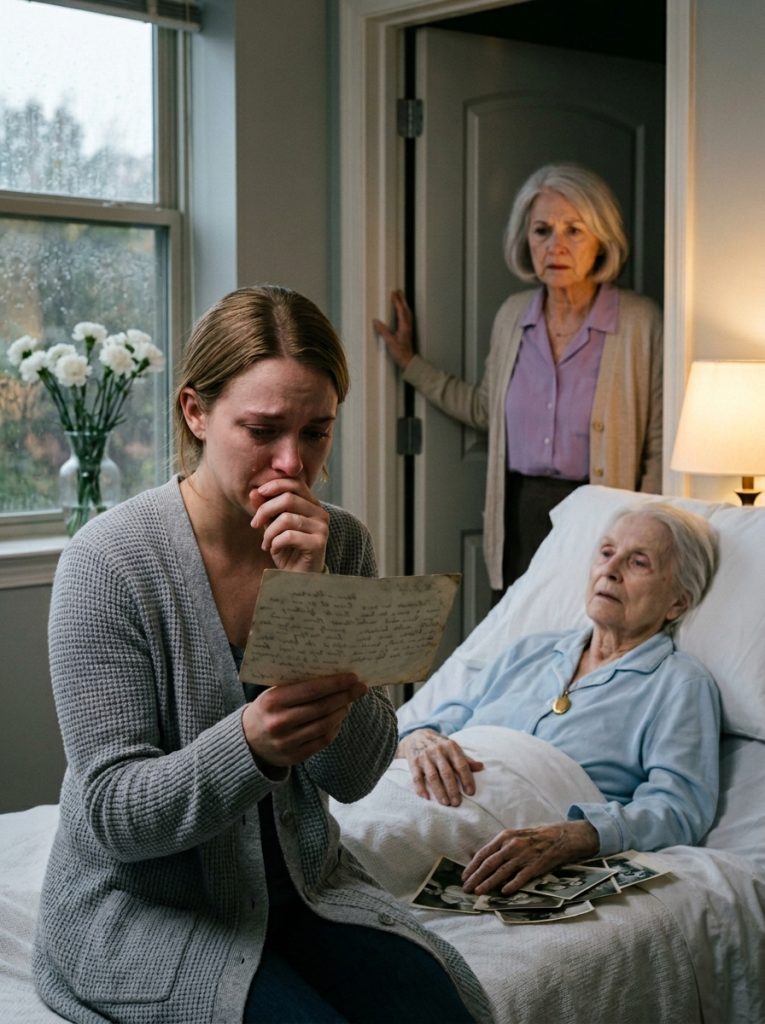
I didn’t hand my mother the photograph when she came back with the coffee.
I slid it into the pocket of my cardigan, and I asked Cora if she’d sit with me in the little family room down the hall. She came. Her hands were shaking as badly as mine.
I took the photo out and turned it over on the low table between us so we could both read the back. My grandmother’s young, firm cursive. A date — June 1959. Three names: Ruth. Walter. And a third, smaller, in a different ink, added later: “the baby — Carol Ann.”
And underneath, the line that had stopped my heart at the bedside:
“My girl. Given to the Bishops so she could be safe. May God forgive what I could not undo.”
Cora read it twice. Then she pressed the back of her hand to her mouth and made a sound I have never heard a person make — not a sob exactly, more like something setting down a weight it has carried so long it forgot the weight had a name.
“Carol Ann,” she whispered. “She named me Carol Ann.”
And that is how I learned, in a hospice family room with vending-machine coffee going cold, that the gentle woman from our church was my grandmother’s first child.
She told me the rest in pieces.
In 1959 my grandmother was nineteen and unmarried and pregnant in a small Tennessee town that had exactly one response to such a thing. Her own father drove her to a home for “wayward girls” three counties over. The young man in the photo, Walter, wasn’t a boyfriend at all — he was Ruth’s older brother, and when the family needed someone to take the public blame to keep Ruth’s name out of it, Walter stood up and said the trouble was his doing. He let the town think the worst of him so his little sister could one day come home.
The baby was placed with a couple named Bishop, who renamed her Cora and raised her two states away and loved her, truly, all her life.
Ruth came home a year later, married a kind man, had my mother in 1962, and never spoke the first baby’s name out loud again. Not because she forgot. Because in 1959, the rules said forgetting was the kindness. She spent sixty years flinching at the word “adoption” the way you flinch at a bruise.
I asked Cora about Walter — the brother in the photo, the one who took the blame. She told me he’d died young, in his forties, and that the family had let the false story follow him to his grave because nobody left alive had the nerve to correct it. My great-uncle Walter spent his whole life as the town’s cautionary tale, the boy who’d “gotten a girl in trouble,” when the truth was that he’d loved his little sister enough to let the lie land on him instead of her. I’d grown up hearing his name said with a small disapproving sigh. I will never hear it that way again. I told Cora we’d be fixing his headstone. She said Ruth had wanted to for years and never found the courage. We found it for her.
But she never stopped looking.
“She found me a year ago,” Cora said. “One of those DNA websites — my granddaughter signed me up as a Christmas gift. A match came back. A woman in Knoxville. We wrote letters first. Then I drove down, and I walked into that church, and I knew her the second I saw her. You don’t forget a face you’ve been imagining your whole life.”
A year. They’d had a year. Sundays, mostly. Held hands in a pew and called it friendship because some habits of secrecy don’t loosen even when the reason for them is long dead. My grandmother had finally found her lost daughter and had still, even then, been too afraid of the old shame to say it out loud to her own family.
Cora told me what those Sundays had been. Lunch at the cafeteria after the service, every week, the same booth. Ruth quizzing her on everything — what she’d studied, whether she’d been happy, whether the Bishops had been good to her, whether she’d had children, grandchildren. “She wanted sixty years in twelve months,” Cora said. “She kept apologizing for asking too much. I kept telling her to ask more.” Once, Cora said, Ruth had reached across the table mid-bite and just held her face in both hands, like she was checking that the years had been kind to it. They never told a soul. They were two grown women in their sixties and eighties, sneaking the most ordinary thing in the world — a daughter and her mother, having lunch.
Until the very end. Until she got too weak to manage the secret anymore, and left an old photograph in a shoebox where she must have known a curious granddaughter would eventually turn it over.
She wanted us to know. She just couldn’t be the one to say it first.
I went and got my mother from the hallway. I sat her down. I gave her the photograph, and I let her read the back, and I watched my mother learn at fifty-eight that she’d had an older sister all along — sitting three pews back at church for a year, holding their mother’s hand.
My mother didn’t get angry. I’d braced for anger. Instead she looked at Cora for a long, long moment, and then she said, “You have her hands. I always wondered where she got those hands.” And the two of them held onto each other and cried in a way that had sixty years in it.
We went into Grandma’s room together. All three of us.
And here is the part I will carry for the rest of my life, the part I can barely type.
Ruth woke up.
Not the foggy, drifting waking of the last weeks. For about an hour that evening — the nurses called it rallying, said it sometimes happens near the end, a last clear window — my grandmother surfaced all the way up. Her eyes were sharp. She knew the date. She knew all of us.
She looked at the three of us standing at her rail, and she understood, the way the dying seem to understand everything, that the secret was finally out and the sky hadn’t fallen.
She reached for Cora’s hand first. Then my mother’s. She held one daughter in each of her own.
“My girls,” she said. Out loud. After sixty-five years. “Both my girls.”
She told Cora she was sorry, and Cora told her there was nothing to forgive, that she’d had a good life, a loved life, and that finding her was the gift, not the grievance. She told my mother to look after her sister. She told me I was a snoop and she was glad of it, and she actually laughed, and we all laughed, in that room, at the edge of everything.
The window closed near midnight. She drifted back down, peaceful, and she didn’t surface again.
She died two days later, early in the morning, with Cora on one side of the bed and my mother on the other, holding the hands she’d held them with first.
It is not a story with a clean happy ending. I won’t pretend it is. They got one year and one hour, where they should have had a lifetime. The arithmetic of that still wakes me up some nights. Sixty-five years is a cruel amount of time to lose to a town’s idea of decency.
But Cora comes to Sunday dinner now. She sits in the chair that would have been hers all along. She and my mother finish each other’s sentences in a way that startles them both. My children call her Aunt Cora, and they will never know a version of the family that didn’t have her in it, and maybe that’s its own kind of mercy.
I keep the photograph on my mantel now, propped so you can see both sides if you turn it — the three young people squinting into a 1959 sun on the front, and on the back, in my grandmother’s young and certain hand, the truth she carried alone until she finally trusted us to carry it for her.
Some Sundays I catch my mother and Cora on the porch at dusk, two gray heads bent together, laughing about something only sisters would find funny.
I don’t interrupt. I just stand at the window and let them have the time they’re owed.