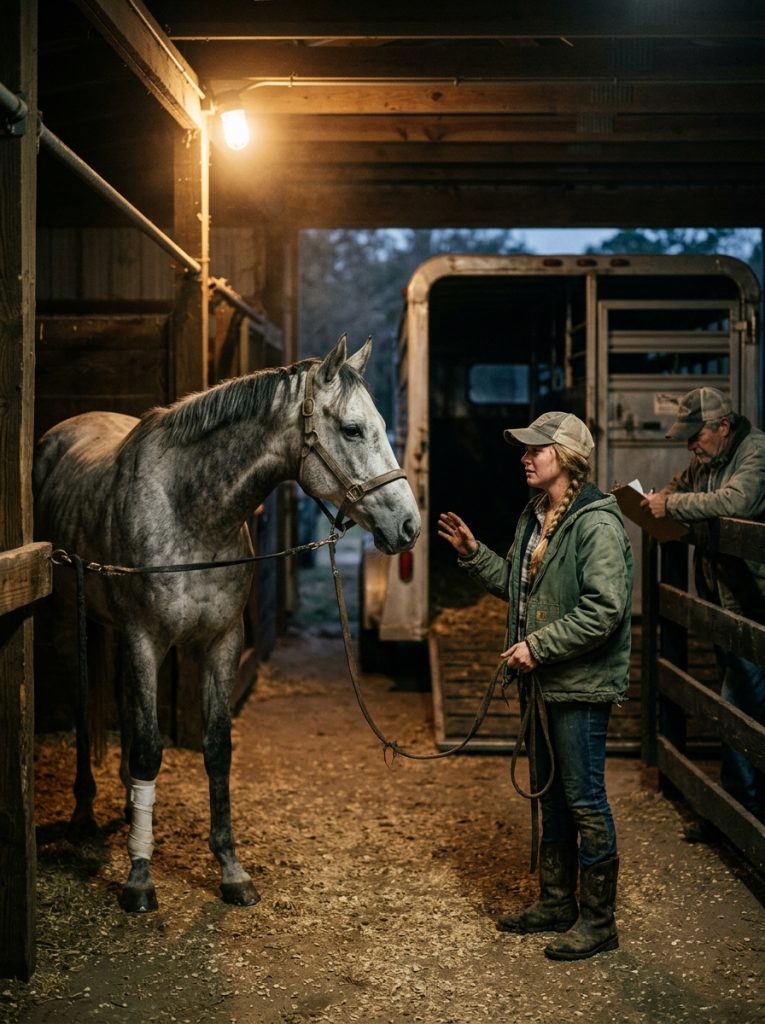
Hal Briggs looked at me for a long moment, the kind of look men give you when they’re deciding whether you’re a problem. Then he shrugged, wrote something on his clipboard, and said, “Sold. To the girl. Cash before he loads on your trailer, not mine.”
I didn’t have a trailer. I borrowed one from the feed-store owner who’d known my grandfather, and I drove Copper Smoke back to the broken-down barn I worked at in the dark, and I stood in his stall at two in the morning with my whole future spent and no idea on God’s earth what I was going to do with a racehorse who couldn’t race.
The leg healed slower than the rest of him. The rest of him came back fast — June grass, good grain, a routine. But that bowed tendon meant he’d never breeze a furlong again, and everybody who knew horses told me the same thing in the same gentle voice. A Thoroughbred who can’t run and can’t breed is a thousand-pound pet you can’t afford. I’d saved a horse just long enough to watch myself fail him slowly.
It was my grandfather who gave me the answer, even from a hospice bed.
I’d been reading to him on Sundays — he was mostly sleeping by then, the morphine pulling him under — and one afternoon I was just talking, telling him about Copper, about how the horse had this way of dropping his big head onto the shoulder of anyone who was hurting, how a hospice volunteer had brought her grandson to the fence once and the kid, who was having a hard year, had gone still and quiet and calm the second that gray nose touched his hair.
My grandfather opened his eyes. Clear, just for a second.
“That’s his job, then,” he said. “You found the one, Junebug. Just not the job they wrote on his papers.”
Therapy horse. The words I didn’t have until a dying man handed them to me.
I spent that whole winter learning a new trade. Equine-assisted therapy is a real thing with real certification, and I am stubborn, and I had a horse who turned out to be a natural at the only event that mattered: standing still while a human being fell apart against his neck. We partnered with a program for wounded veterans an hour north, and another for kids in grief. Copper Smoke, the salvage horse, the math that didn’t work, started showing up on a schedule again. Just a different kind of meet.
It was not a straight line. The first program we approached turned us down flat — a “green” handler and an unproven horse with a bad leg and no record of temperament. So I did the certification anyway, on nights and on my phone, in the same stall where I’d wrapped that tendon a hundred and forty-one times. I documented everything Copper did: how he lowered his head for the smallest children, how he stood like a carved thing for the shaky ones, how he somehow knew the difference between a person who needed him to hold still and a person who needed him to walk slow beside them. By the time the veterans’ program finally said yes, I had a binder on that horse thicker than his Jockey Club papers had ever been.
My grandfather did not live to see the first session.
He died on a Tuesday in March — and I will always notice that it was a Tuesday, the same day of the week they’d loaded the trailer — eight days before Copper’s first official day as a therapy horse. I had wanted so badly for him to be there. I’d pictured wheeling him out to the arena, parking his chair in the sun, letting him watch the thing he’d named come true.
Instead I did the only thing left to do. The evening before he passed, when he was lucid for a little while, I sat at the rail of his bed the way I’d sat at a hundred paddock rails beside him, and I told him the whole plan. The veterans. The kids. The certification. Copper’s name on a real schedule again. I told him the horse he’d taught me to feel before my head caught up was about to spend the rest of his life catching other people.
He couldn’t say much. But he found my hand, and he squeezed it, and he said, “Champion.” Just the one word. And then, a minute later, with his eyes closed and a ghost of the grin I grew up on: “Different kind.”
He was gone by morning.
Eight days later, Copper Smoke’s first rider was a boy named Eli. Nine years old. He hadn’t spoken a full sentence since his father’s funeral four months before — not to his mother, not to his teachers, not to the counselor his school sent him to. His grief had gone somewhere words couldn’t reach. They told me not to expect anything. They told me sometimes a kid just needs to be near something big and gentle and alive, and that was enough, and I shouldn’t push.
I led Copper out into the spring light. Eli stood at the rail exactly the way I had stood at a different rail a year before — wanting to come closer, not knowing if he was allowed.
I didn’t say anything. I’d learned that from a gray horse and an old man.
Copper Smoke walked to the end of his lead, dropped his enormous dappled head down to the boy’s level, and breathed. Just breathed, slow and warm, the way he’d breathed at the bottom of a loading ramp the day I couldn’t walk away from him.
Eli put both hands flat on that gray nose.
And after a minute, in a voice so small I almost missed it, he said, “He’s sad too.”
Three words. The first three in four months. His mother made a sound behind me like something breaking and mending at the same time, and I had to turn around and look hard at the fence line because my grandfather wasn’t there to see it and that was the whole grief of my life in one spring morning — the wanting to turn and find him in his chair, and the empty sun where he should have been.
One of the veterans put it to me better than I ever could. A retired staff sergeant named Della, who came every Thursday and rarely said more than ten words, watched Copper work with a new kid one afternoon and said, “Funny. They wrote him off for being broken. That’s the only reason he’s any good at this. A horse that never got hurt couldn’t do what he does.” She scratched the gray neck for a long moment. “Takes one to know one.”
But here’s what I’ve come to understand about “too late.”
My grandfather never watched Copper work. That’s true, and it will always ache. But he named it. He saw it before any of us, the way he saw everything — before his head caught up, before his body gave out. He didn’t need to be at the rail to have been right.
Copper Smoke worked for six more years. Hundreds of veterans. Dozens of grieving kids. A wall of photographs in our little arena office, every one of them somebody who got quiet and calm and a little more able to keep going because a “washed-up” horse stood still and let them lean.
He never won a race. The racing world that called him salvage never gave him a single line in any record book.
But Eli’s still talking. He’s fifteen now. He comes back every summer to help muck stalls, and he tells the new kids the same thing I tell them: that the best horse he ever met was one nobody wanted, and that being wanted by the right person at the right rail is a kind of winning they don’t hand out trophies for.
You’ll know the one, my grandfather told me. You always feel it before your head catches up.
I felt it at a kill auction with three thousand borrowed dollars in my pocket.
My head’s still catching up.