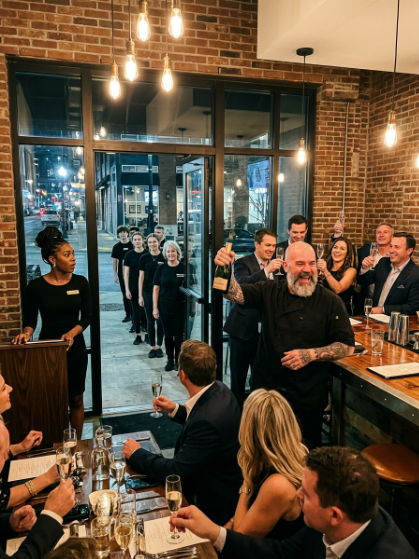
Dominic’s grin was still frozen on his face, but his eyes had gone somewhere else entirely, and the dining room of Ember & Vine got so quiet you could hear the Edison bulbs faintly humming over the bar.
Eight people. Eight black shirts. They stood in a loose line down the center of the room, between the communal tables, facing the bar where Dominic still held the broken neck of the champagne bottle. Nobody had told them where to stand. They just knew, the way people know when they’ve rehearsed something painful enough times in their heads.
Carmen was at the front. The woman who’d trained me my first shift, who’d followed Dominic from his old restaurant because he’d promised her a sous chef position “one day.” She wasn’t shouting. None of them were. That was the thing that made it unbearable — there was no scene to call security on. They were just standing there, letting the room read.
The fronts of the shirts named him. The backs carried the numbers. And the numbers were wages. Final paychecks that never came. Overtime worked and never paid. Carmen’s number was one of the biggest — months of work, by the look of it, from the closing months of his last restaurant, the one that shut its doors overnight and left its staff with bounced checks and a locked back door.
That was the story nobody at Ember & Vine would tell me. That was why, when I asked what happened to the people who’d been hired and then vanished from the schedule, another server just said don’t ask about that, seriously. Some of these eight had been hired for this opening, realized whose kitchen they were walking back into, and walked right back out. The rest had never stopped being owed.
One of the food bloggers near the window lifted her phone and started filming. Then another. Within a minute, half the phones in the room were up. And the brand — the whole brand, painted right there on the wall above Dominic’s head in clean white script, FARM TO TABLE, FAMILY VALUES — was now framed in the same shot as eight people he used to call family, holding the receipts.
Dominic finally moved. He set the bottle down and crossed the room toward Carmen with his hands out, palms up, doing the warm-chef voice I’d watched charm investors all night.
“Carmen. Carmen, sweetheart. This isn’t the place, okay? Come to the office Monday, we’ll figure it out, all of it—”
“We came to your last office,” Carmen said. Quiet. Steady. “You changed the locks.”
That landed harder than any shouting could have.
He tried a few more things. He told the room it was a misunderstanding. He told the room these were disgruntled former employees. He used the word disgruntled, which is a word that has never once made a crowd side with the person saying it. The phones stayed up. The investors — the two men in the good blazers I’d assumed were just rich customers — were not customers at all. They were his backers. The people whose money built Ember & Vine. And they were watching their farm-to-table family-values restaurant become a video, in real time, with the founder pleading in the middle of it.
One of them walked over and said something low in Dominic’s ear, and whatever it was, it ended the performance. Dominic stopped talking. He stood there in his unbuttoned chef’s coat in the middle of his grand opening with nothing left to say.
I keep coming back to one detail from that night. While Dominic was crossing the floor toward Carmen with his palms out, doing the warm voice, I saw the young line cook — the quiet one who used to park his bike out back — reach over and steady the older woman beside him with a hand on her shoulder. None of them had to be there. Most of them had already moved on to new kitchens, new cities, new bosses. They came back, on a Saturday night, to stand in a room full of strangers and wear their own unpaid wages on their backs, because Dominic had taught each of them the same lesson and they’d decided, together, to teach it back.
That’s the thing about the word “family” when a boss uses it. It’s almost always a way of asking you to accept less. Work the double, skip the break, wait on the check — we’re family. The eight people in those shirts had heard it for years. And what they understood, that the rest of us figured out only as we watched, is that real family doesn’t bounce your last paycheck and change the locks. Real family pays you what it owes you. Everything else is just a word painted on a wall to make the taking feel like belonging.
Here’s the part I learned later, in the weeks after.
The eight hadn’t only made shirts. The shirts were the visible part — the part designed for exactly that room, exactly those phones. But three weeks before the opening, several of them had filed a formal wage complaint with the Tennessee Department of Labor over the unpaid wages from the old restaurant. The shirts weren’t the whole strategy. The shirts were the cover of the book. The complaint was the book.
And the timing was deliberate. They could have shown up to picket on the sidewalk any day. They chose grand opening night, with the press there and the investors there and the cameras there, because they understood something Dominic had forgotten: a man who builds his entire brand on the word family is uniquely destroyed by the people he treated like they weren’t.
They were testing it, really. Testing whether “family values” meant anything or was just paint on a wall. He failed the test in front of everyone who’d come to celebrate him passing it.
The video was everywhere by Sunday. The wage complaint, which might otherwise have ground through the system in quiet obscurity, now had a face and a hashtag and a room full of witnesses. The Department of Labor doesn’t move faster for going viral, exactly, but it does pay closer attention when it’s already on the news. The back wages are being pursued. From what I hear, the people in those shirts are going to be paid — every number on every back.
Ember & Vine didn’t make it under Dominic’s name. The investors who’d whispered in his ear that night were not in the forgiveness business; their names were attached to it too, and they pulled out. The restaurant exists now under different ownership, different management, and — I checked — it actually paid its opening staff on time.
I’m still a hostess. Two weeks on the job became my whole strange initiation into what this industry can be, good and bad. I think about Carmen a lot. She trained me with such patience my first shift, rolling silverware, telling me to follow the chef because he was “like family.” She said it the way you say something you’re trying hard to keep believing. By grand opening night she’d stopped trying to believe it. She’d decided to make it true the other way — by making him keep his word, in public, in front of everyone.
The last thing she said to me, before the eight of them filed back out as quietly as they’d come in, was at the host stand on her way past. She squeezed my arm, the way she had that first shift, and she said, “When you work somewhere, write down what they owe you. All of it. Doesn’t matter how much you love the place. Especially if you love the place.”
I’ve worked four jobs since. I write everything down now.
Family is a beautiful word. But the people in the black shirts taught me it isn’t proof of anything.
The receipts are.