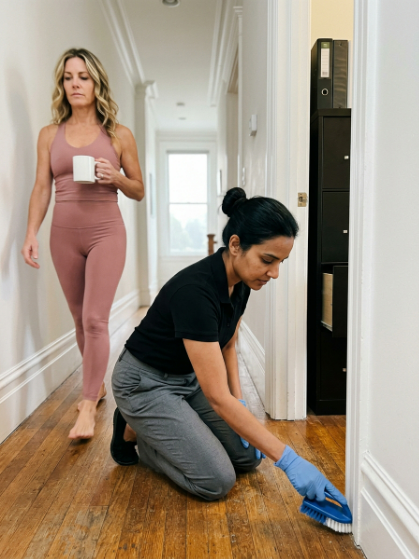
Gordon turned the card over in his fingers, frowning, the way you’d inspect something you suspected was a joke.
“Priya Anand,” he read. “Licensed Realtor.” He looked up. “What is this? You clean houses.”
“For seven days I cleaned yours,” I said. “For free. You told me it was a trial.”
“It was a trial. And you didn’t pass.” He set the card down on the granite like he was done with it. “So if you’re hoping I’ll pay you now because you printed a fancy card —”
“I’m not hoping you’ll pay me anything, Mr. Beaumont.”
I kept my voice exactly level. I had practiced this moment in my head for three weeks, on my knees in his hallways, and I had promised myself I would not let it shake.
“That card has a second line,” I said. “Read it.”
He picked it up again. His eyes moved. I watched the exact instant the words landed.
Tenants’ Rights Collective.
“I represent the families in your buildings,” I said. “The ones in the rent-controlled units. The ones you’ve been pushing out so you can flip their homes into short-term rentals at triple the rent. The elderly couple on Clay Street. The widow on Jackson who’s been there thirty-one years. The man on Pierce you turned the heat off on in February to make him ‘decide to move.'”
Lisa had stopped in the doorway, coffee halfway to her mouth.
“I came into your home as a maid,” I said, “because the city needs proof, and proof doesn’t live in your emails. It lives in your house. And on the third day, when you sent me to clean your home office, I found your binder. The one labeled Rotation Schedule.”
Gordon’s face did something I’d waited twenty-five years to see on a man like him.
“You went through my —”
“I cleaned your office. You told me to. The binder was in a half-open drawer.” I let that sit. “Inside it is a coded calendar. Short-term rental check-ins and check-outs, matched against the units the city still believes are occupied by your protected tenants. Page after page. I photographed every one. Seven days of it, while you looked straight through me and called me ‘the help’ to your wife.”
“That’s not admissible,” Lisa said suddenly, sharp. “You can’t just — that’s private property, you can’t —”
“I’m not the police, Mrs. Beaumont. I don’t need a warrant to remember what I saw while doing the job you assigned me.” I picked up my bag. “But the seven families I represent have been waiting a long time for someone to be able to say, under oath, what’s in that binder. Now someone can.”
Gordon tried to get ahead of it then, the way men like him always do. He switched, mid-breath, from outrage to charm.
“Listen,” he said, and he even smiled. “Whatever you think you saw, I’m sure we can come to an understanding. You’re clearly a smart woman. Smart women understand that these situations are more complicated than they look. The rental market in this city is a nightmare. I was providing flexibility. There’s a number that makes this go away — for everyone. Including you.”
There it was. The offer. The thing he believed had no floor, because in his world everyone had a price and the only question was finding it.
“You just offered to pay me to bury seven families,” I said. “I want to make sure I heard that correctly, since I’m recording this conversation. I told you that when I came in. It was on the second line of the card, right under my name.”
His smile died the way a candle dies when you close your hand around it.
“I don’t have a number, Mr. Beaumont,” I said. “And even if I did, you couldn’t afford it. Because the thing you took from those people isn’t measured in dollars. I know that better than you ever will.”
I’ll tell you the part I didn’t say out loud in that kitchen. The part I have never told the families either, because it isn’t theirs to carry.
Twenty-five years ago, I was twelve, and my parents cleaned houses just like this one. They were immigrants. They worked themselves down to the bone for a rent-controlled apartment in a building owned by a man exactly like Gordon Beaumont — same cashmere, same loafers, same way of looking at the air just above your head when he spoke to you.
And one day that man found his own quiet, legal-looking way to make us leave. A “renovation.” A notice. A clock.
I watched my mother fold our entire life into cardboard boxes while the landlord stood in our doorway checking his watch, waiting for us to be gone so the next, richer family could move in.
I was twelve. I promised myself two things that day.
That I would never feel that small again.
And that someday, I would be the one standing in the doorway — except I would be standing there for the family being pushed out, not the man doing the pushing.
It took me twenty-five years. A real estate license. Eight years learning how fraud hides in plain sight. And three weeks on my knees scrubbing Gordon Beaumont’s baseboards while he sighed at me.
Worth it.
The city moved faster than I expected, once they had the binder authenticated. There were inspections. There were depositions. There was a number, at the end of it, that made even me blink: one-point-four million dollars in fines and restitution, for operating illegal short-term rentals out of protected units and for the documented harassment of long-term tenants.
But the money was never the point. The point was the order that came with it.
Every displaced family was offered their unit back. At their original, protected rent. With the back-rent difference they’d been overpaying elsewhere returned to them.
I made the calls myself. I didn’t have to — a paralegal could have — but I wanted to.
The widow on Jackson Street cried on the phone and then apologized for crying. I told her she never had to apologize to me for anything again.
And the elderly couple on Clay Street — the ones who’d been there longest, who’d raised children in that apartment and buried one of them from it — I drove them back myself. I walked them up to their own door. I put the keys in the husband’s hand and folded his fingers over them, because his hands shook too much to hold them on his own.
He looked at the door for a long moment. Then he looked at me.
“You’re the girl who cleaned for that man,” he said. “I saw you, in the lobby. I thought you were one of them.”
“No, sir,” I said. “I was never one of them.”
His wife came up behind him then, slow, leaning on a cane. She’d lived in that apartment for forty-one years. She told me she’d stopped unpacking the boxes at the temporary place because some part of her had refused to believe they weren’t coming home. The tape was still on them. Forty-one years, packed in cardboard, waiting.
“I kept telling him we’d be back,” she said. “He said I was being foolish. An old woman’s hoping.” She squeezed my hand. “You made an old woman right. Do you know what that’s worth?”
I did, actually. I’d watched my own mother stop being right about things, one box at a time. I’d have given anything, at twelve, for someone to walk up our stairs and hand the keys back.
I couldn’t do that for my mother. She’s been gone six years now.
But I could do it for the woman on Clay Street. And I had.
I think about the woman I used to be sometimes. Twelve years old, watching the boxes, swearing in the dark.
I didn’t burn anything down. I didn’t shout. I got on my knees and I scrubbed a cruel man’s floors for seven days without a dollar, and I kept my eyes open, and I waited.
Slow is not the same as weak.
Sometimes slow is just the sound of someone keeping a promise she made a very long time ago.