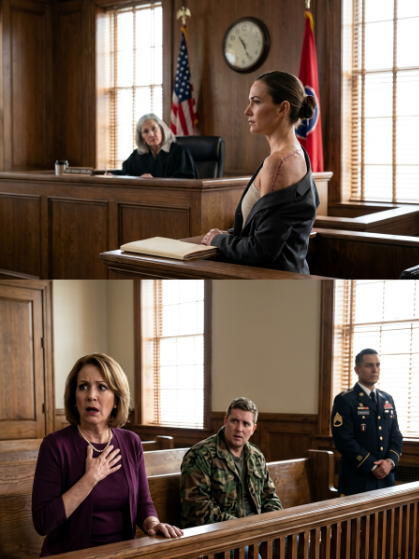
I opened the folder.
I didn’t slide it dramatically across the rail. I just opened it, and I started laying pages on the witness stand one at a time, like I was triaging a patient — worst first.
“This is my DD-214,” I said. “Certificate of Release from Active Duty. Eight years. Two deployments. Honorable.”
The clerk passed it up. Judge Sterling read it without expression.
“These are my deployment orders. These are my hazardous-duty records. This is the citation for the Bronze Star with valor device, awarded after the incident that left the scar you all just saw.”
My mother, Gloria, had stopped performing. She sat very still in her plum twinset, the way people go still when the ground they were standing on turns out to be a trapdoor.
“For eight years,” I said, “my mother told this court I never served. That I forged photographs. That I manipulated a dying man for a hundred and twelve acres.” I set down another page. “Grandpa left me the farm because I’m the only one in this family who ever helped him work it. He wrote that, in his own hand, in the letter attached to the will. He also wrote that he always knew exactly what I did for a living, and that he was proud.”
“Objection,” my mother’s lawyer started, half-hearted.
“Overruled,” said Judge Sterling. “Sit down.”
“There’s a witness my mother didn’t list,” I said. “Because she didn’t know he’d come.”
The doors at the back opened.
Sergeant First Class Daniel Reyes walked up the center aisle in his dress uniform, ribbons catching the hard courtroom light, and the whole gallery turned to watch a man who very obviously was not in a costume.
Cody, in his oversized woodland camo he’d bought online to mock me, slid down in his seat.
Reyes was sworn in. He’d been my platoon sergeant on the second deployment. He described, in the flat unhurried voice of a man who has told the worst stories enough times to survive them, the day an IED hit our convoy. He described a medic — me — who pulled two soldiers out and worked on them in a ditch with shrapnel in her own shoulder until the bird came.
“Staff Sergeant Voss is the reason two of my men have children now,” Reyes said. “I flew here on my own dime. I’d have walked.”
The courtroom was silent.
Then I laid down the last page. The one I’d dreaded and needed in equal measure.
“My attorney has a recording,” I said. “Made at a family dinner four months ago. My mother didn’t know my phone was on the table.”
The judge nodded permission.
Gloria’s own voice filled the courtroom, loose and confident, the voice she used when she thought only family was listening:
“Of course she served, don’t be stupid. That’s not the point. The point is if we make it ugly enough and expensive enough, she’ll settle and we split the land. Nobody’s going to side with a soldier over her own mother. We just have to sell it.”
The recording clicked off.
You could have heard a pin drop on carpet.
Judge Sterling took off her glasses.
“Let me make sure I understand,” she said, in a voice that had gone arctic. “You filed suit to void a will. You testified, under oath, that your daughter never served. And you are on a recording, in your own voice, acknowledging that she did, and describing this entire proceeding as a strategy to extract a settlement.”
Gloria said nothing.
“Judgment for the defendant,” Judge Sterling said. “The bequest stands. The farm is Staff Sergeant Voss’s, free and clear, as her grandfather intended.” She set the glasses down. “And Ms. Voss — you will remain. I’m holding you in contempt and referring this matter for perjury. People have gone to prison for less than what I just heard in your own words.”
My mother was led to a side table, not in cuffs, but not free to leave either, and for the first time in my life I watched her face register a consequence she couldn’t talk her way out of.
There was one more thing.
My brother’s lawyer had tried, early on, to bolster the case by painting Cody as the family’s “real veteran-minded” son, the one who “almost enlisted.” So my attorney, thorough to a fault, had requested Cody’s records too.
The judge read one line into the record, almost as an afterthought, almost as mercy withheld:
“For the record, the court notes that Cody Voss was administratively separated from basic training in 2014 following an investigation into theft of personal property from fellow recruits.”
The camo jacket suddenly looked like exactly what it was. A costume.
Cody didn’t apologize. He left through a side door before the gavel fell.
I walked out of that courthouse into hard Tennessee daylight, the folder under my arm, my grandfather’s farm under my name, and Sergeant Reyes beside me asking if there was anywhere in this town a man could get a decent cup of coffee.
There was.
We drove out to the farm. A hundred and twelve acres my grandfather and I had worked since I was a girl, the only place I was ever simply Maren, not a rank, not a target, not a daughter at war with her own mother.
Reyes stood at the fence line and looked out at it for a long time.
“This is what you were carrying her out of that ditch to come home to,” he said. It wasn’t a question.
“Yeah,” I said.
“Good,” he said. “Then it was worth it.”
The scar got their attention.
The folder ended the argument.
But the farm — the dirt, the fence, the quiet — that’s the part that’s actually mine.
And nobody, not my mother, not my brother, not a costume jacket in a county courtroom, is ever taking it again.