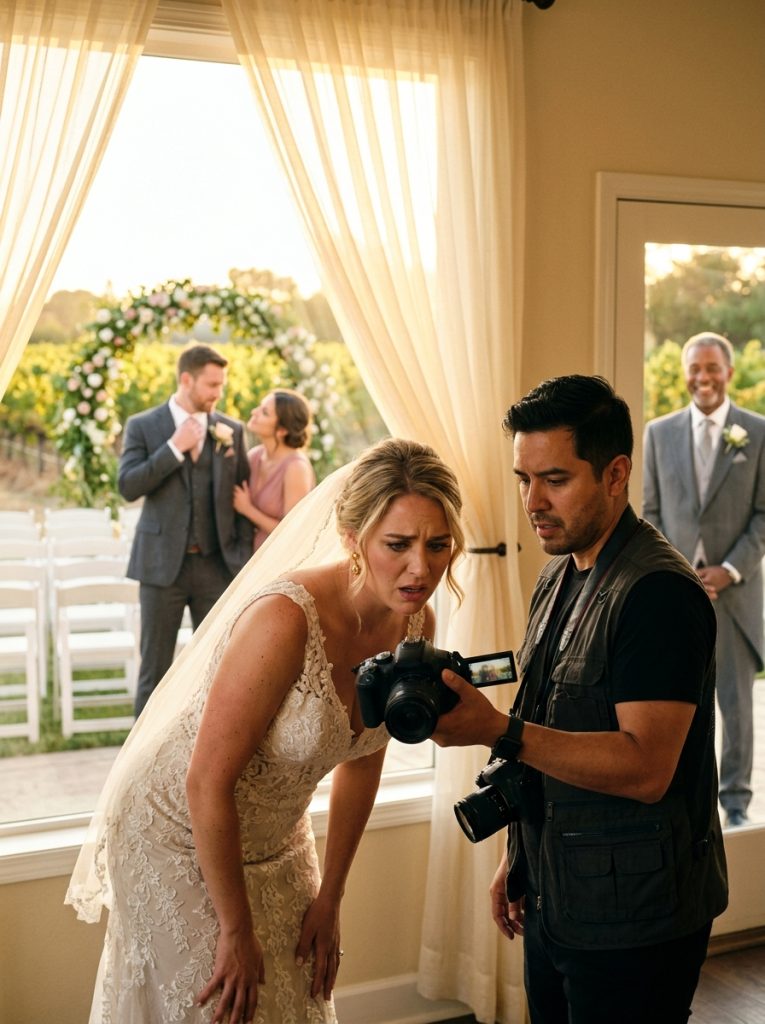
I used four of those five minutes to decide who I was going to be. The fifth, I used to fix my lipstick.
Because here is what I knew, standing in that sunlit room with a hundred and forty people waiting on a lawn: a woman who runs out the back in tears hands the story to everyone else. They get to say she couldn’t take it. She fell apart. Poor Camille.
I thought about every time that year I’d swallowed a question. The hotel charge I didn’t ask about. The way Whitney stopped meeting my eyes. The “work trips.” Each time, I’d chosen the comfortable silence over the expensive truth, and each time the silence had cost me a little more of myself.
I was done buying silence. I’d just been handed the truth in focus and full color, and for once I wasn’t going to look away from it.
I was not going to give Aaron Voss one more thing of mine, least of all the ending.
I asked Joss to do one thing. “Keep the camera on,” I said. “Whatever happens out there, you keep shooting.” She nodded, pale, and she did.
I took my father’s arm at the top of the aisle. Daniel Brooks, sixty-one, still dabbing his eyes, the proudest man in California. He patted my hand. “Ready, sweetheart?”
“Walk me down, Dad,” I said. “I love you. Trust me for the next two minutes.”
The quartet played. Everyone stood and turned, all those faces lit gold, phones up, the way they are now at everything.
I walked the whole aisle. I want you to understand that. I didn’t falter. I smiled at the people I loved and I let them have the picture of a bride walking toward her future, because the rest of what I was about to do, they’d earned the truth of.
Aaron was glowing at the end of it. He really was a beautiful liar. Charcoal suit, blush boutonnière, that easy certain smile, Whitney standing at the front in dusty rose with her eyes fixed very hard on the flowers.
I reached the arch. The officiant opened his mouth.
“Before you start,” I said, and I took the microphone clipped to his stand, because I’d learned from watching my father that you never let someone else hold the mic at the moment that matters, “I have something to say, and then I promise you can all go straight to the cocktail hour.”
A nervous laugh rippled through the chairs.
I turned to Aaron. Quiet, just for him first.
“I saw the photo,” I said. “From the cottage. An hour ago.”
I watched it hit. The smile didn’t fall all at once — it flickered, recalculated, reached for a version of events that would still work. Same thing his whole face did when a deal went sideways.
“Camille,” he murmured, “whatever you think you saw—”
“Don’t.” I’d said that word to him in my head a hundred times that hour. Out loud it was almost a relief. “I spent a year letting you tell me I was imagining things. I’m not going to spend my wedding doing it too.”
Then I turned to the guests, and I kept my voice steady and warm, almost cheerful, which I think frightened Aaron more than screaming would have.
“There isn’t going to be a wedding today,” I said. “I’m so sorry you got dressed up. I found out this morning that the man I was about to marry has been involved with my maid of honor. I’d rather find out twenty minutes early than twenty years late, so — small mercies.”
The sound a hundred and forty people make when they inhale at once is something I’ll never forget.
Whitney started crying. Aaron started talking, fast and low, about how this was a misunderstanding, about how I was humiliating myself, about how we could “discuss this privately like adults.”
That word again. Privately. Where men like him do their best work.
“No,” I said. “You picked the venue. A hundred and forty witnesses. That was your call, not mine.”
I’d love to tell you that was the whole of it. An affair, a brave bride, a clean exit. But I didn’t understand the real shape of it until that afternoon, and you should know it, because it’s the part that still makes my skin cold.
Aaron never wanted me. He wanted Brooks & Company.
My father built that firm over forty years. Aaron had come into my life almost exactly when my father started talking about succession — and I’d thought that was sweet timing, two chapters of my life turning the same page. It wasn’t timing. It was a plan.
I found it because my father, bless him, is old-school and thorough. After the ceremony that wasn’t, while I was numbly accepting hugs, my dad’s longtime attorney pulled him aside about the prenup Aaron’s lawyers had pushed so hard for — the one with the strange clauses about board seats and “marital interest” in the company, the ones I’d been told were “standard” and not to worry my head over.
They were not standard. They were a slow, patient instrument for getting Aaron a foothold in my father’s company through me. The marriage was the door. I was the key. The affair with Whitney was just the arrogance of a man who assumed he’d already won and could help himself to whatever he wanted on the side.
Whitney, it turned out, hadn’t fully known what she’d walked into either. He’d told her he was leaving me “after the merger went through.” She thought she was the love story. She was the second pawn. We are not friends now, and we never will be, but I’ve made my peace with the fact that he played us both.
My father shredded the prenup himself. Literally. Fed it into the machine in his study page by page while I watched, and then he poured us each a whiskey and said the truest thing anyone said to me that whole day: “Forty years I built that company, and a stranger almost walked off with it because he was handsome and you wanted to be loved. There’s no shame in wanting to be loved, baby. The shame is all his.”
Aaron got nothing. No wedding, no company, no foothold, no quiet private conversation where he could rewrite it. The merger talks he’d lined up evaporated the moment my father understood what they’d really been for. Last I heard, he’d moved to another state and was telling people I was unstable, which — given that I’m the one who’s calm and he’s the one who lost everything in a single afternoon — has not landed the way he hoped.
I kept the photograph. Joss sent me the whole gallery, and I kept exactly two images. The candid that saved me. And one she caught at the very end, that I didn’t know she’d taken: me, walking back up the aisle alone, veil off, my father a few steps behind, and on my face — I’ve studied it — not heartbreak. Relief.
The strangest part was the day after. I woke up in a hotel suite that was supposed to be the first morning of a honeymoon, and instead of grief I felt this enormous, embarrassing lightness, like setting down a suitcase I’d been carrying so long I’d stopped noticing the weight. I kept waiting for the collapse. It never came. It turns out you don’t mourn a man who was never real. You just mourn the year you spent believing him.
I went back to work at Brooks & Company that next month — really back, this time. My father had been talking about succession; I’d been treating it like his decision to make about me. After that wedding, I started treating it like mine. I learned the business from the inside out. Two years later he handed me the firm a stranger had nearly stolen, and I run it now, and I read every clause in every contract myself, slowly, out loud if I have to. Nobody tells me not to worry my head about the fine print anymore.
People ask if I regret walking the whole aisle before I called it off. The drama of it. Whether I should have just slipped out quietly.
No. The aisle was mine. The mic was mine. The story was mine. For the first time in a year, I wasn’t going to let Aaron Voss tell me what I’d seen.
The string quartet, God love them, didn’t know what to do, so they just kept playing as I walked back out. Same song. Same gold light.
I left to the music I’d chosen, in the dress I’d chosen, on no one’s arm but my father’s — and the only vow I made that day was to myself, on the way out the door.