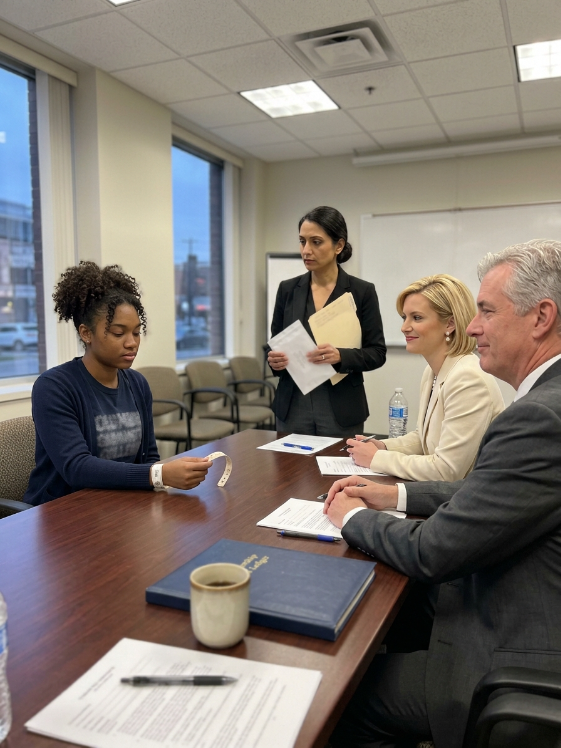
Meera did not break the seal right away.
She turned slightly so Graham could not reach the packet without standing up.
That small movement changed the room.
Until then, I had been the one who did not belong. The foster kid at the wrong table. The community college student who had misunderstood a rich family’s rules. The girl with the thrifted cardigan and the old hospital bracelet.
Now Graham Hale looked like the person sitting too close to a door he wanted locked.
“Meera,” he said, and the softness in his voice was worse than shouting. “This is outside the committee’s authority.”
Meera looked at him over the top of the packet.
“It is exactly within the committee’s authority. The trust requires verification when a bloodline claim is made.”
Allison laughed once.
“A claim? She brought a bracelet.”
My cheeks burned.
I wanted to close my hand around it again, hide it, apologize for making everyone uncomfortable.
But Meera placed the foster-care intake file on the table beside the sealed packet.
“She also brought a case number,” she said. “And that case number corresponds to an unresolved hospital discharge record from nineteen years ago.”
Graham stood.
Too quickly.
His chair scraped against the carpet and hit the wall behind him.
“This meeting is adjourned.”
No one moved.
Not the junior committee member near the coffee pot.
Not Allison.
Not me.
Meera did not sit down.
“Mr. Hale, if you adjourn before opening a sealed verification packet, I am required to note obstruction in the trust record.”
That word landed hard.
Obstruction.
It was the first official word in that room that did not sound aimed at me.
Graham’s face changed from anger to calculation. He sat, but only halfway, one hand still gripping the back of the chair.
“Fine,” he said. “Open it and end this.”
Meera turned to me.
“Nia, do you consent to the packet being opened in this meeting?”
My mouth was dry.
All my life, adults had opened files about me without asking. Medical summaries. Placement notes. School reports. Behavior evaluations written by people who never asked what happened before I shut down.
This was the first time someone asked permission before making my history public.
I nodded.
Then I made myself say it.
“Yes.”
Meera opened the seal with a letter opener from the table.
The sound was tiny.
Paper tearing.
But it felt like a wall splitting.
She removed three pages. She read the first one silently. Then the second. On the third, her eyes stopped.
Graham stopped breathing first.
That is how I knew.
Before Meera said a word, Graham knew what was on that page.
Allison leaned forward. “What does it say?”
Meera looked at me, not at Allison.
“It confirms a maternal-line match to Celia Hale.”
No one spoke.
I had never heard that name in my life.
Celia.
It sounded like a song someone else had been allowed to know.
Meera continued, slowly enough that I could hold each word.
“Celia Hale was the daughter of Eleanor Hale, founder of this scholarship trust. She gave birth nineteen years ago at Riverside Women’s Hospital. The infant was discharged into emergency protective custody after Celia’s death. The placement notice was sent to the Hale family attorney and signed for by Graham Hale.”
The room tilted.
I put one hand on the table.
Not gracefully.
I needed it to stay upright.
Graham said, “That is not what happened.”
Meera opened the foster-care intake file.
Advertisement
“The signed notice is copied here.”
He reached for it.
She pulled it back.
“Do not.”
It was the first time her voice went sharp.
Allison stared at her uncle.
“What does that mean?”
Graham looked at Allison, then at me, then at the closed scholarship ledger as if the book might rescue him.
“It means paperwork was mishandled after a tragedy,” he said. “It does not mean this young woman is entitled to anything.”
This young woman.
Not Nia.
Not family.
Not even applicant.
But the insult did not land the way it had before. Something stronger had stepped between us.
A name.
Celia Hale.
My mother.
The room waited for me to cry or yell. I did neither. I picked up the bracelet and laid it beside the DNA report.
For the first time, the bracelet looked less like proof of abandonment and more like proof that I had survived being hidden.
Meera turned a page in the trust ledger.
“The scholarship clause says lineal descendants of Eleanor Hale receive priority. If more than one eligible descendant applies, merit review applies. If only one applies, the award is automatic, subject to enrollment verification.”
Allison whispered, “But I applied.”
Meera’s expression softened a little.
“You are not a lineal descendant of Eleanor Hale. You are Graham’s step-niece by marriage. You were eligible only under the general committee pool.”
Allison looked as if someone had moved the floor.
For a moment, I almost felt sorry for her.
Almost.
Then I remembered her smile when Graham asked if I was confused.
Graham slammed his palm on the table.
“Eleanor never intended the trust for a child raised outside the family.”
Meera lifted another paper.
“Eleanor added an amendment after Celia’s death. It says if Celia’s child is ever found, that child is to receive the first full award and access to the education trust archive.”
My vision blurred.
Not because of money.
Because of the word found.
Someone had known I was missing.
Someone had written a sentence for me before I knew how to read.
Graham’s mouth opened, then closed.
The junior committee member near the coffee pot finally spoke.
“Why was the child never found?”
No one needed to answer.
Graham’s signature was already in the file.
Meera excused everyone except the committee voting members. I stood because I thought that included me leaving, but she stopped me.
“You may stay if you want to. This concerns your application.”
My application.
My family.
My life.
I sat back down.
The vote took four minutes.
It felt like nineteen years.
Graham voted no.
His no was recorded.
The other three voted yes.
Then Meera made a second motion to suspend Graham from the scholarship committee pending review of withheld records.
This time he did not get a vote.
When it passed, Allison started crying quietly. Graham told her to get her bag. She did not move.
She looked at me instead.
“Did you know?”
I shook my head.
That was the only answer I had.
I had walked in hoping for tuition help.
I walked out with a mother whose name I could say.
Two weeks later, Meera met me at the foundation office with a box from the education trust archive. Inside were copies of Eleanor Hale’s amendment, Celia’s college photo, and a handwritten letter sealed in a yellow envelope.
For Celia’s child, if we find her.
I read it in my car because I was afraid to cry in front of glass walls.
Eleanor had written that she did not know my name. She did not know whether I liked books or numbers or music. She only knew I existed, and that Graham had told the family there was no surviving child.
Then she wrote one sentence I kept reading until the paper softened under my thumb.
You were wanted before you were known.
The scholarship paid my tuition for the next year. The education trust gave me access to tutoring, housing support, and the kind of stability I used to think belonged to other people.
Allison reapplied in the general pool the following semester. She did not win automatically. No one did after that.
The committee changed the interview process so no applicant ever sat alone at the far end of a table again.
Graham resigned before the investigation became public, but not before Meera placed the signed placement notice in the permanent trust record.
I keep the bracelet on my desk now, in a small clear case Meera gave me.
Not because it is proof anymore.
Because it is a beginning.
Some people inherit houses.
Some inherit portraits.
I inherited a plastic bracelet, a hidden name, and one sentence from a grandmother who refused to let me vanish.
You were wanted before you were known.