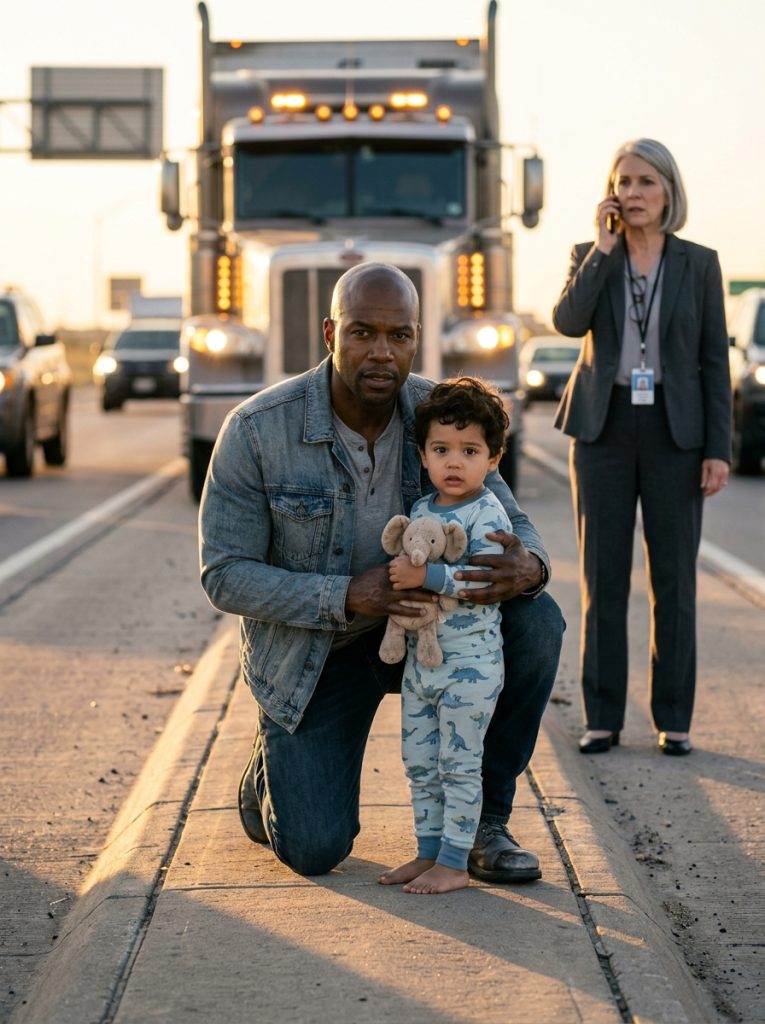
Three days after the median, Marcus Cole’s phone rang at 4:47 a.m.
He was parked at a truck stop outside Flagstaff, Arizona, halfway through a cup of gas-station coffee that tasted like it had been brewed during the previous administration.
The number was a 202 area code. Washington, D.C.
“Mr. Cole? This is Special Agent Patricia Muñoz with the FBI’s Crimes Against Children unit. Do you have a moment?”
He sat up straighter.
“Yes ma’am.”
“We’ve reviewed the dashcam footage from your vehicle. The footage from the evening of the sixth. I need to ask you some questions about what your camera captured beyond the immediate scene.”
Marcus frowned.
“Beyond the scene? I saw the boy. I stopped. That’s it.”
“Mr. Cole, your dashcam has a wide-angle lens. In the seventeen minutes between your initial stop and the arrival of first responders, the camera recorded continuous footage of the westbound shoulder and the access road parallel to the highway.”
“Okay.”
“During that window, a white panel van with no plates exited the access road approximately four hundred meters from your position. The van stopped. A side door opened. And two adults placed three children — ages estimated between two and four — into car seats inside a silver SUV that was waiting in the adjacent lot.”
Marcus’s coffee went cold in his hand.
“That wasn’t a daycare pickup, Mr. Cole. That was a transfer. And the silver SUV is registered to an address linked to an unlicensed childcare network operating across four states.”
Silence.
“Mr. Cole?”
“I’m here.”
“Your footage is the first physical evidence we’ve obtained in fourteen months of investigation. The GPS coordinates, the timestamp, and the plate on the SUV give us what we need for warrants in Texas, Oklahoma, and New Mexico.”
Marcus stared at the dark parking lot through his windshield.
Fourteen months.
They’d been hunting this for fourteen months. And a trucker’s dashcam — running by habit, not by intention — had captured what no surveillance operation could.
“What do you need from me?” he asked.
“Your cooperation. Your testimony if it comes to that. And your patience — because this is going to move fast once we execute.”
“I’ll do whatever you need,” Marcus said.
He meant it.
Because somewhere between that median and this phone call, something had shifted in him. The road had always been his life — the rhythm of miles, the solitude, the simplicity of point A to point B. But now he understood that the road wasn’t just a route. It was a vantage point. A place where you see things other people drive past.
It moved fast.
Within seventy-two hours, federal agents raided four properties across the panhandle. Eleven children were recovered from unlicensed facilities operating under rotating names — Bright Horizons Plus was just one brand in a network of six.
The operators had been cycling children between locations to avoid headcounts during state inspections. When a facility was audited, kids were moved to another site. When that site was checked, they moved again.
Caleb had been moved twice in one week.
On the night Marcus found him, the van transferring him had been flagged down by a supervisor over a scheduling conflict. The driver pulled over. The side door was opened to check the roster.
And a two-year-old in dinosaur pajamas walked out into the dark.
Nobody noticed for forty-five minutes.
Forty-five minutes.
A barefoot child on a highway median while adults argued about paperwork.
Diane Pratt’s emergency suspension shut down the six Bright Horizons Plus locations within hours. But the FBI investigation went deeper — into the network behind the brand, the money that funded it, the landlords who leased the buildings knowing they weren’t up to code, and the county officials who signed off on inspections they never conducted.
Three weeks after the median, Marcus was called to testify before a federal grand jury in Amarillo.
He wore his cleanest shirt. His only tie. His steel-toe boots because he didn’t own dress shoes.
The prosecutor asked him one question that stayed with him:
“Mr. Cole, in your estimation, how many vehicles passed that child before you stopped?”
Marcus thought about it.
“Based on traffic that time of evening? Probably between sixty and ninety cars in the twelve to fifteen minutes before I noticed him.”
“And none of them stopped?”
“No ma’am. None of them stopped.”
The grand jury returned indictments against nine individuals.
Four operators. Two landlords. One county health inspector. One transportation coordinator. And one financial backer whose name Marcus never learned — because that part of the case went sealed.
Rosa testified too.
She told the court how she’d dropped Caleb off that morning at 7:15 a.m. How the facility had seemed normal — bright walls, a receptionist, other children playing. How she’d worked a ten-hour shift at the meat processing plant and arrived for pickup at 5:30 to find the doors locked and no one answering.
How she called the police.
How they told her it was “probably a miscommunication” and to wait.
How she waited three hours before someone found her son on a highway.
The courtroom was silent when she finished.
Marcus sat in the gallery. He didn’t speak to Rosa that day. Didn’t want to intrude. But she saw him as she walked out.
She stopped.
Looked at him for a long moment.
Then she placed her hand over her heart.
No words.
None needed.
Diane Pratt was promoted to director of the state’s childcare licensing division four months later. Her first act was implementing a real-time headcount system — GPS-tagged check-ins for every child at every licensed facility, updated every ninety minutes.
No more paper rosters.
Advertisement
No more cycling kids between sites.
No more forty-five-minute gaps where a toddler could vanish.
She called Marcus once, about six months after the trial.
“I wanted you to know,” she said. “The system we built — the one your footage helped justify the funding for — it flagged its first discrepancy last week. A facility in Lubbock had three fewer children than their roster showed. We were on-site within the hour. All three were recovered from a secondary location.”
Marcus pulled over. He was on I-25 south of Raton Pass, and the sunset was painting the Sangre de Cristos in gold.
He was quiet for a moment.
“Were they okay?”
“They were okay.”
He exhaled.
“Thank you for telling me.”
“Thank you for stopping, Mr. Cole.”
He drove sixteen million miles in his career. Saw a lot of things on the road that most people never think about. Accidents. Weather. The strange loneliness of American highways at 3 a.m.
But he never forgot that golden hour outside Amarillo.
The bare feet.
The elephant with one ear.
The silence of a child who had stopped expecting rescue.
He keeps a photo on his dashboard now. Not of Caleb — he never asked for one. It’s a photo of a stuffed elephant, restitched, sitting on a shelf in someone’s home.
Rosa sent it to him on the one-year anniversary. No caption. No message.
Just proof that the boy was safe.
And that the elephant still had both ears now.
Someone had sewn the missing one back on.