I crossed the cabin slowly and took the photograph down off the mantel.
Mara, in her blue scarf, laughing at something just out of frame. I turned it around so the little girl could see it clearly.
“This lady,” I said. My voice didn’t sound like mine. “She told you to come here?”
The boy answered, because the boy answered everything, standing in front of his sister like a fence. “Not us. Our mom. A long time ago. The lady used to come to the place we stayed. The shelter on Eighth Street.” He watched my face. “She brought books. And she did the braids the right way, my mom said. She told my mom about a cabin with a blue door, way up north, where the key’s under the third stone. She said if we were ever really scared and had nowhere, we should come here, and keep the fire going, and somebody good would come.”
I had to sit down on the bench by the door. My legs just stopped.
The shelter on Eighth Street. Mara’s shelter. Three nights a week for six years, the place she went and never made me feel small for not coming.
“What’s your mom’s name?” I asked.
“Shay,” the boy said. And then, in the flat way children deliver the largest facts: “She died. In October. The cancer.”
The cold came in through the open door behind me and I didn’t feel it.
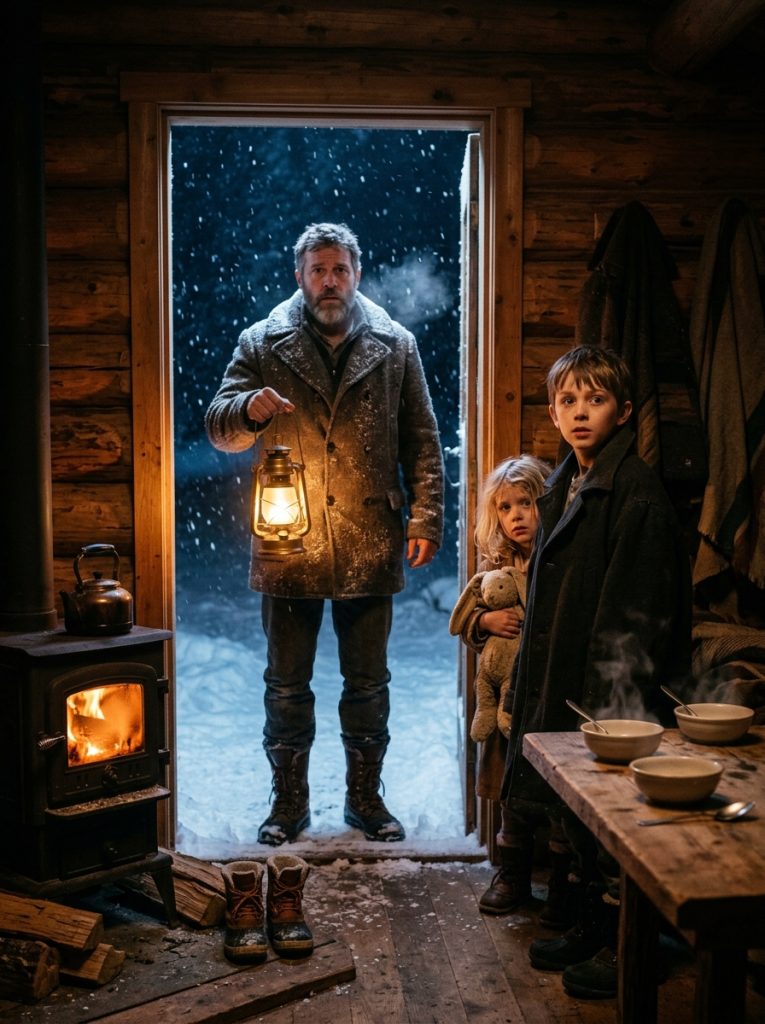
“I’m Bo,” he went on. “This is Wren. She’s seven. I’m ten and a half. After Mom died they sent us to our mom’s cousin in Brainerd, but he — it wasn’t good there. He’d forget about us. For days, sometimes. Last week the heat got shut off and he didn’t come home, and Wren was crying because she was cold, and I remembered.” He lifted his chin, daring me to be angry. “I remembered the lady’s cabin. The blue door. I had bus money saved. We got as far as the county road and walked the rest.”
“You walked.” I looked at the dark window, the snow, the miles of nothing between here and any county road. “In this.”
“The key was under the third stone,” Wren said softly, like that part still amazed her. “Just like the lady said.”
And that broke me. That a woman three years in the ground had reached out of the dark and put a key under a stone for two freezing children she would never meet. That Mara, who I thought I knew completely, had been quietly building safe places in the world the whole time I’d been busy loving her.
I never knew about the promise. She never told me. Maybe she meant to. Maybe it was just one of a hundred small mercies she handed out and didn’t think to mention, the way you don’t report every glass of water you give a thirsty person.
If I had known — that’s the thought that still wakes me at night. If I had known, I could have found them sooner. Before October. Before the cancer took their mother the same way mine had taken Mara. Before a ten-year-old had to become a man on a county road in a blizzard.
I was three years too late to stand beside my wife in the work she did.
But I was exactly on time for the part that was left.
“Okay,” I said. I stood up. I closed the door against the cold. “Okay. First, you finish those bowls, both of you, because your soup’s getting cold and your mom — and the lady — would both have my hide. Then we’re going to figure this out together. Nobody’s going back to Brainerd. I promise you that. And I’m a man who keeps the promises that get made in this cabin.”
Bo didn’t cry. I don’t think Bo had let himself cry in a long time. But his shoulders came down about two inches, and for a ten-year-old who’d carried his sister through a forest, that’s the same thing.
I made them more soup. I dug Mara’s old quilts out of the cedar chest and built a nest by the stove. Wren fell asleep mid-sentence, the stuffed rabbit tucked under her chin. Bo fought it for another hour, watching me from the corner with the wary eyes of a boy who’d learned that grown-ups go away — until exhaustion finally won and he slumped sideways against his sister, a child again at last.
I sat up the whole night feeding the fire.
I hadn’t felt that useful, that needed, since a hospice nurse put Mara’s hand in mine three years before and told me to keep talking, she can still hear you.
I called Mara’s old friend from the shelter that night — a social worker named Gloria who’d been at the funeral, who’d hugged me too hard and said “she saved people, your wife” and I hadn’t understood how literally she meant it. Gloria cried on the phone. Then she got to work, because that’s what the good ones do. The cousin in Brainerd was already under review; there were already case notes, already concerns. The system had been failing Bo and Wren slowly. Mara’s blue door had caught them before the fall finished.
It wasn’t simple. These things never are. There were home studies and hearings and a guardian appointed and a hundred forms. There were nights Wren woke screaming and I sat on the floor outside her door the way Mara would have known to do by instinct and I had to learn. There was a long, careful road to the word that scared me most, which was permanent.
At one hearing, the judge asked Bo, almost gently, where he wanted to live.
Bo didn’t hesitate. “With Owen. At the cabin. The lady said somebody good would come, and he came.”
I had to study the ceiling tiles for a while after that.
But I was a widower with a paid-off cabin, a steady job, an empty house, and a sudden, ferocious reason to be alive again. And they were two kids who had walked through a blizzard on the strength of a dead woman’s kindness.
The county made me their foster father that spring. The adoption came through a year after that. Bo asked me, the week it was final, if it was okay to keep his mom’s last name as his middle name. I told him it was more than okay. I told him Shay should get to ride along in his name the way Mara rides along in everything I do.
We kept the cabin. Of course we kept the cabin. We painted the door again — the same blue, brighter now. Wren picked the color.
And we kept Mara’s promise going, the only way I know how. Gloria sends us a family sometimes, in the bad stretches of winter. People who need a few weeks somewhere warm and safe and far from whatever they’re running from. We light the stove. We set out bowls. We tell them the same thing Mara told a sick young mother on Eighth Street a long time ago.
If you’re ever really scared and have nowhere, there’s a cabin with a blue door, and the key is under the third stone, and you keep the fire going until somebody good comes.
Somebody good always comes now. I make sure of it.
Some nights, after the kids are asleep, I sit by that woodstove and I look at Mara in her blue scarf on the mantel, and I tell her about our day. About Bo’s hockey. About Wren’s reading. About the family from Duluth we’ve got staying through the thaw.
I never got to stand beside her in the work while she was alive. I’ll carry that the rest of my life.
But every time I feed that fire, I feel like I’m finally answering the question she never got to ask me out loud.
Yes, Mara. I’ll keep it lit. For as long as I’ve got. Send me the cold ones — I’ve got the fire, and I’ve got the door, and I’ve finally got the sense to leave it open.