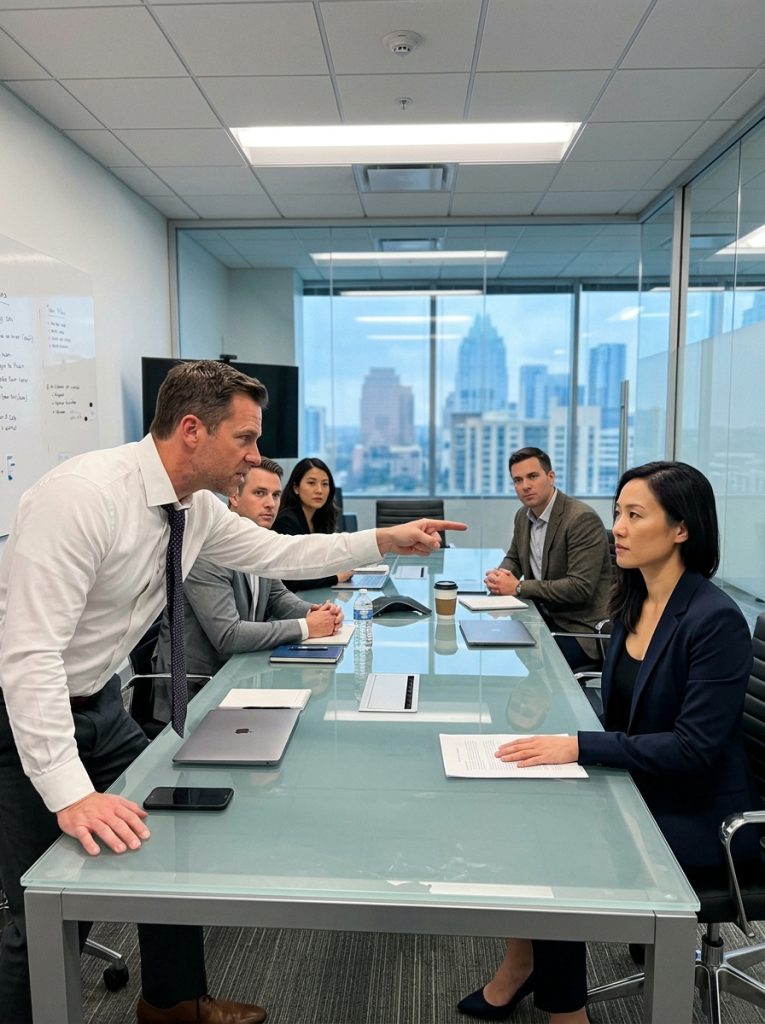
The chair called for a recount.
That’s what happens when someone invokes a clause that nobody in the room has read in three years. The chair — Jonathan Briggs, 55, outside board member, gray suit, the kind of corporate lawyer who charges $900 an hour and earns it by reading things nobody else bothers to read — looked at the document under my hand and said, “We need to recalculate.”
Marcus Webb was still standing. His finger was still extended toward me across the length of the glass table. But the energy in his arm had changed — the pointing had become something else, something without direction.
“This is — ” Marcus started.
“This is Article 9,” Briggs said. He wasn’t looking at Marcus. He was looking at me. “Naomi. Can you confirm your Class B share count?”
I said, “Four shares. Ten votes per share. Forty votes.”
Briggs looked at the company attorney — David Park, 44, who had been seated behind Marcus the entire meeting and who was now very carefully not meeting anyone’s eyes.
“David,” Briggs said. “Is Article 9 still in effect?”
David Park swallowed. “It was never amended.”
“So the voting weight on this motion is — “
“Forty votes against removal. Twelve votes for.”
The silence that followed was the kind of silence that has weight. I could feel the three board members — Angela Marsh, 48, Stephen Kee, 51, and Paula Romero, 39 — processing what had just happened to the votes they had cast three minutes earlier.
Their combined Class A shares totaled twelve votes. My Class B shares totaled forty.
The motion failed.
Marcus sat down. He placed both hands flat on the glass table and he looked at the skyline through the wall behind me. I recognized that look — I had seen it in engineering sprints when a deployment failed. The look of someone calculating whether the situation is recoverable.
It was not.
I slid a second document from beneath the first. I had brought two.
“I’d like to table a counter-motion,” I said.
Briggs nodded. His face was neutral but I thought I saw something at the corner of his mouth — not a smile, but the acknowledgment of someone watching a well-prepared case unfold.
“Motion to remove Marcus Webb as Chief Executive Officer for cause,” I said. “Grounds: breach of fiduciary duty — specifically, undisclosed personal equity stake in Aldrin Systems, a vendor contracted by ArcVault for $2.3 million in infrastructure services over the past two fiscal years. Additionally: falsification of board meeting minutes on three occasions, documented by audio recordings I am prepared to submit to the board attorney.”
Marcus’s jaw moved.
“And termination of two employees — engineers Ravi Deshmukh and Sarah Okonkwo — who raised safety compliance concerns to me directly and were subsequently fired using forged exit interview documentation.”
I placed the second document on the table.
“The forged documents are attached. The original exit interviews, which I preserved, are on file with outside counsel. I’m prepared to submit the full evidentiary package to this board within twenty-four hours.”
Nobody spoke.
Angela Marsh was looking at her hands. Stephen Kee was looking at Marcus. Paula Romero was looking at me.
Marcus said, “This is — this is a personal attack. You’re retaliating because — “
“Jonathan,” I said. “I’d like to call the vote.”
Briggs said, “The motion is on the table. Voting weight applies as previously calculated.”
My forty votes were for removal. The three board members abstained. Marcus’s personal shares — five votes — were against.
The motion carried.
Briggs said: “Marcus Webb is removed as Chief Executive Officer effective immediately. The board will appoint interim leadership pending a full review.”
Marcus stood up. He picked up his phone. He walked to the glass door of the boardroom and he stopped with his hand on the handle.
He turned and looked at me. I expected anger. I expected a threat, or a final sentence designed to cut.
He said nothing. He opened the door and walked out.
I sat alone in that boardroom for a long time after. The glass walls reflected the cranes on the Austin skyline. The morning light had moved while we were talking — it was almost noon now. The document was still on the table in front of me, Article 9 header visible, the ink slightly smudged where my palm had pressed it flat.
I opened my laptop. I opened Slack. I typed in the engineering channel: we are fine.
Forty-seven replies in under two minutes. Heart emojis. Fist bumps. One message from Ravi Deshmukh — who had been fired four months ago and was now consulting remotely while we rebuilt his position — that said: finally.
The board named me interim CEO that afternoon. The formal appointment came three weeks later after the investigation confirmed everything I had submitted. Aldrin Systems’ contract was terminated. Marcus’s equity stake was disclosed to investors. Two of the three board members who had voted for my removal resigned within the month.
I hired back Ravi and Sarah in January. I gave them raises.
The company did not collapse. The product shipped on time. The Series C closed in March at a valuation 40% higher than the previous round — investors cited “leadership stability and governance reform” in their decision memo.
I never discussed Article 9 with Marcus because I never needed to. I had read the document I signed. I understood its implications. And when the moment came where that understanding mattered — I was ready.
That’s the thing about being the person who builds the architecture.
You know where the load-bearing walls are.
And you know what happens when someone tries to tear them down without checking the blueprints first.
I want to add one more thing. About the moment after.
When I typed “we are fine” into Slack, I meant it in two ways. The first was obvious — the company was fine, the product was fine, the team was fine. But the second meaning was personal.
I was fine.
For three years I had been carrying the weight of documentation — recordings, receipts, forged documents, meeting notes that didn’t match reality. I had been carrying it alone because I was not sure anyone would believe me over the man with investor connections and a gift for talking.
When the chair read the vote count and Marcus walked out, something lifted. Not relief exactly — something more physical than that. Like I had been holding my breath underwater for three years and finally broke the surface.
I didn’t celebrate. I closed my laptop. I walked to the window — the glass wall with the Austin skyline — and I stood there for a long time watching the cranes move.
ArcVault’s engineering team sent me flowers that afternoon. Forty-seven engineers. They chipped in and bought the most absurd bouquet I have ever seen — tropical, enormous, so large it wouldn’t fit on my desk and had to go on the floor beside it.
The card said: “The architecture holds.”
Ravi and Sarah came back. We rebuilt their roles. We gave them not just their old positions but expanded ones — Ravi leads security compliance now, Sarah runs the safety review board. The things they were fired for raising are now core functions of the company.
The Series C deck included a slide about governance reform. Investors cited it as a confidence signal. The round closed oversubscribed.
Marcus Webb was last seen at a Denver startup conference in February, pitching a new venture. I don’t follow his work. I don’t think about him often.
But I keep Article 9 in my desk. The original printed page, slightly creased where my hand pressed it flat on that boardroom table.
Not as a trophy. As a reminder.
That the person who writes the code, who builds the architecture, who sits quietly at the far end of the table while others point and shout — that person is not powerless.
That person is the one who knows where the load-bearing walls are.
Advertisement
And no one tears down a building if the architect is still in the room.