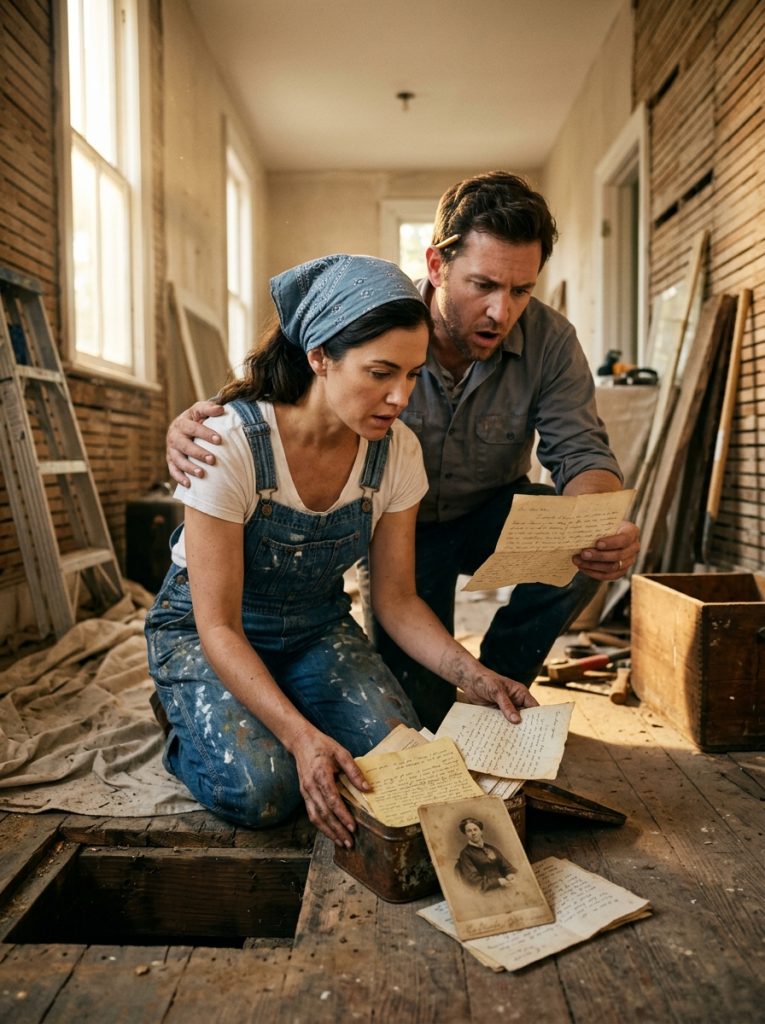
Mark held the last page up to the dusty window light and read me the name.
“Dawson,” he said. “There’s a granddaughter. Denise Dawson. And an address, in Cora Mae’s hand. It’s here in Savannah. Or it was.”
I knelt there on the bare subfloor of a house I’d thought was mine, holding a sepia photograph of the woman it should have gone to, and I understood that I had a choice to make that most people never have to make out loud.
We didn’t sleep that night.
We spread everything across the kitchen counter — the handwritten deed, my great-grandfather’s letter calling Cora Mae “the truest member of this family,” the clipped pages where my grandfather’s clean, lawyer-built paperwork quietly erased her.
“Maybe he didn’t know,” Mark said around two in the morning. “Maybe he thought the handwritten deed wasn’t real.”
I wanted that to be true so badly. But the letter was right there in his own father’s hand, and the dates told a story of their own. The handwritten deed was signed the spring my great-grandfather died. The clean one was filed that same autumn — after the funeral, when there was no one left to argue.
He knew. A young man, suddenly holding a house and a conscience, had made a choice. And then he’d smiled through sixty years of Sunday dinners and let the floor keep his secret for him.
This was the grandfather who taught me to ride a bike on the sidewalk out front. Who slipped me butterscotch candies. Who cried at my wedding.
People are not one thing. That was the hardest lesson in the tin.
In the morning I called a real-estate attorney, because I am a coward and I wanted someone to tell me I didn’t have to do anything.
She told me exactly that.
“Legally? You’re fine,” she said, after an hour with the documents. “The recorded deed is your grandfather’s. That handwritten one was never filed. Whatever was promised, the law calls it ancient history. There’s no claim here anyone could win. The house is yours, free and clear. My professional advice is to put the tin back where you found it and enjoy your home.”
“And your personal advice?” I asked.
She was quiet a moment.
“That’s not something I can bill you for,” she said.
I sat with it for three days.
I kept walking the parlor, running my hand along the mantel, doing the math on our savings and the renovation loan and the years it would take to climb back. Every practical voice I owned told me the lawyer was right. Keep the tin. Keep the house. No one alive could touch us.
But every time I closed my eyes I saw a woman carrying her things down a back staircase with a month’s pay and a promise turned to paper in her pocket. A woman who kept the proof anyway. Who hid it in the bones of the house like a message in a bottle, betting on a stranger sixty years down the line.
She’d bet on me. I wasn’t going to be one more person who let her down.
I found Denise Dawson through the address in the tin, a county clerk, and three phone calls. She was seventy-one. She lived twenty minutes away, in a small tidy house with a porch swing, and when I told her on the phone that I’d found something of her grandmother’s in a house on Habersham Street, the line went so quiet I thought she’d hung up.
“That house,” she finally said. “You live in that house.”
“I do,” I said. “For now.”
We met on her porch. I brought the tin.
I’ll never forget her hands when she opened it. The way they hovered over the photograph before she let herself touch it. The way she pressed it to her chest and rocked.
“My grandmother talked about that house her whole life,” Denise said. “We thought she was — you know how old folks get. We thought she was confusing herself. A house on Habersham, left to a Black housekeeper in 1962? In this city? We loved her, but nobody believed her. Not even me.”
“She wasn’t confused,” I said. “She was right. About all of it. I have the proof sitting in your lap.”
Denise read her great-grandfather’s letter — my great-grandfather’s letter — twice. When she reached “the truest member of this family,” her composure finally broke.
“She died thinking we doubted her,” Denise whispered. “She died thinking she’d imagined her own life.”
I reached over and held that grieving stranger’s hand on her own porch swing — two women bound together by a wrong neither of us had committed — and I made a promise of my own.
“Everyone believed her too late,” I said. “I’m not going to be one more of them.”
That was the moment I stopped pretending there was a version of this where I kept the house and still slept at night.
Here is what I learned about bittersweet: it is not the same as happy, and it is not the same as sad. It is what’s left when you do the right thing far, far too late for it to be the whole repair.
Cora Mae was gone. I could not give her the porch she’d been promised, or the years she spent being disbelieved, or the dignity of dying in a home that was legally hers.
That door closed before I was born.
But there was another door, and it was the only one I had the power to open.
Mark and I talked for a long time. We’d poured our savings into that house. We’d planned a whole life inside its walls. Giving it up would set us back years.
We did it anyway.
We couldn’t undo my grandfather’s deed in a courtroom, so we wrote our own. We had the attorney — who quit trying to talk me out of it somewhere around the second meeting — draw up a transfer of the Habersham Street house to Denise Dawson and her family.
Free and clear. The way it should have read in 1962.
Denise fought me on it at first. “I can’t take your home,” she said. “You didn’t do this. Your grandfather did.”
“That’s exactly why I have to,” I said. “He couldn’t make it right. So it falls to me. That’s what a family is, Denise. You inherit the good and the debt both. I’m just paying down a debt he left in the floor.”
The day we handed her the keys, Denise stood in the front parlor — the one where I’d pried up the board — and set her grandmother’s photograph on the mantel.
Cora Mae looked out over a house that finally, legally, belonged to her people.
It had taken sixty years, a warped floorboard, and a tin she’d hidden with her own hands, trusting that someone, someday, would be willing to find it and tell the truth.
Mark and I rent a place across town now. It’s smaller. It’s fine. Some nights I miss those tall old windows.
Then I think about Denise’s grandchildren running down a hallway Cora Mae Dawson was promised and cheated out of, and missing that house feels like the cheapest thing I have ever paid for anything.
Denise had us over for dinner the first Sunday after she moved in. She cooked in Cora Mae’s kitchen — her kitchen now — and set a place for her grandmother’s photograph at the head of the table, the way you do for someone you want present.
Mark said grace. Denise cried. I cried. We were strangers who’d become something the law doesn’t have a word for.
We kept one photograph. Denise insisted — pressed it into my hands at the door.
It’s the two of them now, framed on our wall. Cora Mae in her housekeeper’s dress. And beside it, Denise on the porch of the house, holding the deed, standing in the light, where everyone can finally see her.