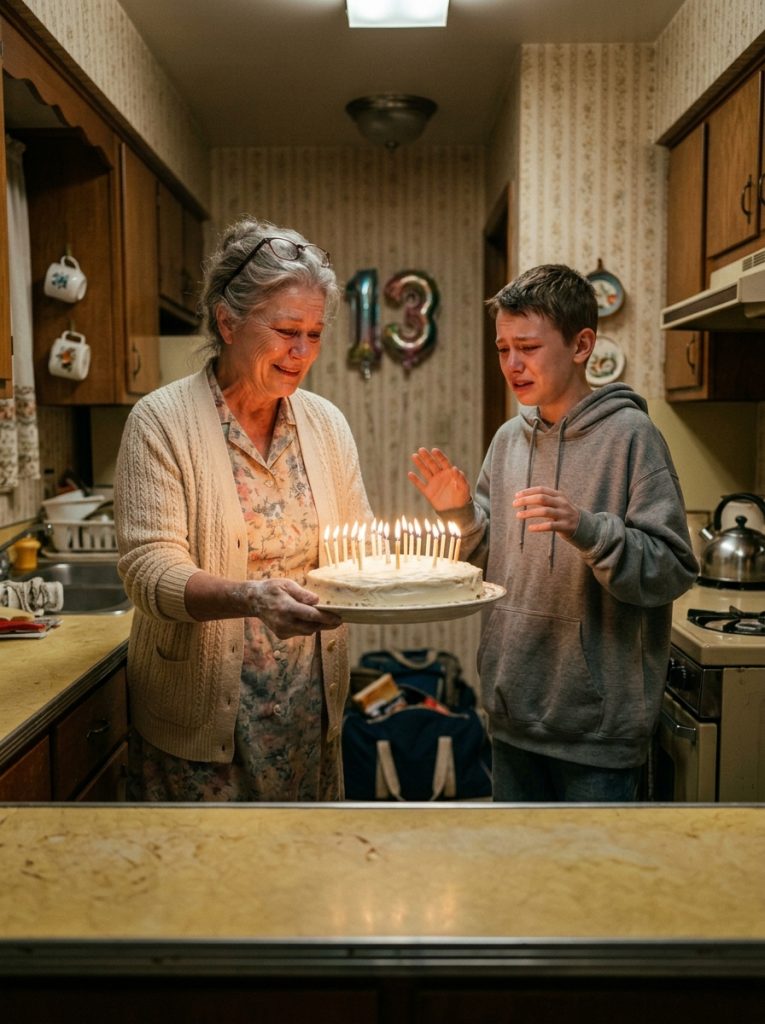
He looked at the cake. Then he looked at me. And in a voice so small I almost lost it under the hiss of the candles, Marcus said:
“You got the right number.”
I didn’t understand. Not at first.
“Every other place,” he said, not lifting his eyes from the flames, “if they did anything, they grabbed whatever candles were in the drawer. Five. Eight. One year somebody put a four on it. Like I wasn’t even worth checking.”
Thirteen candles. Thirteen years. I’d counted them twice at the kitchen counter to be sure.
“You counted,” he whispered.
And then this boy who had held himself together through twelve homes and three weeks in mine finally, completely, came apart.
He cried like something that had been locked a long time and didn’t know how to come open quietly. I set the cake down before I dropped it. I didn’t grab him — I’d learned that much — I just opened my arms and waited.
He walked into them.
We stood in my little kitchen in Dayton and he soaked the shoulder of my cardigan and I held the back of his head the way you hold something you have no intention of ever putting down.
“I’ve got you,” I kept saying. “I’ve got you. You’re home.”
That night, for the first time, he unpacked the duffel bag.
I sat on the floor of his room and he showed me, one at a time, what he’d been carrying from house to house for six years. It wasn’t clothes. It barely had any clothes in it at all.
It was cards.
Goodbye cards. Dozens of them. Every foster family that sent him on had handed him a little card on the way out the door. “Best of luck, Marcus.” “We’ll miss you, buddy.” Cheap drugstore cards that cost less than the gas to drive him to the next placement.
He’d kept every single one.
“So I’d remember I was somewhere,” he said. “Even if I wasn’t anymore.”
I had to leave the room for a minute. I told him I needed water. I stood in the hall and pressed my hand over my mouth so he wouldn’t hear me.
Then I came back and I helped him put them in a shoebox and slide it under the bed, where keepsakes go. Not a bag by the door. Keepsakes.
It was not all healed after that. I want to be honest, because the world tells these stories like one cake fixes a childhood.
It doesn’t.
There were nights he tested me on purpose, daring me to send him back so he could be right about people. There were months he flinched at raised voices that were only the TV. He kept a packed bag in his closet for almost a year — smaller, hidden, but there. I let him. Some doors you don’t rush.
And there was the waiting.
Because for a long time, a part of Marcus was still watching the driveway for his birth mother. She’d lost him to the system at four. He’d built a whole secret cathedral of hope around her coming back.
She never did. She passed two years later, in another state, and I had to be the one to tell him. He was fifteen. He didn’t cry that time. He just nodded, like he’d been bracing for that particular blow his whole life, and went out to the porch and sat a long while.
When he came back in, he said, “You’re my mom now. If that’s okay.”
I said it was more than okay. I said it was the honor of my life.
The adoption was finalized the spring he turned sixteen. Marcus Sullivan. He picked the name himself, at the courthouse, in a borrowed tie.
He’s twenty-six now.
He went to Ohio State on a scholarship he earned with his own stubborn brain, and then — of all the things in the world he could have done — he became a caseworker. The kind who shows up in driveways and warns foster parents that a kid runs, doesn’t talk much, won’t bond.
And then stays long enough to find out why.
Last October he came by the house with his fiancée and a grocery-store cake, and he made me sit at the same kitchen table while he lit the candles himself.
He got the number right.
He always does, now.
We don’t talk much about the twelve homes anymore. But every birthday, before anybody eats, he finds my eyes across the table and says the same two words, quiet, just for me.
“You counted.”
And every year I tell him the truth.
“Baby, I’d count to a thousand.”