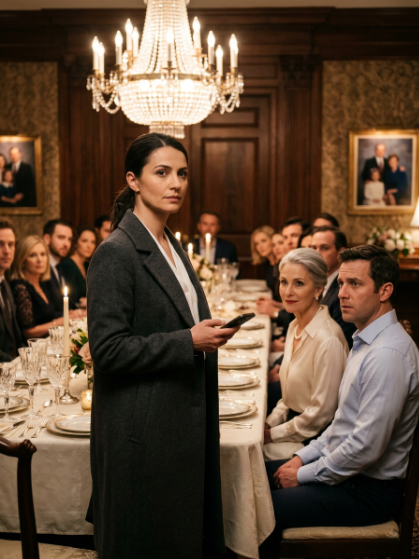
I put the phone on the table and turned it to speaker, and the whole dinner party leaned in without meaning to.
The voice that filled the dining room was crisp, accented, formal. A man’s voice.
“Mrs. Petrescu, this is Henrik Sandor, senior trustee. I’m confirming, as you requested this morning, that the protective hold has been lifted. The estate, the holdings, and the foundation are now legally restored to your name. We are, all of us here, very relieved you are safe. Your mother would be proud. Welcome home.”
Then a click.
And then a silence at that table I will remember for the rest of my life.
Diane’s wine glass was still in her hand, frozen halfway through a toast about how I’d “arrived with nothing.”
Let me tell you the part she spent three years not asking about.
I did arrive with one suitcase. That was true. But not because my family had nothing.
My family had quite a lot. And in the country I left, that made us a target. My father stood up to people you don’t stand up to and pay no price. When it became dangerous — genuinely dangerous, the kind with no police you can trust — my mother made the only choice a mother can. She got me out. Quietly. Under a changed name. With nothing visible to connect me to the family, because anything visible could be traced.
The estate didn’t vanish. It was placed in a protective trust, sealed, untouchable, waiting on one condition: that it not be released until the people who’d hunted us were no longer a threat. My mother didn’t live to see that day. My father didn’t either.
I did.
The morning of that dinner, after years of patient lawyers and changed governments and a long, careful process, the trustee had called to tell me the danger had passed and the seal was lifted.
I could have announced it like a lottery win. I could have corrected Diane a hundred times over three years of dinners.
But my mother taught me to let people show you who they are before you show them who you are. So I stayed quiet, and I watched, and I learned exactly who my husband’s family was when they believed I was beneath them.
I learned that Diane introduced me to her friends as “Brett’s charity case.” I learned that she’d tried, twice, to convince Brett to get a prenup “to protect the family from people like her.” I learned that when she thought I couldn’t hear, she called me “the refugee” — never my name.
And I learned the most important thing of all.
I learned what Brett did when his mother spoke about me like that.
He looked at his plate.
Every time.
That hurt more than anything Diane ever said. Diane was a stranger who decided to be cruel. Brett was my husband who decided to be quiet.
So when the trustee’s voice finished and the silence settled, I didn’t gloat. I didn’t list the holdings or name the figure. That would have made it about money, and it was never about money.
I picked up my phone, slipped it back into my pocket, and looked down the table at the family that had taken me in like a stray.
“Diane,” I said. “Thank you for the toast. You’ve been telling this table for three years that you gave me everything and I came with nothing. I let you, because I wanted to know who you’d be if you believed it.” I paused. “Now you know who I am. And I know who you are. I think those are both worth knowing.”
Then I turned to my husband.
“Brett. Every time your mother called me a charity case, you looked at your plate. I kept waiting for the dinner where you’d look at her instead. It never came.” I set my napkin down. “I’m not leaving you because you didn’t have money. I never needed yours. I’m leaving because you had a voice, and you only ever used it to stay comfortable.”
I stood up.
I’d love to say the room erupted. It didn’t. It just sat there, stunned, the chandelier humming over a table full of people recalculating every unkind thing they’d ever said in front of “the refugee.”
I walked out of that house with the same dignity I walked in with. The only thing that had changed was that now they could see it.
The months after were busy in ways I’d never imagined. There was an estate to steward, a foundation to rebuild, my parents’ life’s work to honor. I moved back into a world I’d been hidden from since I was a girl, and I had to relearn how to belong to it.
I did keep one promise to myself.
The foundation my mother started funds legal aid for immigrants — real refugees, people who actually did arrive with one suitcase and no trust waiting offshore. People the Dianes of the world look right through.
I run it now. I put my mother’s name on the door and my father’s courage in the mission.
Brett wrote to me, eventually. A long letter. He’d finally found his voice, he said. He used it to apologize.
I wrote back two lines. I told him I forgave him, because carrying anger is a weight my mother taught me to set down. And I told him a voice you only find after you’ve lost the person it was for is a lesson, not a reunion.
Diane never wrote.
I didn’t expect her to. People who mistake quiet for weakness rarely understand it when the quiet finally speaks.
My name is Ana Petrescu.
I arrived with one suitcase.
It was never the only thing I had. It was just the only thing they bothered to look at.