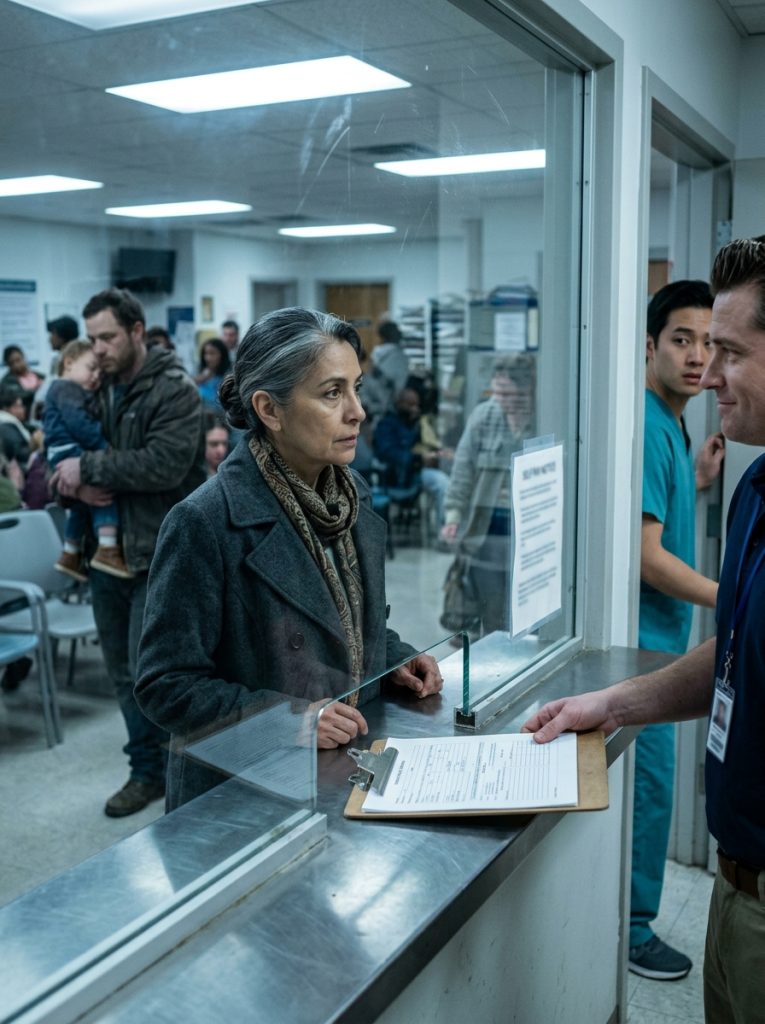
The administrator’s name was Lonnie Pratt, and I watched the introduction die in his throat the moment he placed my face.
He’d seen me the night before. Not at the window — Lonnie didn’t work the window — but on his way out, breezing past the waiting room in his good coat while a tired woman in a frayed gray one stood being turned away at the glass. He hadn’t given me a second look then. He was giving me nothing but second looks now.
I let the silence sit. Silence is a tool most powerful people never learn to use.
“Thank you, Mr. Pratt,” I said, and took my seat at the head of the table. “Before we start the agenda, I want to tell the board how I spent last night.”
I told them.
I told them about the gray coat and the church-sale scarf and the chest tightness that was, thank God, only a warning and not the real thing. I told them about giving my name at the glass and being slid my own paperwork back across the counter with two fingers.
I told them the word the supervisor used. “That.” As in, the county clinic handles that.
I told them about the young father with the feverish little boy asleep on his shoulder, turned away with a medicine bottle still clutched in his fist. And about the one nurse, junior and frightened, who stepped forward to at least take the child’s temperature and got stared back into his place.
The boardroom of Cardinal Health is glass on three sides, the city laid out below it, and you could have heard a pin drop across the whole floor.
“I didn’t take this chair to look at quarterly dashboards,” I said. “Numbers can be massaged. A waiting room cannot. So I went and stood in ours. And what I learned is that we have built a very expensive building that is extremely good at deciding who deserves to walk in.”
Lonnie tried. They always try.
“Chairwoman Vega, our self-pay protocols are designed to protect the system’s solvency, and—”
“Mr. Pratt, a man with chest pain was directed to drive across town instead of being triaged. Do you know what we call it when that drive ends badly? We call it a lawsuit, and a headline, and a death. In that order of importance, apparently.”
He stopped trying.
I want to be clear about something, because this is the part people get wrong. I did not walk in there to fire one rude man at a window.
Brett Holloway was a symptom. The disease was a set of policies, written in this very room over years, that quietly taught every employee that the uninsured were a problem to be deflected rather than people to be treated. Brett was just the one doing out loud what the system had been rewarding him to do quietly.
So we started with the disease.
By the end of that first meeting I had directed three things, and I had the votes to make them stick.
First: no patient presenting to our urgent care or emergency department would be screened on ability to pay before being screened on medical need. Federal law already required the ER to do this. We extended it, in writing, to every front door we operate, and we put it on a sign big enough to read from the parking lot.
Second: a charity-care and sliding-scale program, properly funded, with the application built to be finished in minutes by a scared person, not designed to exhaust them into leaving. I’d seen the old version. The old version was the point.
Third: every intake employee and every manager would complete training led by people who had been uninsured patients themselves. Not a video. People. In the room.
Then I dealt with the window.
I did not have Brett Holloway marched out in front of cameras, however much a part of me wanted to. That would have made it about a villain, and it was never about a villain. I had him brought to a meeting with HR and with me.
He went white all over again when I walked in. He started to apologize, fast, the way people do when they’re sorry they got caught and not sorry for the thing.
“Mr. Holloway,” I said, “I’m not interested in your apology to me. I had a bad night and a good insurance plan I chose not to show you. You’ll be fine. I’m interested in the man with the sick child you turned away while I watched. I’m interested in everyone before him.”
He was suspended pending review. In the end he was not fired outright — I insisted the process be fair, because a system that bends the rules to punish is the same system that bends them to harm. But he was removed from any patient-facing role permanently, and required to complete the new training before he could work in the building at all. Last I heard he took a job elsewhere. I hope it took. People can change. The policy just shouldn’t depend on it.
The nurse in the teal scrubs was named Daniel Cho.
I found his name on the schedule. I sat in on a shift, quietly, near the back, and I watched him be the same careful, decent kid he’d been the night he tried to help me and got shut down for it.
I promoted him. Not as a reward for noticing me — he never knew the woman at the window was me until I told him myself, in my office, and he turned the color of his scrubs. I promoted him because he had, with no power and every reason to look away, stepped forward. That is the single rarest and most valuable instinct in a hospital, and I will spend my tenure hiring for it.
He runs our new patient-advocate program now. The training the whole staff goes through? He helped build it.
And the young father. Marcus Tilden.
That one haunted me. I had let him walk out that night because blowing my cover would have changed nothing for the people behind him — but I’d memorized his face and the name he gave at the glass.
It took some doing. We found him. The little boy had an ear infection that had turned serious from waiting; he was treated, fully, no bill, and he is a loud and healthy menace today, by his father’s exhausted and grateful report.
Marcus sat on the panel that helped design the charity-care application. He knows better than any consultant exactly where a frightened parent gives up. We followed his map.
I never did tell the full board the last part. I’ll tell you.
Thirty-five years ago I was the woman at that window. A single mother, a feverish baby, a maxed card, a man behind glass who looked at me the way Brett looked at me, and a clinic across town I couldn’t reach in time before my daughter’s fever spiked and we spent a terrifying night I have never once forgotten.
My daughter is a pediatrician now. She got there because a stranger at a second hospital, a nurse whose name I never learned, broke the rules and helped us anyway.
I built a career to make sure I’d never feel that small again. It turns out the better use of a career is making sure no one else has to.
We hung the new sign last month. I drove over to see it on the day they put it up.
It faces the parking lot, big white letters anybody can read while they sit in their car doing the math no one should have to do.
It says: If you are sick, come in. We will see you first, and sort the rest out after.
A frayed gray coat hangs in the back of my closet. I keep it where I can see it. Some windows you walk through twice — once with nothing in your hand, and once holding the key.