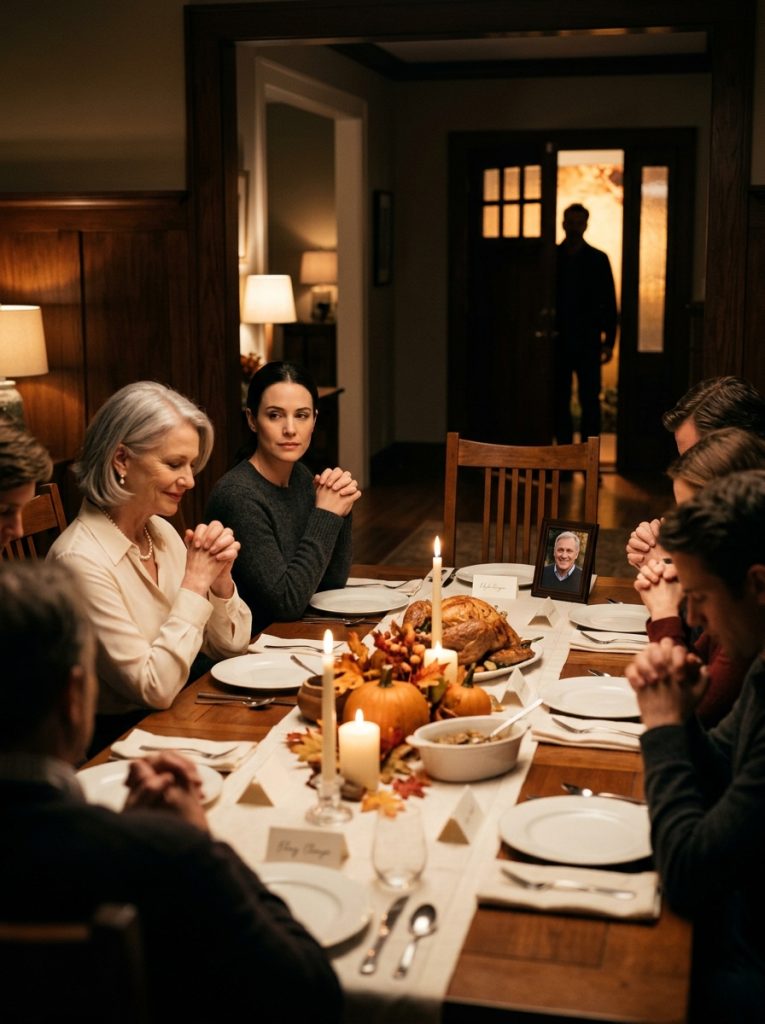
My mother opened the door because the ringing wouldn’t stop.
Two men stood on the porch. One I didn’t know — gray suit, tablet under his arm. The other I knew very well.
Robert Lang. My father’s caregiver for the last three years of his life. The man who held his hand on the Tuesdays and Thursdays I drove out to that hospice room.
The man my family had never met. Because they were never there.
“I’m sorry to interrupt your dinner,” the lawyer said. “But Mr. Harmon left specific instructions. This was to be delivered at the first family gathering after the estate cleared. Tonight qualifies.”
Derek stood up so fast his chair scraped. “This is private property. You can come back—”
“Sit down, Derek,” I said.
I don’t know where the voice came from. Quiet, but it stopped him cold.
Robert stepped inside. He looked at the table. At the candles, the turkey, the empty chair with my father’s photo and the place card my brother had set there to shame me.
His eyes landed on that chair, and something crossed his face that I can only call grief.
“He told me you might do something like this,” Robert said softly, to the whole room. “He said his family was very good at funerals and very bad at visits.”
The lawyer set the tablet upright on the sideboard and pressed play.
My father’s face filled the screen.
Thinner than they remembered. This was filmed near the end, in the room with the window he liked. But his eyes were clear, and his voice was his own.
“If you’re watching this, I’m gone, and you’re all together,” he said. “Which means somebody’s already started arguing about me.”
A few uncomfortable laughs. Then silence.
“I want to clear something up before you carve anything else up. For three years I was sick. In that time I had exactly one regular visitor from this family.” He paused. “It wasn’t the son who calls himself the responsible one. It was Claire.”
Every head turned toward me.
“She came twice a week. She paid for Robert. She paid for the medicine and the room and the window. She asked me not to tell any of you, because she didn’t want it to become a competition.” His voice tightened. “I kept that promise while I was alive. I’m done keeping it now.”
Derek’s face had gone the color of the tablecloth.
“Derek,” my father said from the screen, looking right at him, “you posted online about how hard it was to care for me. Son, you visited me three times in three years, and two of those were to ask about the will. I know because I kept a calendar. Robert has it.”
Robert opened the folder. Inside were pages — a logbook, dates and initials, three years of Tuesdays and Thursdays in my father’s shaking hand. Page after page of C. A scattering of D’s you could count on two hands.
“So here is what happens,” my father said. “The house goes to Claire. The accounts go to Claire. Not because I loved her more. Because she showed up, and showing up is the only currency that ever mattered to me. The rest of you are welcome to the silver and to each other.”
He softened at the end.
“Claire. Sweetheart. Take down the chair. I’m not at this table. I’m in the people who actually sat with me. You don’t owe these folks a performance. You never did.”
The screen went dark.
Nobody spoke. The candles burned. The turkey went cold.
Then my mother — who had set that empty chair, who had let Derek tell his story for two years — put her face in her hands and started to cry. Not the performing kind. The real kind. The kind that comes when a story you told yourself finally cracks.
Derek tried, even then. “Dad wasn’t in his right mind. We can contest—”
“There’s a notarized cognitive assessment from the same week,” the lawyer said mildly. “And the logbook. And Mr. Lang. You’re welcome to contest. I wouldn’t advise it.”
I stood up.
For two years I’d let them call me the cold one, the daughter who left. I’d swallowed it at every holiday to keep a peace that, it turned out, only protected the people lying about me.
I walked to the head of the table, to the chair with my father’s photo, and I picked up the frame.
I didn’t throw it. I didn’t make a speech.
I just held my father’s picture against my chest the way I’d held his hand on all those Tuesdays, and I said, to no one and to everyone, “I never forgot you, Dad. I just didn’t need an audience.”
Then I set the photo gently on the mantel where it belonged, and I left the empty chair empty, because that’s what it had always honestly been.
I didn’t stay for pie.
I drove home light for the first time in years. Behind me, the house I now owned glowed with people learning, too late, what it costs to set a chair for a man whose hand you never once held.