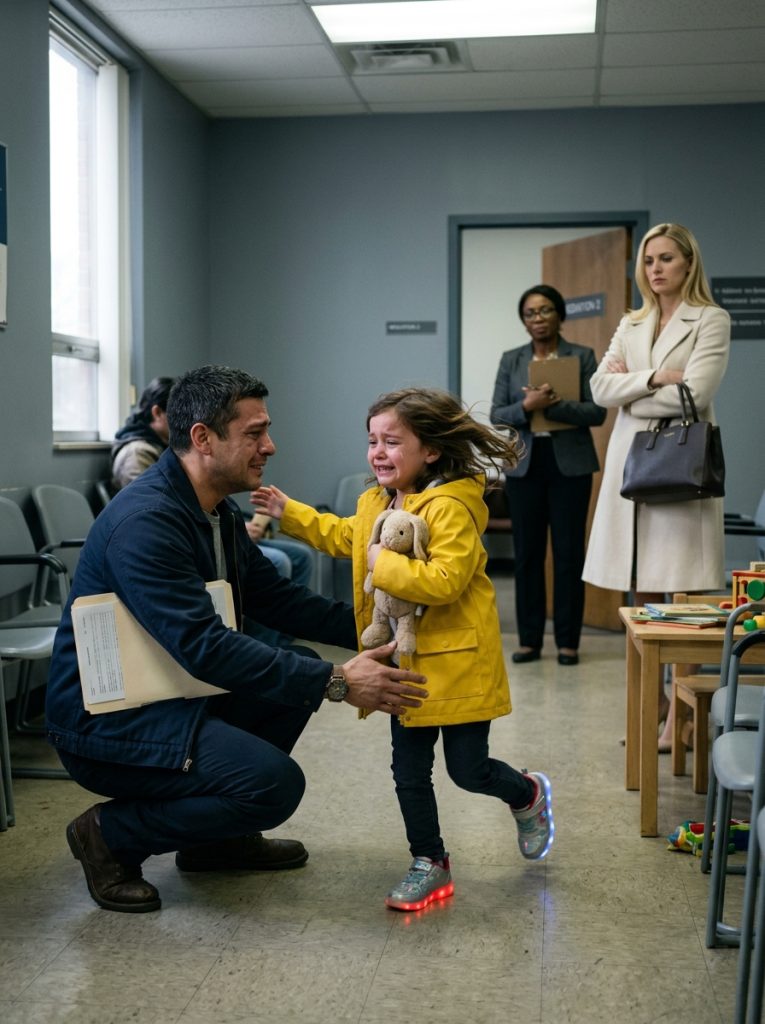
I held my daughter while she cried herself quiet, and over the top of her head I watched the woman in the doorway write something on her clipboard.
I didn’t know who she was. I assumed she was another caseworker, another person paid to find me lacking.
Her name was Ms. Okafor. She was the court-appointed mediator, and it turned out she’d been in that waiting room for forty minutes before anyone important arrived — sitting in a plastic chair like a tired aunt, watching how a frightened six-year-old behaves when the adults forget she’s there.
When the session reconvened, Vanessa’s lawyer started up again with the binder. The hours. The apartment. The one missed pickup.
Ms. Okafor let him finish. Then she said, quietly, “I’d like to address the pickup from two years ago, since it’s in the filing three times.”
The lawyer smiled, ready.
“I pulled the phone records,” she said. “Mr. Reyes called the school at 3:02, the mother at 3:04, and a tow service at 3:09. His vehicle had broken down on the interstate. He arranged alternate pickup within eleven minutes.” She looked up. “I’ve reviewed a lot of files. Eleven minutes is not neglect. Eleven minutes is a parent in a crisis doing everything right.”
Vanessa shifted in her seat.
Then Ms. Okafor set down her clipboard and did the thing I will be grateful for until the day I die.
“I’m going to tell you what I saw,” she said, “because the law lets me, and because I think this room needs it. A child in distress doesn’t perform. She doesn’t calculate. She goes, on instinct, to the person who has made her feel safe the most times in her short life. I watched Sofia have a frightened moment with every option in this room available to her. Her mother. Her grandmother. Three attorneys. A familiar waiting area.”
She paused.
“She ran past all of it. To her father. And she stopped crying the second he had her. That is not nothing. In my experience, that is the closest thing this building ever gets to the truth.”
The room was silent.
I had brought my own folder too. I never had to open it. But it was full: a logbook of every pickup and drop-off for two years, every fever, every dentist appointment, every parent-teacher night. Sofia’s teacher had written a letter. So had her pediatrician. I’d spent weeks terrified that it still wouldn’t be enough — that paper could never compete with their binders and their billable hours. In the end, it wasn’t paper that did it. It was a six-year-old’s feet, crossing a cold room to the one place she’s always felt safe.
I want to be fair, because Sofia will read this someday. Vanessa is not a monster. She grew up believing that love is proven with private schools and a big house and the right zip code, and she genuinely thought she was rescuing our daughter from a small apartment and a man who smells like a kitchen at the end of his shift.
But love isn’t the square footage. It’s who’s there at 3 a.m. with the bucket and the cool washcloth. It’s who learns the braid. It’s who the child runs to when the world gets loud.
The mediator’s recommendation went into the file that afternoon. I keep primary custody. Sofia is with me on weeknights and every other weekend with her mom, and — slowly, awkwardly — Vanessa and I are learning to be parents on the same team instead of opposite sides of a binder.
She came to Sofia’s school play last month. We sat in the same row. It wasn’t warm, exactly. But it wasn’t war, and that’s a start.
People think the system always crushes the parent without money. Sometimes it does. But sometimes a tired woman with a clipboard sits in a plastic chair longer than anyone expects, and pays attention to the one person in the room nobody else is watching.
Sofia still won’t take off the yellow raincoat.
She wore it to the courthouse, she wears it to the grocery store, she’d wear it in the bathtub if I let her.
Last night I braided her hair before bed, the way the phone tutorial taught me three years ago, and she said, sleepy and matter-of-fact, the way kids drop the biggest things like they’re nothing:
“I knew you’d catch me, Papa. You always do.”
Then she was asleep mid-sentence, the way she always is, and I knew exactly what she’d been about to say.