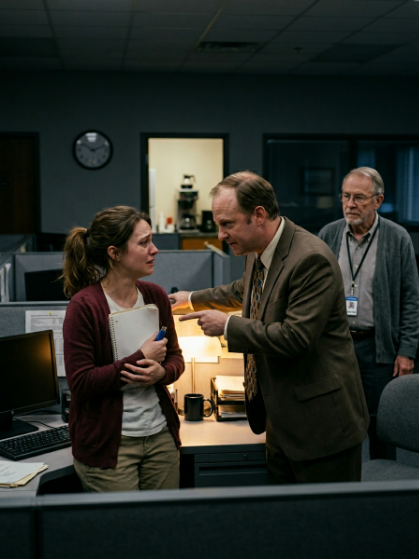
The lanyard said WALTER COOMBS — FOUNDER.
Roland read it twice. I watched the color leave his face the way it leaves a check when you void it.
Walt — the printer man, the second-coffee man — held out his hand. Not to shake. Palm up.
“May I see the notebook?” he asked me.
I gave it to him. My hands weren’t even shaking anymore. There’s a kind of calm that lands when the worst part is finally over and someone real is finally in the room.
He put on his wire-frame glasses and read. Slowly. Page after page. Date. Clock-in. Clock-out. Seven months of stolen hours in a single dollar-store notebook.
“Mr. Pace,” he said without looking up. “These overtime hours. Were they worked?”
Roland’s mouth opened and closed. “I’d have to — the system shows—”
“The system shows what someone entered into it,” Walt said. “I’m asking if she worked them.”
Silence.
Then Walt looked at me. “Did you back this up?”
I held up the little blue USB.
Something in his weathered face softened all the way through.
“I started this company out of a rented garage in 1981,” he told me. “Two trucks and a phone. We’ve been bought and sold so many times I barely recognize the letterhead. So every couple of years I take off the suit, put on the cardigan, and I walk my own floors as a nobody. You’d be amazed what people show a nobody.”
He turned to Roland.
“You showed me everything I needed to see.”
It came out over the next two weeks, the way these things do once a founder starts asking questions instead of a clerk. Roland hadn’t just shaved my hours. He’d been doing it across the floor — rounding down overtime, pocketing the difference in the budget he was “managing,” and using the savings to pad the numbers that got him his bonus. Three other people had quietly kept their own versions of my notebook. They’d just never had anyone to hand them to.
Roland was walked out on a Thursday. Not by security he called on someone else — by security called on him. He carried his own cardboard box past the cubicles where he’d made the rest of us carry ours, and nobody looked away this time. We all watched. Quietly. The way you watch a tide finally go back out.
I got the back pay. Every hour, plus the penalty the labor board adds when a company doesn’t pay people what they’re owed. It was more money than I’d ever seen in one place. The first thing I did was pay off the daycare balance I’d been carrying like a stone.
The other three got theirs too. Walt made sure of it. He sat with each of them — Danielle from billing, the two night-shift dispatchers — and he had them lay their notebooks on the table beside mine, four ragged little records that no manager had ever wanted to see. He apologized to every one of them personally. I have never watched a man with that much money make himself that small on purpose. It changed how I think about what power is supposed to look like.
There was a moment, in his office, when he turned my notebook over in his hands and went quiet.
“My mother cleaned offices at night,” he finally said. “Somebody shorted her checks for years and she never had the proof. She’d have killed for a notebook like this.” He set it down gently. “You kept the receipts she couldn’t. Thank you.”
But Walt wasn’t finished.
He found out — from HR files Roland had buried — that I’d applied twice for an analyst position and been “screened out” both times. Roland had killed the paperwork because a clerk who got promoted couldn’t be a clerk he stole from anymore.
Walt put me in the role himself. “You already do the analysis,” he said. “You’ve been auditing this company for seven months for free. Might as well pay you for it.”
Then he did the thing I’ll never forget.
He stood up in front of the whole floor — founder, cardigan and all — and he announced a new policy. Every hourly employee would get a printed pay summary they could check against their own records. “Because one of your coworkers,” he said, “kept better books than my managers did. And she kept them in a three-dollar notebook. That should never have been her job. From now on, it’s mine.”
He held up my notebook like it was a trophy.
I cried. The good kind. The kind you don’t have to hide in an elevator mirror.
My son asked me that night why I was happy and tired at the same time.
I told him I’d learned something I wanted him to know early: that the quietest person in the room is often the one keeping the truest record, and that you should be kind to the man fighting the printer, because you never know who’s been watching to see who’s kind.
I still have the notebook. It lives in my desk drawer in the analyst’s office now.
New pages. Same handwriting. Different ending.