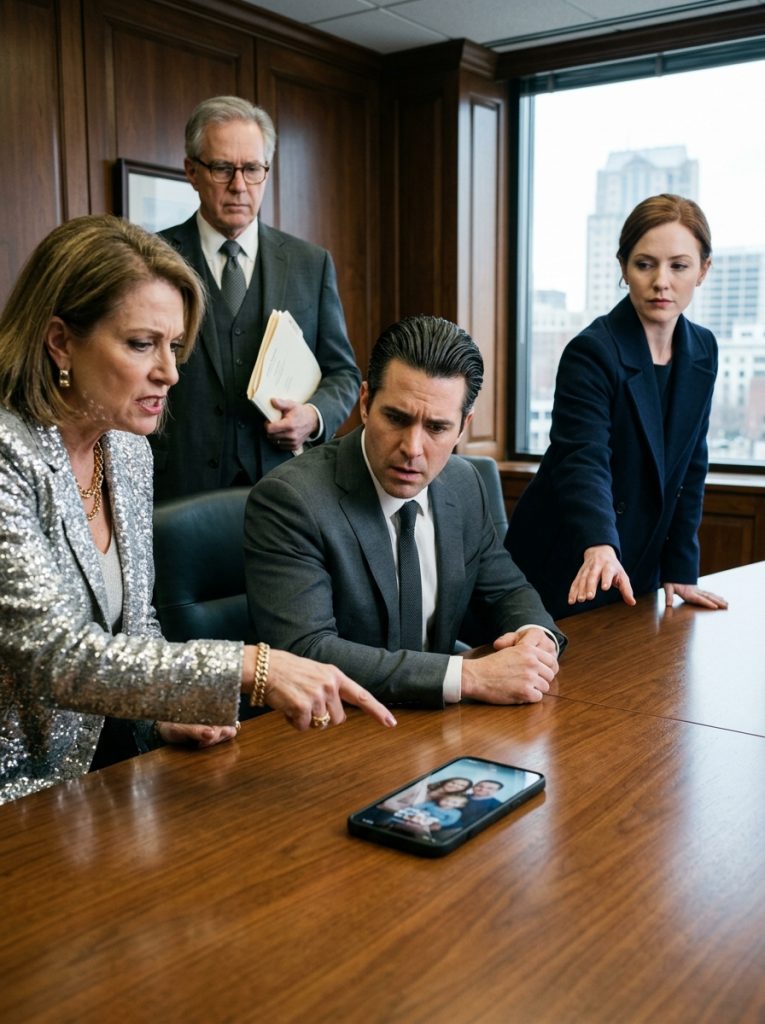
My father looked into the camera like he was looking straight at me.
“Hannah,” he said. “If you’re the one who unlocked this, then I was right, and I’m sorry it took me dying to prove it.”
Diane reached for the phone. Mr. Pennington put two fingers on it and slid it out of her reach.
“Let him finish,” the attorney said.
On the screen, my father took a breath. He looked tired, but his eyes were sharp.
“Six years ago I told you that you broke my heart by marrying David. That was a lie I let other people write for me.” His jaw worked. “Diane didn’t like that David had no money. She told me you only kept in touch to wait for your inheritance. I was old and angry and I believed her, and I cut you off.”
I felt David’s hand find mine under the table. He’d driven me here. He’d told me not to expect anything. He’d been wrong about that, but right that it didn’t matter — I’d have come anyway.
“Then I got sick,” my father said.
“And a funny thing happened. The daughter who ‘only wanted my money’ was the one who showed up. You didn’t know I knew. You called the hospital under your married name. You paid down two of my bills anonymously — the hospice thought I didn’t notice. You sent a card every month with no return address.” His voice broke. “You never asked for a thing. The people who were going to inherit everything couldn’t be bothered to visit. The daughter I disowned was paying my bills in secret.”
Grant’s smirk was gone. Diane had gone very still.
“So I changed it all,” my father said. “Quietly. With Mr. Pennington. I made my passcode your birthday because I wanted the truth to come out exactly like this — to land in the hands of the one person who’d remember a date that mattered.”
Mr. Pennington opened the real file then. Not the version Diane had been planning around. The amended will, signed and witnessed fourteen months ago.
The house came to me. The investment accounts came to me. There was a separate letter, sealed, with my name on it in my father’s hand.
To Diane, he left a single line, which the attorney read aloud without expression: “To my wife, I leave the truth, which she has been avoiding, and the prenuptial agreement she signed, which she seems to have forgotten.”
Because that was the other thing.
Diane had married my father on a prenup. She’d spent the morning carving up assets that, by her own signature, were never going to be hers to carve. The lake house she wanted to sell first was specifically excluded. So was almost everything else.
“This is fraud,” Diane snapped. “He was manipulated. That girl manipulated a sick old man.”
“That girl hasn’t spoken to him in six years,” Mr. Pennington said. “There’s a paper trail showing the opposite of manipulation. Anonymous payments. No contact. No demands. If anything, the manipulation ran the other direction.” He looked at her over his glasses. “I’d be careful what I put in a courtroom, Mrs. Cole. The discovery process is very thorough about where money actually went.”
That landed. Because Grant flinched.
It turned out my golden half-brother had been borrowing against an inheritance that wasn’t coming. He owed people. He’d promised them this estate. And the estate had just walked out the door in a navy coat.
“Grant,” Diane said, “say something.”
But Grant was already doing math on his face, and the numbers were bad.
I didn’t gloat. I want to tell you I had some perfect line, but I didn’t. I just picked up my father’s phone, and the sealed letter, and I stood.
“You can fight it,” I told them. “Dad said you would. He also said you’d lose, and that the trying would cost you more than the losing.”
I read the letter in the car, with David in the driver’s seat and the heater running.
It was short. He apologized for the years. He said he’d spent them being proud, and pride had cost him the only person who’d have sat with him at the end. He said the money was the least of what he owed me, and the most he had left to give.
The last line is the one I keep folded in my wallet now.
“You knew the passcode because you were the only one still paying attention. You always were. I’m sorry I needed a locked phone to admit it.”
Diane contested the will. She lost in four months, exactly as he’d predicted, and the legal fees took the rest of what the prenup had left her. Grant’s creditors came calling, and the lake house he’d promised them was never his to promise.
I kept the house. I rarely go to the big rooms. But there’s a small study with a window my father liked, and a chair that fits one person, and some Tuesday evenings I sit there with his letter and the city light.
He spent six years sure I wanted his fortune.
I’d have traded all of it for one more of those Tuesdays.