They gave Roy Maddox a sheet cake and called it a retirement.
I was there. I’m his neighbor, and I’d been invited to the station because Roy didn’t have much family left to fill a room. Thirty-one years on the engine, and the new captain, Brett Vaughn, stood up with a plastic cup and made a toast that was really a shove: “To Roy. Finally too slow to be a liability.”
People laughed because Vaughn was their boss. Roy just smiled, held his coffee, and said nothing. That’s his way. He keeps his late captain’s brass cross in his pocket and rubs it with his thumb when he’s swallowing something he’d rather say out loud.
Vaughn had spent a year cutting Roy’s hours, calling him “old guard,” making sure the rookies saw him as a relic. By the night of the Ridge Fire, Roy wasn’t even on the schedule.
The fire turned faster than the models said it would. It came over the hill toward Cedar Hollow with a wind behind it, and suddenly the whole town was an evacuation — taillights and embers and a sky the color of a healing bruise. Roy and I were out at the line because that’s where Roy goes. Retired or not, he can’t not.
At the station, two things went wrong in the same thirty seconds.
The rookie, Theo Nguyen, twenty-two, froze solid. I’d never seen it before, but Roy had warned me it happens — the heat hits a wall in front of a person and their body just refuses. Theo stood by the engine in a turnout coat two sizes too big, helmet crooked, not moving.
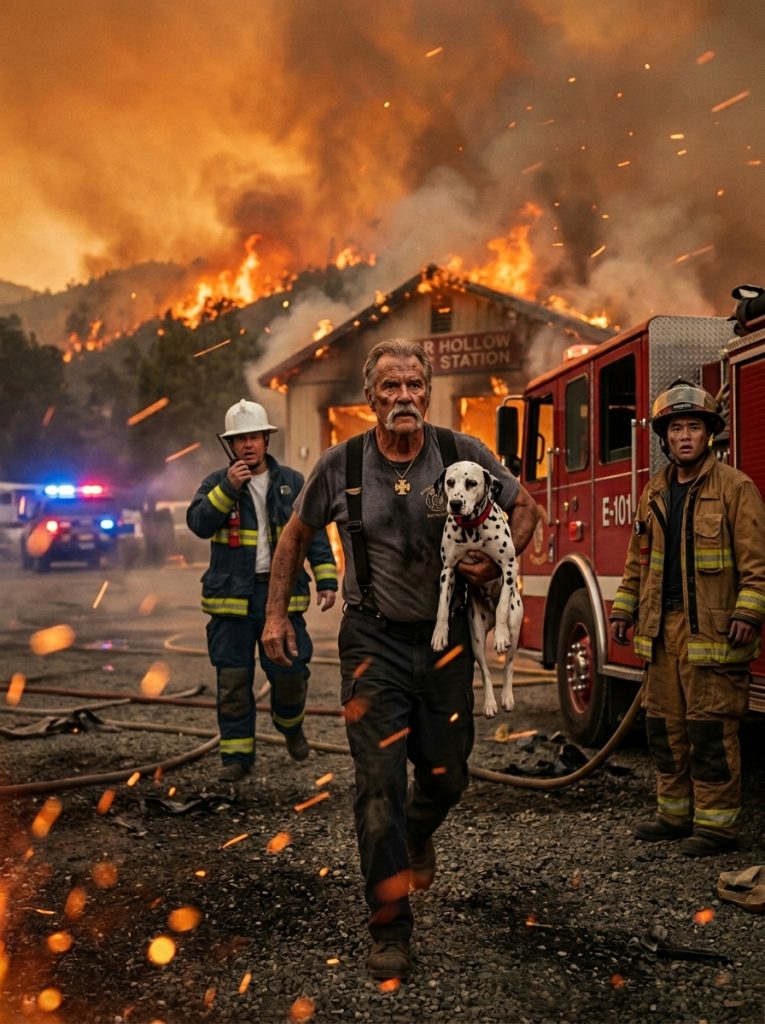
And Biscuit — the station’s Dalmatian, the dog every kid in Cedar Hollow has petted — was still shut in the engine bay as the fire reached the back of the structure.
Captain Vaughn was backing away from the heat with his radio up, shouting at everyone to clear the building. Procedure. Defensible. Also: he left a frozen kid and a trapped dog and called it leadership.
Roy didn’t say anything. He never does. He just handed me his coffee like he was setting down something he’d pick up later, and he ran the wrong way.
Sixty-three years old, in a cotton T-shirt and suspenders, into a building the captain had already written off.
I want to be honest about how long it took, because it felt like an hour and it was maybe ninety seconds. The orange light swallowed him. Then it gave him back. He came out of the smoke with Biscuit clamped against his chest, the dog’s singed collar smoking, and he didn’t stop — he went straight to Theo, grabbed a fistful of that oversized coat, and physically turned the kid away from the heat and walked him to safety like you’d walk a sleepwalker out of traffic.
What none of us knew — what Vaughn especially didn’t know — was who was standing at the command post the whole time.
Her name was Marisol Alvarez. County fire chief. She’d come to Cedar Hollow that night, unannounced, to evaluate the station and its new captain. She had a clipboard and a clear view of the bay, and she watched the entire thing: who backed away, who froze, and who ran into a building in suspenders for a dog and a boy.
The next morning she pulled the bodycam and helmet-cam footage. All of it. Vaughn’s calls. The thirty seconds where command went quiet because the man in charge had no idea what to do. And Roy, off-duty, doing the job Vaughn had said he was too slow to do.
It wasn’t even close.
Vaughn was relieved of command of the station within the week — not fired into the street, the union saw to that, but reassigned to a desk where he couldn’t freeze over anyone’s life again. The story he’d told for a year, the one where Roy was a relic and he was the future, evaporated the second there was footage.
And Chief Alvarez offered Roy something I don’t think he expected to ever hear again.
The county was standing up a new training academy — a program to teach young firefighters not just how to handle a hose, but how to handle the moment when the heat hits the wall and the body wants to quit. She asked Roy to build it. To lead it. To teach the next twenty years of rookies the thing that can’t be put in a manual.
He said yes. Of course he said yes.
There’s a photo from his first day at the academy. Roy’s standing in front of a class, and Theo — the rookie who froze, who asked to be in that first cohort specifically — is in the front row.
At the end of that first day, Roy walked up to Theo and put something in his hand. The brass Maltese cross. His late captain’s cross, the one he’d rubbed raw with his thumb through a year of being called a liability.
“My captain gave me this the day I froze,” Roy told him. “Everybody freezes once. What you do after is the whole job. Now it’s yours.”
Theo still carries it. I’ve seen it on a chain at his collar.
They threw Roy a sheet cake and called him too slow. Turns out the man was just getting to the part of his career that mattered most. Some people run toward the fire. The least we can do is let them lead.