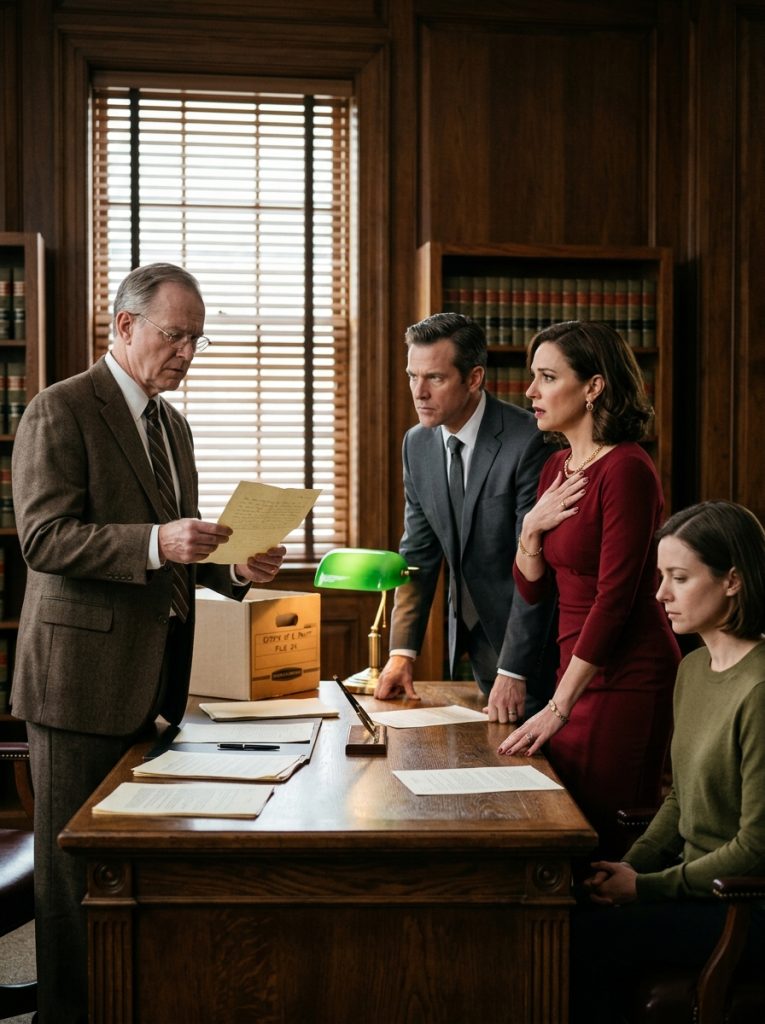
The first name my father’s letter said was Greg’s.
“‘To my son Gregory,'” Mr. Abernathy read, in that flat lawyer’s voice that makes every word weigh the same. “‘You called the house eleven times in the last four years of my life. I know because I kept the phone log. Nine of those calls, you asked about money. The other two were on Christmas, and you put me on speaker so the grandchildren could say hello before you hurried off.'”
Greg’s jaw worked. “This is— he was sick, he wasn’t himself—”
“‘I was entirely myself,'” Abernathy read, as if Dad had anticipated the interruption, which I think he had. “‘The cancer took my appetite and my hair. It did not take my memory.'”
Then came Vanessa.
“‘To my daughter Vanessa. You live forty minutes away. In four years you visited nine times, and you photographed seven of those visits. I always knew which visits would end up online, because those were the ones where you brought the good camera and stayed exactly long enough for the light to be nice.'”
Vanessa made a sound like she’d been slapped. The gold bracelets on her wrist had gone very still.
“‘I am not writing this to be cruel,'” the letter went on. “‘I am writing it because in a few minutes, you are all going to hear how I divided what I had, and I want you to understand that I divided it the same way you divided your time with me. Honestly. To scale.'”
I had stopped breathing somewhere around the phone log.
Because I knew what was coming, and I didn’t want it. I want to be clear about that. I never did any of it for this.
“‘To my daughter Hannah,'” Abernathy read, and his voice changed, just slightly, the way a voice does when it reaches the part that matters.
“‘You moved into the garage so I wouldn’t be alone. You learned to flush my port line so I wouldn’t have to go to the clinic at two in the morning. You memorized which nurses were kind. You held the basin. You drove forty-one round trips to the cancer center, and I counted, because counting was one of the few things I could still do from that passenger seat while you pretended not to notice me watching you.'”
Across the table, Vanessa whispered, “This isn’t fair.”
Abernathy didn’t pause.
“‘In the top drawer of my dresser is a logbook. Two hundred and forty-three entries, every one a day Hannah showed up. There are no entries for anyone else. Not because I was punishing you, Greg, Vanessa — but because love, it turns out, keeps its own honest record, whether or not you ever mean for it to be read aloud in a lawyer’s office.'”
Then Abernathy set down the letter and picked up the will.
Not the will my siblings expected. A newer one, signed fourteen months before Dad died, witnessed by two of his nurses.
The house in Marietta went to me. The land behind it — the acres Greg had already been talking to a developer about — went to me. Dad had named me executor. There was a trust, smaller than my siblings imagined because so much had gone to the care they never saw, and it, too, came to me.
To Greg and Vanessa, he left ten thousand dollars each “to be paid only after they have read this letter in full, which by the time you hear this, they will have.”
He’d made them sit through every word to collect a cent.
That was the most Dad thing I ever heard. Gentle and absolutely without mercy.
Greg threatened to contest it. He spent four months and a good deal of money on a lawyer who eventually told him what mine told me: a will witnessed by two clinical professionals who would testify the man was sharp as a tack is not a will you break. He dropped it. He doesn’t call anymore. I find I don’t miss the calls that were only ever about money.
Vanessa took it harder, in the way that vain people take the loss of an audience. She told the extended family I’d “manipulated a dying man.” For a while some of them believed her.
Then I did the only thing I knew how to do. I had Dad’s logbook scanned, and I mailed each of them a single page. Just a page. Forty-one round trips, in his shaky hand, with the little notes he’d added. “Hannah brought soup.” “Hannah stayed over.” “Hannah sang to me when the machine was loud.”
The whispering stopped.
I still live in the house. I turned the garage apartment into a room for my own daughter now. The logbook sits in the top drawer of the dresser, where Dad left it, and I have never added to it and never will, because it was only ever his.
Sometimes, on the bad-weather days when the chemo-center parking lot floods in my memory, I take it out and read a page.
Two hundred and forty-three days.
He was counting the whole time.
I just thought I was the one keeping him company.