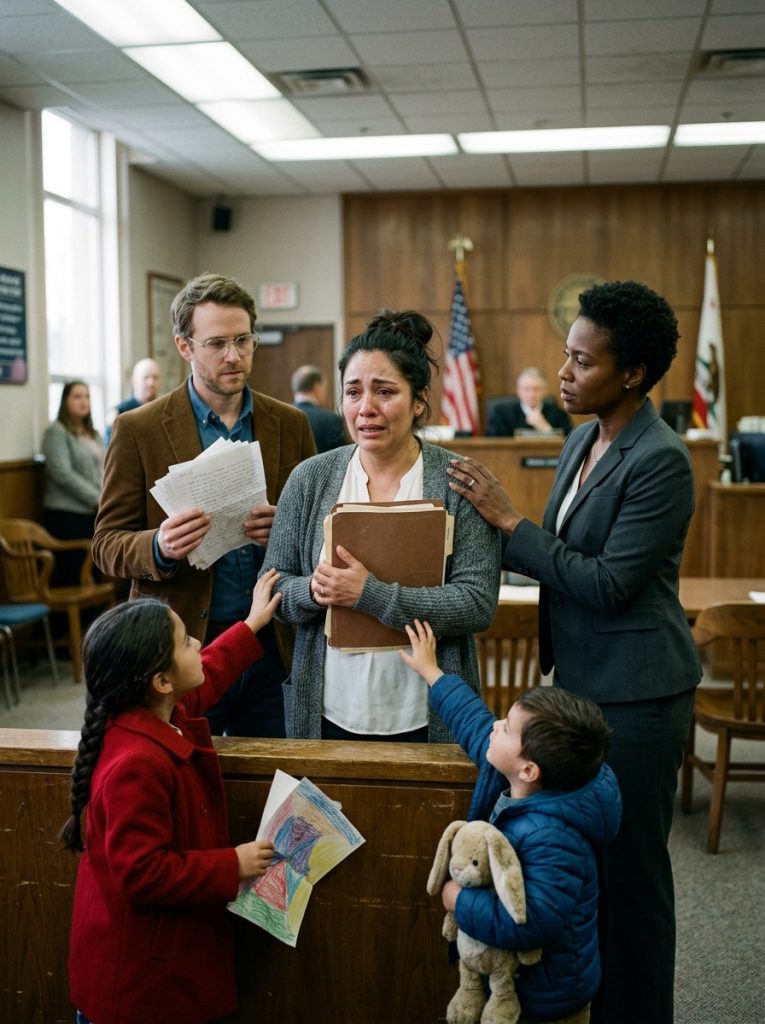
Dana laid the folder open on the little table and asked the hearing officer for ten minutes. She got them.
She started with a single sheet of paper: the flag itself. The record that had swallowed my life. And she read it out loud, slowly, line by line, the way you read something when you want everyone in the room to hear exactly how thin it is.
A name. A string of letters almost identical to mine. A case opened in a state I had never lived in, never visited, could prove I had never set foot in. A date of birth that was not mine — off by four years. A physical description that did not match the woman sitting at the table.
“The system matched my client to this record on the basis of a name,” Dana said. “Not a photograph. Not a fingerprint. Not a date of birth. A name, typed quickly, that happens to resemble another name. That is the entire basis on which a mother was separated from her children.”
Then she built the wall of who I actually am, brick by brick.
My lawful residency, eleven years of it, documented and dated. My employment — nine years cleaning rooms at the same hotel, the general manager’s signed letter confirming every one of them, my tax records lined up beside it. My lease. My utility bills. My daughter’s and son’s school enrollment, their pediatric records, their library cards. A whole life, paper-thin individually and unbreakable stacked together, every page saying the same thing: this woman has been exactly who she says she is, in exactly this place, the entire time.
And then she set down the letters.
Mr. Ellison’s stack. Dozens of them. He stood when Dana nodded to him, and he carried the bundle up himself, and he said, in the steady voice he must use to settle a room of nine-year-olds, “I’m Sofia’s teacher. These are from her classmates’ parents. From our neighbors. From the people Mrs. Santos has worked beside for nine years. We didn’t ask anyone to write them. We asked once if anyone wanted to, and this is what came back by the next morning.”
The hearing officer took them. I watched her read. Not all of them — there were too many — but more than she had to. She read for a while. The room was very quiet. Somewhere behind me, Mateo whispered to his rabbit.
When she looked up, something in her face had changed. She was not a villain, I understood then. She was a person inside a machine that had made an error and made it very hard to undo, and she had just been handed the lever.
I had spent the nights before this hearing rehearsing my own name and my own dates like a prayer, terrified no one would ever simply look at me and see a mother instead of a flag. Now someone was looking. Really looking. And I made myself sit very still, because I had learned that hope, let loose too early, can break you worse than despair.
She pulled it.
“This is a misidentification,” she said. “The record does not pertain to this individual. I’m clearing the flag, effective immediately, and noting in the file that the match was erroneous.” She looked at me directly. “Mrs. Santos, I’m sorry. This should not have happened, and it should not have taken this long to correct. You’re free to go. Your children’s placement is terminated as of right now.”
For a moment I couldn’t make the words mean anything. I had braced for those words so many times in my head, in so many versions that ended badly, that my body didn’t trust the good version when it finally came. Dana had to touch my arm. “Mariela,” she said softly. “It’s over. Go to them.”
I don’t remember standing up.
I remember the barrier — the low wooden rail that had stood between me and my children the entire hearing — and I remember Dana putting her hand on the small gate in it and swinging it open. And then Sofia was running, the drawing crushed in her fist, and Mateo was running, the rabbit dragging by one ear, and they hit me at the same time and I went down to my knees on the courtroom floor and held both of them and did not let go.
Sofia kept saying I knew it, I knew it, I knew you’d fix it. And I had to tell her the truth, even then, even in that moment, because she’s nine and she’s too smart for comfortable lies.
“I didn’t fix it, mija,” I whispered into her hair. “I couldn’t fix it alone. These people fixed it. Don’t ever forget that. When you’re grown and someone is trapped by a mistake nobody will admit — you be the person who carries the letters in.”
Here is the part I think about most, now that we’re home.
I did everything right, and it still happened. I want to be careful saying that, because I don’t want anyone to hear it as despair. But it’s the truth, and the truth is the only thing that got me out, so I won’t start lying now. I followed every rule. I kept every document. I have lived a careful, lawful, quiet life for eleven years. And a fast keystroke on a record that wasn’t mine still took my children, still took my dignity, still took days of my life I will never get back — Mateo’s lost tooth, Sofia’s spelling test, the ordinary mornings that are the whole substance of a family.
The system did not save me. People saved me. A lawyer who works for free because she decided long ago that this exact kind of cruelty was the thing she’d spend her life fighting. A teacher who didn’t have to do a single thing, who has thirty children and his own family and every reason to stay in his lane, and who instead spent his evenings collecting the words of strangers and carrying them into a government room because he believed a child needed her mother.
That’s the part that breaks me open, even now. Not the officer’s apology. Not the cleared flag. The letters.
Dozens of people I had cleaned up after, lived beside, stood next to at school pickup, sat down and wrote, in their own words, We know this woman. We know who she is. That stack existed because over eleven quiet years I had, without ever meaning to, become known. Become part of a place. And when the machine tried to erase me, the place I belonged to wrote me back into existence.
We are home now. The kitchen smells like dinner again. Mateo sleeps with the rabbit and Sofia has pinned her drawing — the one she clutched through the whole hearing — to the refrigerator, where I see it every morning. It’s a picture of the four of us, except there are only three of us, and she drew a fourth figure anyway and labeled it with Dana’s name. The lawyer. Family now.
I keep the folder too. The worn one, with all the paper that proved I was me. I don’t need it anymore; the flag is gone, the file corrected, the apology in writing. But I keep it by the door, packed and ready, and I hope I never reach for it again.
People ask if I’m angry. I was. For a while, the anger was the only thing standing me upright.
But anger is heavy, and I have two children to carry, and I’ve decided to spend my strength on something else.
So I write letters now. When I hear about someone trapped the way I was — a wrong name, a frozen file, a family pulled apart by a mistake no one will sign their name to undoing — I sit down at my kitchen table, under Sofia’s drawing, and I write. We know this person. We know who they are.
Because a teacher once taught me that a stack of those, carried into the right room by someone who refuses to look away, is the strongest thing in the world.
It brought my children home. It can bring someone else’s home too.