Here is what the guests could not see from their white folding chairs.
Trent did not run because of cold feet. He ran because, ninety seconds before the ceremony, his own attorney called him in a panic, and the message that reached him in the holding room was the last thing he expected.
The deal was dead. All of it.
The morning of the wedding, my father had quietly restructured the company. The shares Trent planned to maneuver his way into no longer existed in the form he was counting on; they had been moved into a family trust that a spouse could never touch, signed and notarized two days earlier with our attorney as witness. The prenup Trent had skimmed and signed without a real lawyer, certain it didn’t matter because he planned to control everything anyway, turned out to matter enormously.
And the email. His clean confident email to his lawyer, the one laying out the whole plan.
I had a copy. So did my father. So, as of that morning, did Trent’s own attorney, who wanted no part of what he was now looking at and told Trent so in the parking lot by phone.
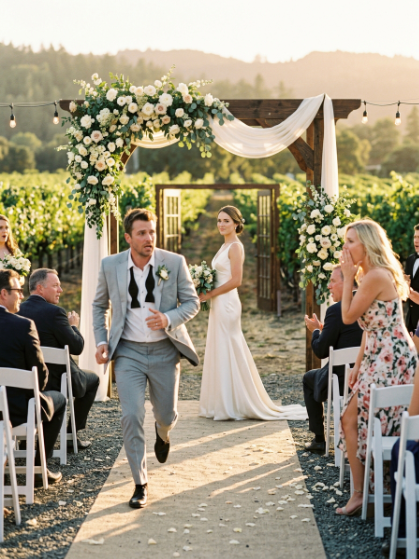
Trent realized, standing at the altar in his gray tuxedo, that he had walked into a marriage with nothing to gain and a paper trail that could ruin him.
So he ran. Not from love. From a losing hand.
I let him get halfway down the aisle.
Then I lifted the microphone the officiant had set down, and I spoke into the stunned, golden silence.
“Don’t worry, everyone,” I said. “He’s not nervous. He just read the prenup.”
A ripple went through the vineyard. Confused laughter, then not laughter.
“Trent,” I called after him, and he stopped at the open doors like a man who’d hit glass. “You forgot your copy.”
My maid of honor, on cue, walked down the aisle and handed him a manila envelope.
Inside was a printout of his own email. Stapled to it, a letter from our attorney terminating any claim he believed he had. And a check, from me, for exactly the amount he’d spent on the engagement ring, with a note: We’re square. We were never anything else.
He didn’t open it in front of everyone. He wasn’t brave enough for that. He shoved it under his arm and walked to his car, and the guests who had pitied me an hour earlier watched him go with very different faces.
My father stood up from the front row then. Seventy years old, hands that built a company from one truck, and he was shaking, but not from weakness.
“I want to thank you all for coming,” he said, taking the mic from me gently. “There’s no wedding today. But the food is paid for, the band is here, and my daughter is the smartest person I know. So this is a party now. Dance with us.”
And we did.
I peeled off the veil, kept the gown, and danced barefoot in the grass with the people who actually loved me until the string lights came on.
The fallout came in the weeks after, quiet and complete.
Trent’s “consulting firm,” I learned, ran the same play on midsize family businesses up and down the coast. Marry in, restructure, push out. I was supposed to be number four. My father’s attorney passed what we had to a contact at the state level, and Trent’s name now sits in a file with three other families who had not been as lucky as us, who had not found the email two weeks early.
He did not go to prison. It is hard to prosecute a charming man for a plan he never finished. But the families compared notes, the story traveled in the small world of regional business, and the door he walked through so easily for years is closed now. People take his calls and then they don’t.
Me? I am still my father’s daughter, and one day his company will be mine, and it will be mine because I learned the most important thing he ever taught me, in a diner booth two weeks before a wedding that never happened.
“Vivian,” he’d said, sliding the contracts across the table. “Anybody can love you on a good day. Watch what they do when they think you’re not watching.”
I watched.
People still bring up that wedding sometimes. The runaway groom. The jilted bride who didn’t cry.
I let them. I never correct the parts they get wrong.
The only thing I keep, from the whole day, is a photo someone snapped without my knowing: me at the altar, dry-eyed, half-smiling, while a man in gray sprints for the door behind me.
I framed it.
Some people think it’s a picture of the moment I lost.
I know exactly which one of us won.