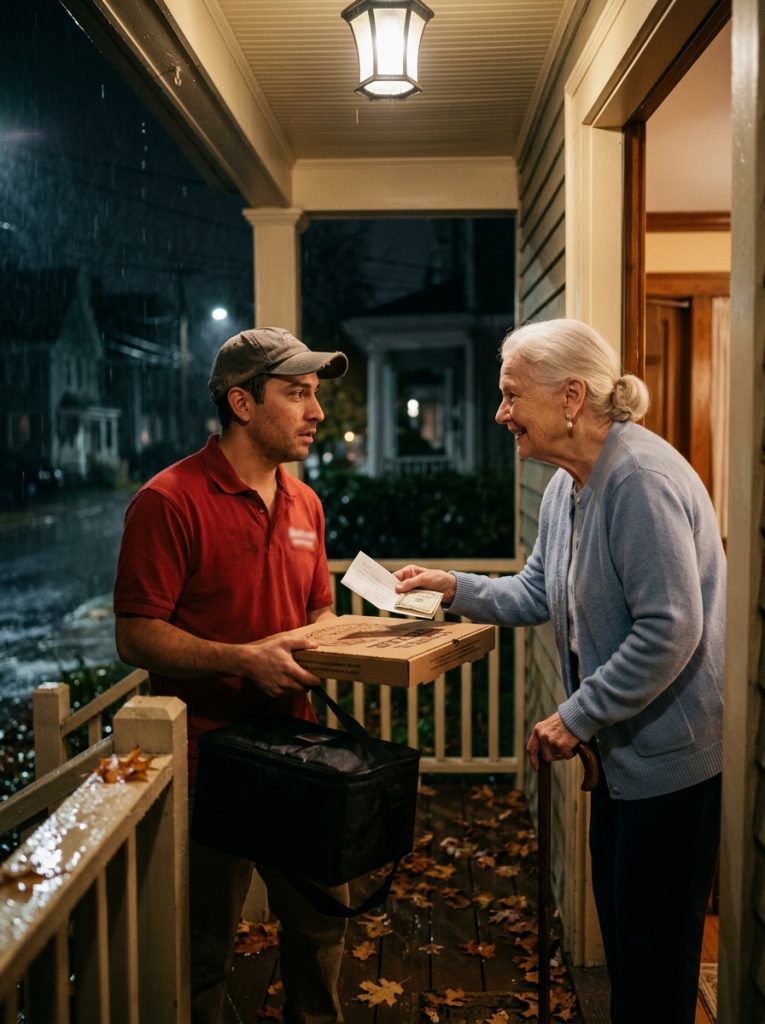
The note was written in careful, old-fashioned cursive, the kind they don’t teach anymore.
It said: “A cook who is kind when he’s tired is the only kind worth betting on. Don’t hand in that apron. Call this number Monday and tell them Eleanor sent you. — E.B.”
Below it was a phone number. And below the number, a name I knew. A name printed on the side of a building downtown. A name on the awning of the restaurant where, two years earlier, I’d stood on the sidewalk in the rain reading the menu I couldn’t afford, telling myself that someday I’d cook in a place like that.
Brandt’s.
Everyone in Providence knew Brandt’s. It had been the city’s restaurant for forty years — the place you went for your anniversary, your graduation, the night you got the job. The chef who built it had passed away that spring; the whole city had felt it. There’d been a line out the door for the memorial.
His name was Walter Brandt.
His widow’s name was Eleanor Brandt.
I had just delivered a large pizza to the woman who, with her late husband, had built the restaurant I’d dreamed about from the sidewalk. And she’d watched me drip rainwater on her doorstep, tell her I was quitting, and call myself nothing but the pizza guy — and she’d handed me a note instead of letting me believe it.
I sat in that rattling car and cried, and I am not embarrassed to tell you that.
I did not call on Monday. I called Saturday morning, because I couldn’t wait, and I figured if it was a mistake I’d rather know fast.
It wasn’t a mistake.
The number was the office of the Walter Brandt Culinary Foundation. Eleanor had started it after he died — a scholarship and apprenticeship program for kids who wanted to cook and couldn’t afford the door. The woman who answered already knew my name. “Oh, you’re Eleanor’s pizza boy,” she said, warm as anything. “She called us first thing this morning. She doesn’t do that for just anyone. When can you come in?”
Here is what I learned later, in pieces, over many dinners at Eleanor’s kitchen table.
That night hadn’t been random. Not entirely. Eleanor was lonely, yes, and grieving, and a large pizza was easier than cooking for one in a kitchen that still felt like her husband’s. But she’d also spent forty years beside a man who hired on instinct, who used to say you can teach knife skills and you can teach recipes but you cannot teach whether a person is decent when nobody’s watching and they’re exhausted and the night’s gone wrong. Walter had hired half his best people off the street, out of other kitchens, out of bad luck. He looked for the tired and the kind.
Eleanor had been watching for that her whole married life. It was habit. So when a soaked young man stood in her doorway, didn’t rush a slow old woman fumbling for her purse, sat down when she asked even though he clearly wanted to bolt, and told her the truth about giving up — she saw exactly what her husband would have seen.
“You passed a test you didn’t know you were taking,” she told me once, with that crinkled smile. “Those are the only real ones. Anybody can be kind for an audience. Walter only ever cared what you did when you thought it didn’t count.”
I started in the foundation’s apprenticeship that next month.
The first time I walked into Eleanor’s house in daylight, I finally saw what I’d missed in the rain. The wall of photographs wasn’t just a widow’s keepsakes. It was forty years of a restaurant — Walter in chef’s whites behind a line, Walter shaking hands with people whose faces I recognized from the news, Walter and a young cook who I realized, with a jolt, had gone on to open three of his own places. Half the chefs in the city had come through that kitchen. And in nearly every photo, in the corner, at the register, behind the host stand, was Eleanor. She’d run the front of the house for four decades. She didn’t just marry a great cook. She built the place with him, brick by brick and night by night.
“People think I’m a sweet old lady who funds a scholarship,” she told me, catching me staring at the photos. “I ran payroll for two hundred employees and fired more line cooks than you’ve met in your life. Don’t mistake kind for soft, sweetheart. The best people are both. Walter was both.” She tapped the frame. “So are you, or you wouldn’t be standing in my kitchen.”
I want to be careful here, because the easy version of this story is that a rich widow waved a wand and made me a chef. That’s not what happened, and Eleanor would be the first to swat me for telling it that way.
What happened is that I got a door. Just a door. The scholarship covered the tuition I could never have scraped together — the same program I’d been accepted to and forced to walk away from. The apprenticeship put me in a real kitchen four nights a week under people who’d trained under Walter himself. Nobody handed me anything past the threshold. I burned things. I got yelled at. I cried in a walk-in cooler more than once. I worked harder than I’d ever worked at anything, because for the first time the work could actually go somewhere, and that turns out to be the difference between exhausting and unbearable.
The thing I’d been missing wasn’t talent. Eleanor was blunt about that too. “You always had the hands,” she said. “What you didn’t have was a single person willing to bet on you.” She paused. “Everybody needs the one. Walter was mine. I get to be other people’s now. It’s the best thing I do.”
I didn’t hand in the apron. I framed Eleanor’s note instead. It hangs in my apartment where I see it every morning: Don’t hand in that apron.
That was three years ago.
I graduated the program. I work the line at a restaurant downtown now — not Brandt’s, which closed for good after Walter died, but a new place a few blocks over, run by one of his old proteges. I’m a sous chef. Next year, if I keep my head down and my standards up, I’ll be running a kitchen of my own. I mentor two apprentices from the foundation, both of them kids who got a door the way I did, and I watch them like Walter watched, like Eleanor taught me — not for whether they’re brilliant, but for whether they’re decent when they’re tired and the night’s gone wrong.
The first apprentice I mentored reminded me so much of myself that first week that it hurt. He showed up convinced he didn’t belong, certain someone was about to realize they’d made a mistake letting him in. I told him what I wish someone had told me at twenty-four: that the doubt never fully leaves, you just stop letting it drive. He runs the brunch line now.
Eleanor is eighty-three now. I cook for her every Sunday. Real food, in her husband’s kitchen, in the second place at the table she used to set out of habit and now sets for me. She’s slower than she was that rainy night, and she falls asleep in her chair sometimes before dessert, and I clean up quietly and let her sleep and let myself in to check on her midweek.
She likes to remind me that she only ordered a pizza because she didn’t feel like cooking. As if the whole thing were an accident. As if she didn’t change a stranger’s entire life with a folded note and a tip.
But I know what I know. I was done that night. Apron as good as turned in, dream as good as buried, on my way to a warehouse job and a smaller life I’d talked myself into calling realistic.
A lonely widow at the end of a dark street looked at the most discouraged version of me and bet on it anyway.
They called me just the pizza guy. For one night, that’s all I thought I was, too.
Turns out the last delivery before you give up is sometimes the most important one you’ll ever make. You just can’t know which door it’ll be.
So be kind when you’re tired. Especially then. You never know who’s watching from the doorway — or what they’re about to hand you.