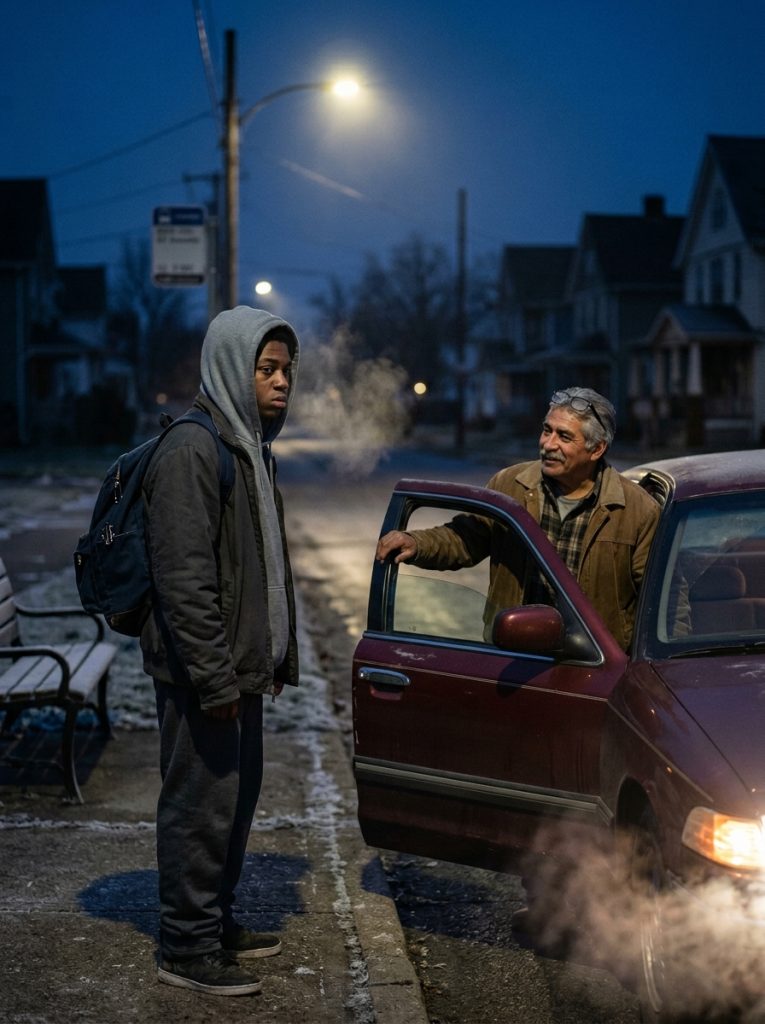
For two weeks, Frank just drove me.
Every morning before the sun, the old sedan was warm and waiting, coffee in the cup holder, a breakfast sandwich on the dash. We didn’t talk much at first. He’d put on a baseball game from some city neither of us lived in and let the announcers fill the quiet. We’d park across from Nia’s school and I’d watch her at the fence until the bell, and then he’d drive me to my own school, and neither of us called it anything.
Then one morning Nia saw the car.
She’d seen me at the fence plenty of times. But this time there was a man beside me, and a whole car, and she got this look — scared and hopeful at the same time, the look kids in the system get when something changes and they don’t know yet if it’s the good kind of change or the kind that takes something away.
Frank rolled down the window. He didn’t get out. He just lifted one hand, a small wave, and called across the street, “Your brother talks about you nonstop, you know. Says you’re the smart one.” And Nia laughed — I hadn’t heard her laugh in months — and the bell rang and she ran inside still smiling.
That afternoon, Frank said, “Okay. This isn’t enough. You watching her through a fence isn’t a life. Let me make some calls.”
I told him not to bother. I told him the system doesn’t work like that, that I’d already tried, that every time I started the paperwork they moved me and the clock reset. I told him the word they’d written in my file. Runner. I told him people stop trying once they read it.
Frank looked at me for a long moment. Then he said, “I’m fifty-eight years old. I buried my wife two years ago. I have got nothing but time and nothing left to be scared of. Watch me bother.”
He told me about his wife that night, over the worst spaghetti I’ve ever eaten. Her name was Marie. They’d never been able to have kids of their own, and they’d talked for years about fostering and always found a reason to wait — money, the house, next year. Then Marie got sick, and then Marie was gone, and Frank was alone in a house with a spare room and forty years of waiting for the right time. “I signed up the month after the funeral,” he said. “Marie would’ve smacked me for waiting so long. I wasn’t taking a kid to fix my grief. I took a kid because we always meant to, and I ran out of laters.” He pointed his fork at me. “You were my first placement. I got real lucky.”
I didn’t know what to do with that, so I ate the terrible spaghetti and didn’t say anything. But something in me unclenched a notch that night that hadn’t unclenched in two years.
Here’s what I didn’t know about Frank.
Before he retired, he spent thirty years as a union steward at the plant. Which means he spent thirty years sitting across tables from people who wanted to say no, and not leaving until they said yes. The man knew how to file a thing. He knew how to ask for the supervisor’s supervisor. He knew how to write a sentence that made a bureaucrat nervous.
He called my caseworker. When she gave him the runaround, he called her boss. He requested my full case file in writing, and he actually read all of it, every page, which I’m not sure anyone ever had. He found the part where it said “exhibits attachment-seeking behavior toward biological sibling” and he made them sit with what that sentence actually meant — that the boy they called a runner had never once been running away from anything. He was running toward his little sister. Every single time.
He demanded a meeting. Not a phone call. A meeting, in a room, with everyone who had a say.
I was there for part of it. I watched Frank Delgado, in his good flannel, lay it out for a table of tired county people. He said the State had taken two kids whose mother was gone and split them across a city and then labeled the older one defiant for refusing to disappear. He said he had a home, a clean record, a spare room, and he was prepared to be licensed for both of us. He said — and this is the part that got me — “You wrote ‘does not bond’ in this boy’s file. He’s spent two years riding two buses before dawn to protect the bond you said he doesn’t have. Read your own paperwork.”
The room was quiet for a while after that.
It didn’t happen overnight. I won’t pretend it did. There were home studies and background checks and a licensing class Frank took on Tuesday nights, and a transition plan with steps and dates, and a stretch where I was sure it would fall through like everything always had.
There was one week it nearly did. A supervisor I’d never met flagged my file — the runner label, the placement history — and recommended against putting “a flight-risk teen” in a home with a younger child. Just like that, on paper, by a person who had never met either of us, it was almost over. I remember reading the email over Frank’s shoulder and feeling the old floor drop out from under me. This is how it always goes, I thought. This is the part where they move me again.
Frank didn’t yell. He got very calm, which I’d learn was scarier. He wrote back and asked one question: how many times, in two years of being labeled a runner, had I ever actually run away from a placement to avoid responsibility — versus how many times had I traveled, on public transit, to check on a sibling the State itself had separated me from. He asked them to count. He asked them to put the number in writing. They couldn’t, because the honest number was zero and zero, and a label fell apart the second somebody made them do the math. The recommendation got reversed the following week.
But Nia’s foster family — the nice one across town — turned out to be exactly as kind as everyone said. When they understood the whole picture, they didn’t fight it. They cried, actually. They’d loved Nia. But they said a sister belongs with her brother, and they helped. They still send her birthday cards. They came to the thing at the end.
Because there was a thing at the end.
On a Thursday in March, in a courtroom that smelled like floor wax, a judge made it official. Frank Delgado, licensed kinship-style foster parent, placement of both minor children, together, in one home.
Nia and I share a bathroom now and fight about it like normal people. She has the room with the window. I taught her to make Frank’s terrible coffee the way he likes it. Frank put a basketball hoop over the garage and pretends his knees still work well enough to play.
I need to be honest about the part that doesn’t get fixed, because the people who really get it will know I’m not lying to make it pretty.
Our mom is still gone. Frank isn’t her and never tried to be. There are nights Nia cries for her and there’s nothing a basketball hoop or a window room can do about that, and Frank just sits in the hallway outside her door the way he told me he used to sit outside mine, listening to us breathe, making sure we know somebody’s there.
We lost years we don’t get back. The fence, the two buses, the cold mornings — that was time nobody had to steal from us, and they stole it anyway.
But last Sunday I came downstairs and Nia was at the kitchen table doing homework, and Frank was reading the paper, and the radio was on, and nobody was anywhere they had to leave before dawn.
I stood on the stairs for a second and just looked at it. The thing I rode two buses for, two years, sitting at our own table like it had been there all along.
Then Nia yelled at me to hurry up and pour the coffee, and I did.