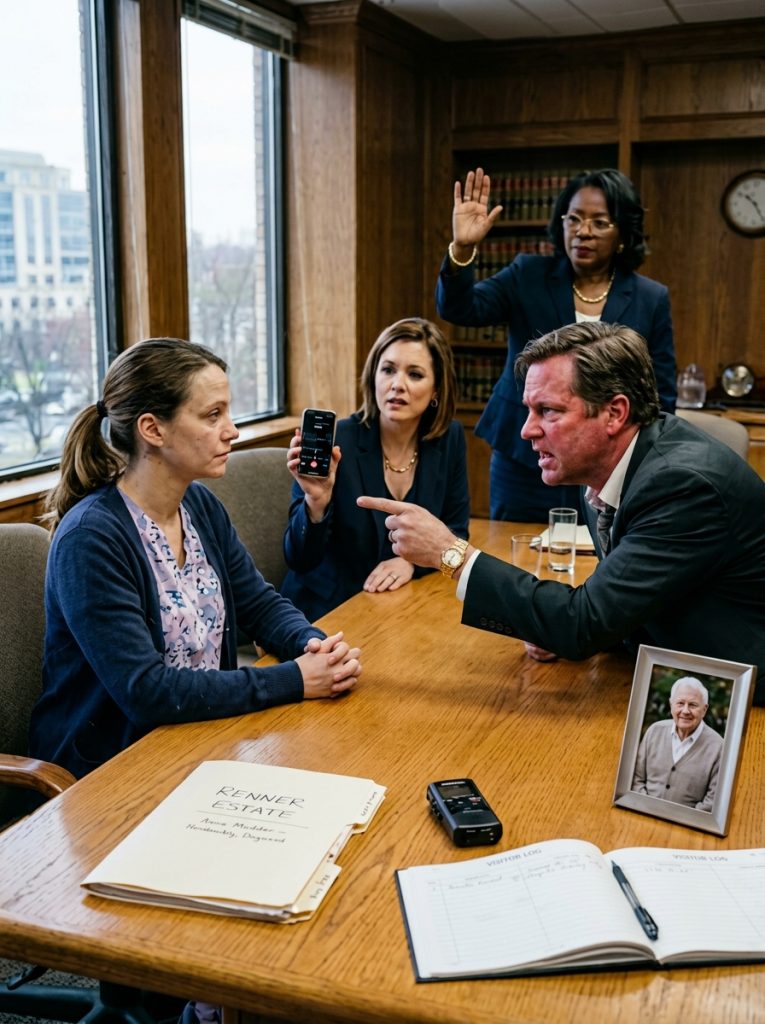
Albert’s voice filled that wood-paneled room, thin and dry and unmistakably him, and I felt my eyes sting before he’d finished the first sentence.
“If you’re hearing this,” the recording said, “then I’m gone, and Diane has done what I asked, and the vultures have shown up right on schedule.”
Greg’s mouth opened. Diane Okafor lifted one finger and he closed it.
“Greg. Paula. I’m going to guess you’re both there. I’m going to guess neither of you came to see me even once after I made this. Let’s find out.”
Diane set the dog-eared visitor logbook on the table and opened it to a ribbon she’d placed.
“Fourteen months of sign-ins from Magnolia Grove,” she said. “Every visitor logs a name, a date, a time. I’ve had it certified. Mr. Renner has two visitors recorded in the final fourteen months of his life. One is a man from his old union local who came twice. The other is Annie Maddox, whose name appears on nearly every page.”
She turned the book toward Greg and Paula. “Yours does not appear at all.”
“He was confused,” Paula started. “We called—”
“The facility logs calls too,” Diane said mildly. “There are three from this number across fourteen months. Two were under ninety seconds. One asked the front desk to confirm Mr. Renner’s assets had not changed.”
The recording was still running. Albert wasn’t finished with them.
“You only ever called when you smelled money,” his voice said. “Your mother — God rest her, Greg, she was my only sister — she’d be ashamed of how you turned out, and I told her so before she passed. You let me sit in a room with a view of a parking lot for over a year, and now you’ve put on a suit to fight over what’s in it. So let me save us all the lawyer bills.”
I want you to understand I had no idea any of this was coming. I’d nursed Albert. I’d played gin rummy and let him cheat. I did not know he’d recorded anything. When the lawyer’s office called me, I genuinely thought there’d been a clerical mistake. I was bracing to politely decline whatever small thing he’d left me, a watch maybe, and go home.
“Annie,” the recording said, and my own name in his voice nearly undid me. “You’re there too, I hope. I’m sorry. I know you didn’t want any of this, which is exactly why you’re the only one I trust with it.”
There was a pause on the tape, the sound of him gathering breath the way he did near the end.
“You sat with me when nobody was paying you to. You brought your own quilt because the laundry kept thinning mine. You told me Ruth’s name back to me on the days I couldn’t find it. You think nobody noticed because nobody important was watching. I was watching. I was the only one left, and I was watching, and I am not going to let the last thing I do on this earth be handing my Ruth’s money to people who couldn’t be bothered to learn which window was mine.”
Diane pressed stop.
“Here is the substance of the estate,” she said, sliding a single page across the table. “Mr. Renner’s assets — the house, the savings, the proceeds of a life-insurance policy his late wife maintained — total a little over one point four million dollars.”
Greg actually leaned forward. I watched something hungry cross his face, even then.
“All of it,” Diane continued, “is placed in a charitable trust. The Ruth Renner Fund, named for his late wife. The fund exists to provide companionship and end-of-life care for hospice patients who have no family — sitters, visitors, music, a hand to hold at three in the morning. The exact things, Mr. Renner’s instructions specify, ‘that Annie gave me for free because no one had the decency to.'”
The room was very quiet.
“Annie Maddox is named as the trust’s administrator,” Diane said. “She draws no inheritance. She receives a modest, capped stipend for the work of running the fund — less than her nursing salary, frankly — and not one dollar of the principal goes to her personally. She cannot inherit it. That was Mr. Renner’s specific design, so that no one could ever say what you came here today to say.”
I sat very still. Because I finally understood what the old man had done.
He hadn’t left me money. He’d left me his trust. The kind you can’t deposit. He’d built the whole thing so that the accusation waiting in Greg’s mouth would have nowhere to land.
Greg’s lawyer leaned over and whispered to him for a while. I watched the math happen on Greg’s face — the cost of contesting an airtight, attorney-drafted, recorded, witnessed trust, against the zero dollars he’d personally walk away with even if he somehow won.
“This is absurd,” he said, but the fight had gone out of it. “A nurse. Running a million-dollar fund.”
“A nurse he watched run a clipboard, a med schedule, and a dying man’s last year without dropping a single thing,” Diane said. “He thought she could handle a budget. I’m inclined to agree.”
Paula stopped recording on her phone. I noticed that. The grief documentary had no more use for footage.
They didn’t contest it. Their own lawyer, I suspect, told them what I could see plainly — that there was nothing to win, that a recorded voice and a certified logbook would flatten them in front of any judge, and that the only thing a fight would buy them was a public record of exactly how absent they’d been.
They left without saying goodbye to me. Greg paused at the door like he might say something. He didn’t. The gold watch slid down his wrist as he pulled it open, and then they were gone, and the room felt cleaner for it.
Diane and I sat a moment in the quiet.
“He talked about you constantly,” she told me. “Every time he came in to update the documents. ‘My nurse cheats worse at gin than I do.’ He was trying to make me laugh so I wouldn’t see how scared he was.”
“He cheated terribly,” I said, and then I cried, finally, the way I hadn’t let myself at his bedside.
That was two years ago.
The Ruth Renner Fund is real, and it is busy. We have eleven trained companion volunteers now, and a part-time coordinator, and a little fund within the fund that just buys lemon cake for patients on their birthdays, because Albert insisted, from beyond the grave, that “everybody should get cake.”
I still work my nursing shifts. I run the trust on my own time, mostly, the way Albert ran his whole stubborn life — quietly, and for other people.
We’ve sat with sixty-three patients who would otherwise have died alone. Sixty-three hands held at three in the morning. I keep their names in a book, the way Magnolia Grove keeps its visitor log, except mine is a record of people who showed up instead of people who didn’t.
There was a woman last winter — Doreen, ninety, sharp as a tack and just as alone as Albert had been. One of our volunteers, a retired schoolteacher, came every Thursday and read her the racing form because Doreen liked to pick horses she’d never bet on. When Doreen passed, the volunteer was holding her hand and a list of long-shot winners was taped to the rail. Nobody in this world had to do that. The fund made it possible. Albert made it possible.
That’s the math the will reading was really about. Not one point four million. Sixty-three people who didn’t die in a quiet room with a view of a parking lot.
Greg and Paula, last I heard, told relatives I’d “stolen” from their uncle. Let them. The logbook says what it says. The recording says what it says. I sleep fine.
People ask me if it stings, being called a gold-digger in a room full of lawyers, for the crime of being kind to a lonely old man.
Not really. Because here’s what those two never understood, sitting there in their good clothes, hungry for a number on a page.
Albert didn’t leave his fortune to the people who shared his blood. He left it to the people who’ll sit with strangers in the dark.
And every time I hold one of those hands, the old man wins the argument all over again.