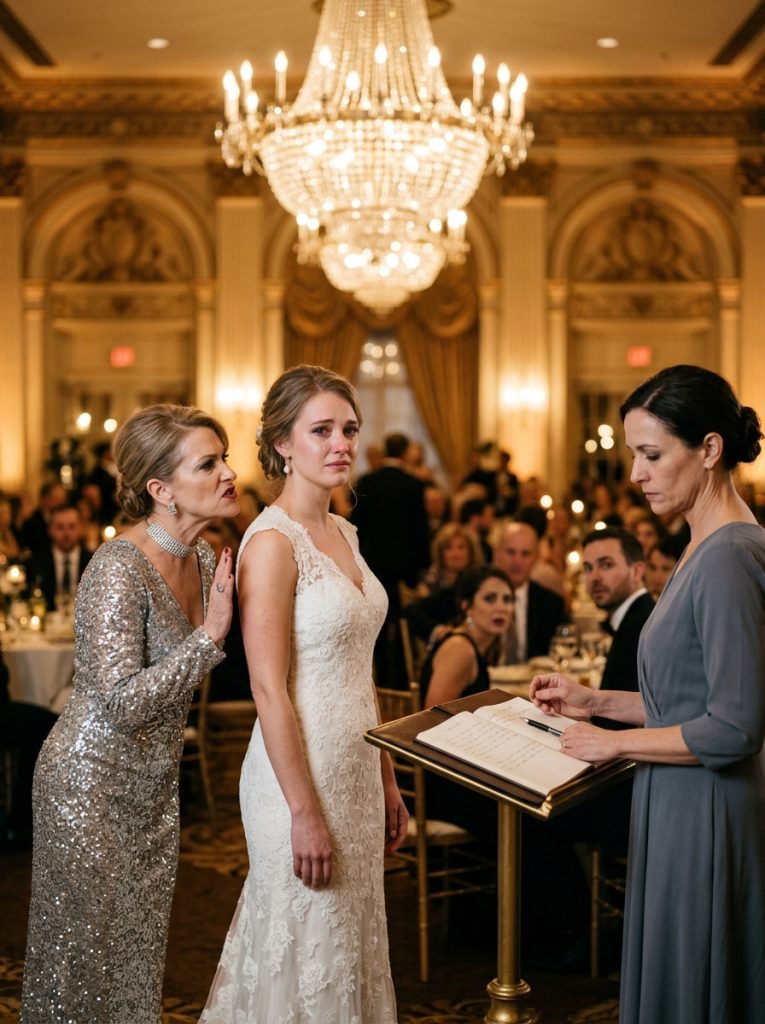
What Harlow Beck told me on the phone, the morning after my wedding, took the floor out from under me a second time.
She wasn’t a jilted ex. She was Trent’s wife. Still. Legally. They’d married six years earlier in Clay County, and when she’d finally left him, he’d promised to “handle the divorce.” He never filed it. She’d assumed for years that he had — until a mutual acquaintance mentioned, casually, that Trent Marlowe was getting remarried at the Ardenne to a young woman who’d just inherited her grandmother’s house.
“That’s when I understood,” Harlow said. “He doesn’t divorce us, Adeline. He just adds. And he only ever proposes right after a woman comes into property.”
My grandmother’s little house. The one I’d inherited three months before Trent proposed.
I sat down on the bathroom floor in my hotel robe.
“He’s going to ask you to put the house in both names,” Harlow said. “Or to sign something ‘for the mortgage.’ He moved on mine within the first month. Whatever he gives you to sign — don’t. Not yet. Because right now, the most powerful fact in your life is one he doesn’t know you have.” Her voice was steady, a woman who’d had years to think about it. “He’s already married. Which means whatever you signed at that altar last night isn’t a marriage at all.”
Right on cue, Trent knocked on the bathroom door, all honeymoon sweetness.
“Morning, Mrs. Marlowe,” he called. “Got us a brunch with Mom at eleven. And I figured after, we’d swing by and get your name and mine sorted on the house deed. Romantic, right? Make it really ours.”
There it was. Less than twelve hours married, and the deed was already on his calendar.
“Sounds perfect,” I called back, in a voice I didn’t know I had.
Then I texted Harlow four words: I’m in. Tell me everything.
We spent that week building it quietly.
Harlow had kept her own marriage certificate from Clay County. We requested a certified copy of the record — proof, stamped and official, that on the day Trent married me, he was already legally bound to her. A paralegal friend of Harlow’s confirmed the divorce had never been filed in any county in the state. The marriage license Trent and I had signed wasn’t worth the paper it was printed on.
Which meant the house was never going to become “ours.”
It had always, only, been mine.
I played the blissful bride for six more days. I let Vivian condescend to me over brunch. I let Trent talk about “our future.” I smiled and deflected every document he slid my way — “after the thank-you cards, baby, my head’s spinning” — and I watched him grow the tiniest bit impatient, because men like Trent run on a schedule, and I was, very politely, refusing to keep it.
And I did one more thing.
I called Trent’s mother and asked, sweetly, if she’d help me plan a little one-week-anniversary dinner. Family only. At the Ardenne, the same private room. “Trent’s so sentimental,” I said. “I want to surprise him.”
Vivian, who loved nothing more than a Marlowe occasion, said yes.
She helped me set the stage for the night everything came apart.
One week to the day after the wedding, we gathered in that same private room at the Ardenne, under a smaller version of the same gold light.
Just family. Trent. Vivian in another sequined gown. A few aunts and the brother-in-law who’d MC’d the reception. The people who’d watched me get called a gold-digger and said nothing.
Trent stood to toast “one perfect week.” Vivian beamed.
“Actually,” I said, rising before he could finish, “I’d like to say something first. I’ve been so welcomed into this family. So I invited one more guest tonight — someone who knows Trent better than anyone.”
The door opened, and Harlow Beck walked in.
Vivian’s face curdled. She knew her. Of course she knew her.
“Most of you have never met Harlow,” I said pleasantly. “She’s the woman who signed our guest book last week, the one your son told me was ‘an unstable ex.’ She’s actually his wife. They married in Clay County six years ago. He never divorced her.”
The room went dead silent.
“That’s a lie,” Trent said, but his face had already betrayed him, and his mother — his mother didn’t look surprised. That was the detail I’d been watching for. Vivian Marlowe didn’t gasp. She just went very still, the way you do when a secret you’ve been managing finally slips the leash.
“You knew,” I said to her. “You called me a gold-digger to two hundred people while you helped your son commit bigamy to get at my house. That’s quite a performance, Vivian.”
I set the certified copy of the Clay County marriage record on the table. Then Harlow set down hers. Two documents, stamped and official, naming the same man, never dissolved.
“Whatever I signed at that altar,” I said, “isn’t a marriage. There’s a word for what it is, and Trent knows it, because he’s done it before.”
It was the brother-in-law — the one who’d MC’d, who’d laughed the loudest at Vivian’s toast — who stood up and quietly moved his chair away from Trent’s side of the table.
One by one, the aunts followed. The same room that had turned toward me with smirks a week earlier turned toward Trent now, and there was no champagne sparkle in it this time. Only the cold arithmetic of a family realizing exactly what its golden son was.
Trent tried every register. Charm. Denial. Then anger — “You ungrateful little—” cut off when his own aunt said, “Sit down, Trent.”
He sat down. The performance was over, and he had no second act.
The legal part was almost anticlimactic after that.
Because the marriage was void from the start, there was nothing to divorce — and nothing of mine for him to claim. My grandmother’s house was never at risk; a bigamous marriage transfers nothing. My attorney made sure the void marriage was formally annulled and the record clean. And the certified proof that Trent had knowingly married two women became exactly the kind of fact that draws the attention of a county prosecutor. Harlow and I told the truth, with documents, to the people whose job it is to care about that truth. The rest moved out of our hands and into the system’s.
Trent Marlowe is not charming his way down another aisle anytime soon.
Harlow and I are friends now — the kind forged by surviving the same man. She told me she’d spent years feeling like a fool for not filing the divorce herself, for trusting his word. “You’re not a fool,” I told her. “You’re the reason I got one week of marriage instead of a lifetime of signing things. You drove to a stranger’s wedding to warn her. That’s the bravest thing I’ve ever seen.”
I kept the house.
I kept my name — my own name, Adeline Cross, which I never legally changed and now never will.
And I framed one page from that leather guest book. Not the page where two hundred guests wished us well. The last entry, in a stranger’s steady hand: I’m not here to ruin your night. I’m here to save your life.
It hangs in my grandmother’s front hall, in the house that was always, only, mine — where a woman once called a gold-digger lives free and clear, and pours coffee for the one guest who came to that ballroom not to celebrate a lie, but to rescue me from it.