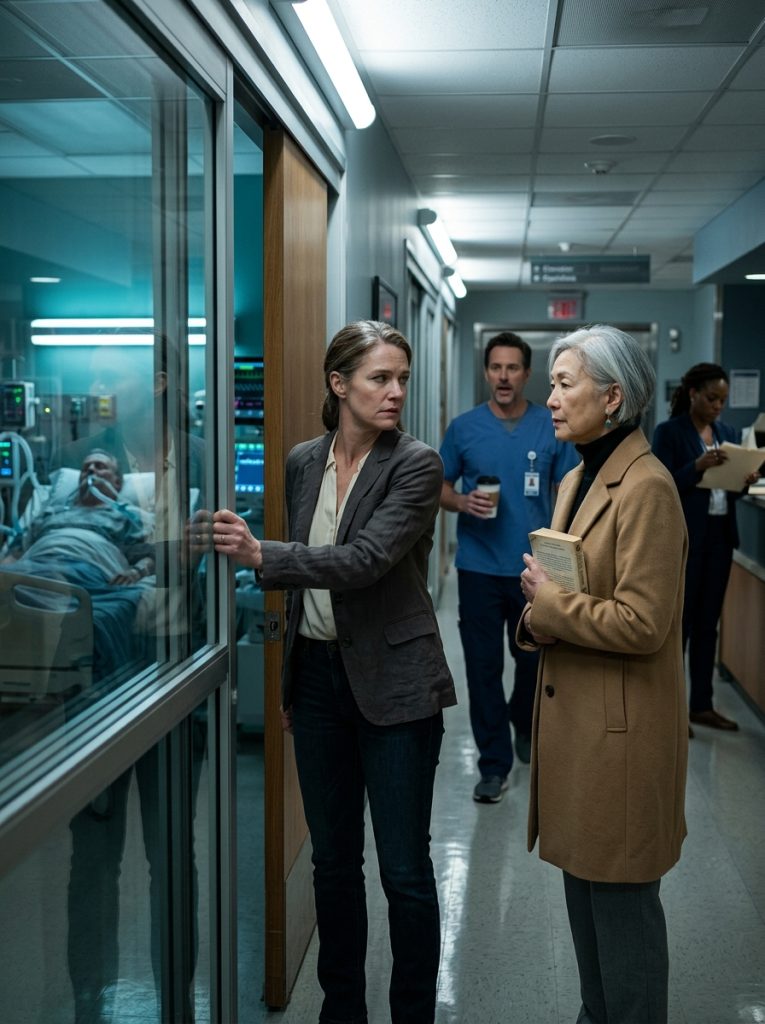
Margery did not flinch when I sat down across from her.
She had spent nine hours preparing herself to be told no a second time. She set the paperback face-down on the cushion beside her. She placed her hands in her lap, the way I imagine she had placed them in a hundred client meetings before she had retired.
She said, “What would you like to know.”
I said, “Everything.”
She told me.
She had met my father at a community-orchestra fundraiser at the Seattle Asian Art Museum in October of 2014. He had been wearing a tie my mother had given him. She had complimented it because she did not know my mother had given it to him. She had taken him to dinner the next Friday. He had, on the second date, told her he was a recent widower with three adult children and that he was not ready to be in a relationship. She had agreed. They had been not-in-a-relationship for eleven years.
They had hiked the Hoh Rainforest together every September. They had a Saturday standing pho lunch. They had a small black labrador named Fig, who is currently at her sister’s house in Bellevue. He had loved Fig. Fig had loved him.
He had called her his “person.” He had not called her his partner. He had not introduced her to me, or Drew, or Caroline, in any of the eleven years.
I said, “Why.”
She said, “Bea. Your father loved your mother. He loved her until the day she died and he loved her every day after. The grief of her did not move out of his chest. He did not believe he was allowed to bring me to a Christmas table. He did not believe his children should have to look at him with another woman in the kitchen. He told me, once, that he was afraid you would feel like he had cheated on her. He did not. We did not start until well after. But he was afraid. He was a proud man and a quiet man and he was afraid.”
She did not say it as an accusation.
She said it the way you say the weather.
She said, “I asked him three times in eleven years whether he wanted to introduce me. The third time, in 2022, he said, ‘Mar, I’m going to update the directive instead. I want you in the room. I want them in the room. I do not need them to know about the rest of it until they need to.'”
She looked at me.
“This was the room he meant.”
I said, “Margery. I am sorry. I am so sorry.”
She said, “Bea. You did exactly what an eldest does. I am not going to spend the next twenty minutes telling you you should have known. You could not have known. He did not want you to know.”
I said, “Margery. Tell me what he wants now. While there is still time to ask.”
She opened her overnight bag.
She produced a folder. Manila. Worn at the edges.
She slid it across the table.
It was a copy of the comfort-care plan they had drafted together in 2022, on the same day the directive was filed. It was specific. No re-intubation. No CPR if his heart stopped. Comfort meds and family in the room. A page in his handwriting at the back that said, in his all-caps engineering print: “I AM NOT AFRAID OF DYING. I AM AFRAID OF MY KIDS THINKING I CHOSE WRONG. PLEASE LOVE ME ANYWAY.”
I read that page three times.
I closed the folder.
I said, “I want to read this with Drew and Caro before we talk to the team. Can you give us thirty minutes?”
She said, “Yes.”
I went and got my brother and sister.
Drew had been waiting. Drew had been waiting his whole life for me to be wrong about something this big. He did not say one word about how much I had been wrong. He said, “Bea. I’m sorry I didn’t tell you. He told me at Easter in 2018. He made me swear.”
I said, “I’m not mad at you.”
I was. I forgave it inside an hour.
Caroline read the comfort-care plan and cried at the all-caps page and said, “Bea. Of course. Of course.”
We brought Margery into the small windowless conference room.
Rina Okafor brought the doctor.
The doctor laid out the picture. The aneurysm had been catastrophic. The vent was breathing for him. He was not going to wake. The team was asking whether to escalate or to begin the comfort-care plan as documented.
Margery did not move toward the answer.
She said, very quietly, “Bea. He named you secondary for a reason. He wanted you in this with me. I am not going to sign without you.”
I said, “We will sign together.”
We did.
It was 11:42 p.m. on a Tuesday.
We went back into his room together. Drew brought four chairs in from the hall. Caroline sat on the bed near his feet. Margery sat on the side of the bed Margery had been sitting on for eleven years. I sat on the side of the bed I had not sat on enough.
We turned the vent down.
We put a CD into a small portable player Margery had brought in her bag — a recording of Pacific Northwest field songs my father had been listening to since 1981. He had listened to it on every long drive he had ever taken any of us on.
Caroline read the second-to-last entry from his journal, which Margery had brought because, of course, she had brought.
Drew held his right hand. Margery held his left hand. I sat at the head of the bed and put my hand on his forehead the way my mother used to put hers on mine when I was running a fever as a child.
He did not regain consciousness.
He passed at 5:08 a.m.
The sky over Elliott Bay was the color the sky goes when winter is ending and the salt wind pushes the rain east into the Cascades.
Margery did not cry until the team had left the room.
Then she cried for ten straight minutes with her forehead pressed to my father’s chest, and Drew and Caroline and I sat with her and let her do it, because it was hers.
I want to say one thing about the next ten days because it is the part I cannot put on a Facebook caption and I do not want it to live only inside our family.
We held the service on a Saturday at a small Episcopal church on Capitol Hill. Margery had been baptized there. My father had not. He had asked, in the comfort-care plan, “Mar’s church if she wants. Otherwise the back deck.”
Margery wanted the church.
I asked Margery to write the eulogy. She said no. She said it should come from the family. I said, “Margery. You are family.” She did not believe me.
So I wrote the eulogy and I gave it to her at the start of the service. I asked her to read it.
She read it.
She read the parts about him I had known from his children’s eyes, and she read the parts about him I had only learned in a hospital lounge nine days before, with the same voice, with no break in the rhythm.
I stood beside her at the front of the church in a black wool coat with my hand on her elbow.
I introduced her, after, to every cousin and old colleague and church friend who came through the line, by the only word I should have been using for eleven years.
I said, “This is Margery Lin. She was my dad’s partner.”
Some of them were surprised. Some of them, it turned out, had known. My father had been less invisible than he had told her, and less hidden than he had told us. Several of his colleagues at the firm had had her over for dinner. They had assumed we knew.
Advertisement
We did not.
That is on us.
It is more on me.
I was the eldest. I was the gatekeeper. I had decided, at thirty-nine, with a freshly buried mother, that there was no room in our family for anyone else.
There had always been room.
I had not opened the door.
Margery and Caroline have started a Saturday standing pho lunch. They invited me last month. I did not go yet. I will. I am building toward it. Margery told me, gently, on the phone, that there is no rush.
Drew has Fig the labrador on alternate weekends. Fig sits in his lap on the couch and watches college football with him in a way I am told my father used to.
Caroline took the comfort-care folder home with her.
I took the all-caps page.
It is in a frame on my dresser in Seattle.
I read it most mornings.
The bittersweet part is the part I have to put plainly so I do not let it become tidy: my father loved a woman for eleven years that I never sat down at a table with. I have spent eleven years furious at a stranger I had decided was an opportunist, and the stranger turned out to be the person who loved him longest in his last decade. I will not get the eleven years back. He will not get them, either. He died, in a hospital ICU, with all four of the people he wanted in the room finally in the room — and the only reason all four were there was because he had taken the time, three years before, to write us into the same paperwork.
I am going to take that as the lesson.
I am going to take that as the reason I bought a plane ticket to Seattle for the second Saturday of next month, for a pho place on Beacon Hill that Margery says is “her and Hal’s place.”
I am going to take that as the reason I will sit on the side of the booth that has been empty for eleven years, and let the woman who held my father’s left hand at his last breath order for me.
She knows what he liked.
I am going to start there.