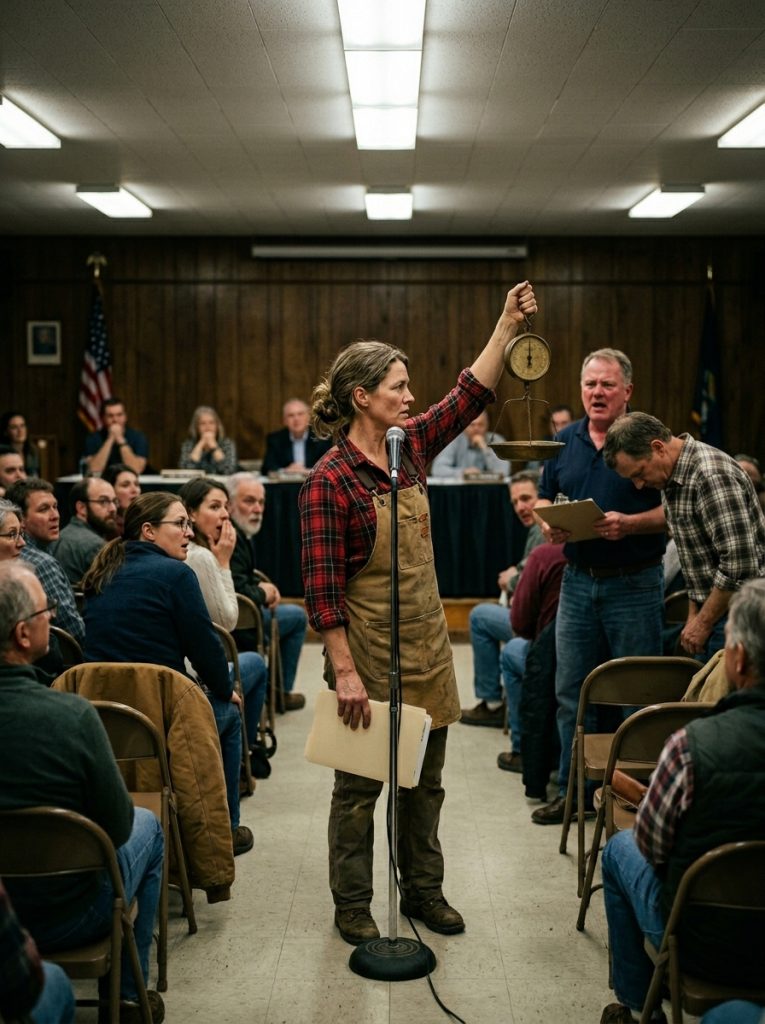
I held up the page from the state registry so the front rows could see it, then I read the name out loud.
“The booth operates as Green Valley Provisions, LLC,” I said. “It’s got two members listed. Ray Dunmore, who runs the stall. And a silent partner who owns forty-nine percent of it.”
I want to back up for a second, because I need you to understand how long it took me to get that one sheet of paper, and why I was so sure.
It started with Mrs. Alvarez, who’s seventy and counts every dollar. She mentioned at my stall that her bag of Ray’s beans always seemed to come up light at home on her own kitchen scale. I might have let it go — people misremember. But then a young dad said the same thing the next week, holding his receipt, frowning. So one slow Saturday I bought a pound of beans from Ray myself, walked it straight to the county extension office that does free produce weigh-ins for growers, and watched it come up four ounces short of what I’d paid for. Four ounces. On one small bag.
I did it again the next week. And the week after. Forty-one times, with forty-one neighbors who agreed to let me re-weigh their groceries in the parking lot. Every single one short. That’s not a broken scale having a bad day. That’s a machine doing exactly what it was set to do.
When I took it to Hal and he buried it, I didn’t understand why a manager would protect a cheating vendor. So I did the last boring thing. I paid eighteen dollars to pull the booth’s business filing from the state. And there it was.
I paused.
“Hal Brindle.”
For a second nobody moved. Then the room made a sound I’ll never forget — not a gasp, more like a long exhale, the sound of a whole town doing the math at once.
Hal shot up out of his chair at the front table. “That’s private business! That has nothing to do with—”
“It has everything to do with it,” I said. My voice didn’t shake anymore. “You’re the market manager. You decide every dispute. You decided mine. And every time a customer said Ray’s scale ran heavy, the man they complained to was secretly pocketing forty-nine cents of every cheated dollar. You didn’t dismiss me because I was wrong, Hal. You dismissed me because I was right, and right was costing you money.”
He kept talking. Something about defamation, about lawyers, about how he’d “built this market.” But he’d lost the room, and a man who has lost the room can feel it, the way you can feel weather coming.
A woman in the third row stood up. Edith Pruett, eighty-one, who’d been buying tomatoes off that corner for years. “Hal Brindle,” she said, in the voice of a retired schoolteacher, “I bought green beans from that stall every Saturday for two summers. You’re telling me you knew the scale was crooked and you were getting a cut?”
Hal didn’t answer. The not-answering was the answer, and everyone heard it.
Then I did the thing I’d planned, the boring thing, the thing that actually wins.
“I’m not asking this room to take my word,” I said. “I brought the certified scale. I brought the receipts. And tomorrow morning I’ve already arranged for the state Division of Weights and Measures to come test every scale at the market — Ray’s included. They do it for free. It’s literally their job. If I’m wrong, they’ll clear Ray in an hour and you can ban me twice.”
You can’t argue with a free, official test. That’s the beauty of it. Hal’s whole defense had depended on it being my word against a beloved institution. The second a neutral state inspector entered the picture, the institution stopped protecting him, because no one wanted to be standing next to Hal when the state showed up.
The vote to ban me never happened. The board chair, a tired man named Foster who I think had wanted out of Hal’s shadow for years, called a recess that never really ended. People just started talking, neighbor to neighbor, and the meeting dissolved into the truth getting passed around the room like a plate.
The inspector came that Saturday. Ray’s scale read a quarter-pound heavy on a calibrated test weight. So did a second scale at the booth. The inspector red-tagged both and opened a case.
It came apart fast after that. Faced with the LLC filing and the test results, Ray admitted the scale had been “off” for a long time and that Hal had told him not to fix it — “people don’t notice, and we both do better.” That sentence, repeated to the board, ended Hal Brindle’s little kingdom. He resigned as manager before they could remove him. Green Valley Provisions lost its stall.
The market did something decent then, something that made me proud to be part of it again. They didn’t just move on. They went back through two years of Hal’s “dispute resolutions” and found a pattern — vendors he’d squeezed, complaints he’d buried, corners he’d handed to friends. They set up refunds where they could. They posted the state inspection results publicly, every month, by the entrance. They wrote a rule that no market official could hold a financial stake in any vendor, and they named it after the thing it was meant to prevent, not after me, which is how I wanted it.
Foster asked me to join the new board. I said no at first — I’m a grower, not a politician. Then my friend Carol, the one who’d stared at her lap the night they tried to ban me, came out to my farm with a pie and an apology and told me that the reason people stayed quiet was that nobody believed one person could win against Hal, so what was the point of standing up alone.
“Then maybe somebody should be on that board who already did it once,” she said.
I took the seat. I sit on it the same way I do everything — quietly, and with the receipts in a folder. The first thing I pushed through was a simple rule: any customer can ask any vendor to re-weigh a purchase on a market-owned certified scale, no questions, no attitude. We bolted one right by the entrance. Nobody uses it much anymore, which is exactly the point. People only reach for proof when trust is gone, and trust came back the day the truth got weighed in public.
My stall is back in its old spot, away from the dumpsters. Business is good — better than before, honestly, because it turns out people will drive a little farther for a market they can trust. New customers tell me they heard “some lady proved the scales were rigged,” and I just smile and weigh their beans on a scale I let them watch.
Here’s the thing I keep coming back to, the thing about a small town where everyone knows everyone.
That closeness can be a cage. It’s what let Hal run me down — a whisper at the feed store travels faster than any truth, and everyone’s too tangled up with everyone else to be the one who stands up.
But that same closeness is what saved it in the end. Two hundred people in one room, neighbor looking at neighbor, and once the truth was on the table where they could all see it, the very gossip mill that had buried me reversed direction overnight.
A town that all knows each other can crush you.
But get the truth in front of them, all at once, in one room, with a free state inspector on the way — and a town that all knows each other will also, finally, do the right thing.
They banned me from the market for lying about the scales.
Turns out the only liar in the building had a polo shirt with the market’s logo on it.
I weigh honest. I always did.
Now the whole town knows it — and they get their receipts checked at the door.