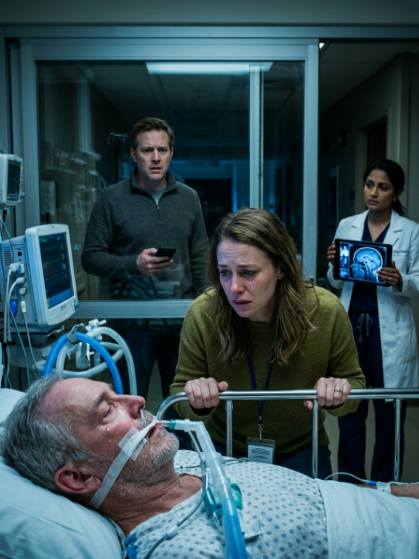
Dr. Patel turned the tablet around so the whole room could see it.
Two scans, side by side. The one from nine days ago. The one from an hour ago.
I’m not a doctor. But even I could see that the second image had light in it where the first had almost none.
“This is your father’s brain beginning to come back,” she said. “It’s early. It is not a promise. But the activity we’re seeing tonight — he is not where we believed he was nine days ago. He’s fighting. And he can almost certainly hear us.”
The room did something strange then.
My mother’s sister gasped and started to cry the good kind of tears. A cousin said “thank God” into both his hands.
And my brother, Doug, standing in the doorway with a consent form folded in his jacket pocket, went the exact color of paper.
Because everyone else in that room had just heard a miracle.
Doug heard a problem.
I should tell you what that form in his pocket was.
It was a request to withdraw life support. He’d had it ready for two days. He’d been gathering the family’s agreement one quiet conversation at a time, the way a person collects signatures for a petition. He kept using the word mercy. He kept the spreadsheet open on his phone.
Our father is not a wealthy man. But he owns his house outright, and his pension pays out very differently depending on whether he is alive to collect it. Doug had done that math. I am certain of it now, as certain as I am of my own name.
He had simply needed Dad to be gone before Dad could wake up.
He missed it by about an hour.
Harold Greer woke the way a tide comes in. Slowly — and then all at once.
A finger, the first night. His eyes, two days later. A week after that he was off the ventilator, breathing his own air, asking for ice chips in a voice like gravel over a creek bed.
The first full sentence my father managed, once he could shape one, was to me.
“You were here,” he said. “Every night. I heard you.”
I started to cry.
Then he said the second thing.
“I heard Doug, too.”
The whole room went still.
My father didn’t shout. That isn’t who he is. He has never once raised his voice in my entire life, and a stroke wasn’t about to turn him into a man who would start.
What he did was ask for his attorney.
He had the hospital chaplain there to witness it. He revoked the power of attorney that named Doug. He named me in his place. He quietly rearranged the small handful of things a careful man arranges, so that the people who actually love him would be the ones to decide for him.
Then he asked to see Doug. Alone.
I don’t know everything that passed between them. But I know our father held my brother’s hand the entire time — because Doug told me later, crying in the parking garage, that he couldn’t get the picture out of his head.
“He forgave me,” Doug said. “He shouldn’t have. But he did.”
“He’s always been better at it than the rest of us,” I told him. It was the kindest thing I had left in me that night.
Here is the part nobody warns you about.
My father lived. That is the miracle, and I will take it on my knees, every single day, for the rest of my life.
But you cannot un-hear your own son planning the end of you while your heart is still beating.
Dad knows what Doug nearly did. Doug knows that he knows. They speak now — carefully, on the phone, on holidays. It is not what it once was. It may never be again.
That is the cost of the truth. Sometimes the scan lights up, and the thing it shows you can’t be switched off either.
The nurses on that floor — the ones who’d watched me sleep folded into the squeaky chair for nine nights running — threw a small party the day Dad was discharged. Sheet cake in the break room. Dr. Patel signed the cast where an IV had bruised him and wrote, in tidy little letters, “Stubborn. In the very best way.”
Doug didn’t come to the party.
He sent flowers to the house instead, with a card none of us have ever read out loud.
Dad’s home now. The garden’s a disaster, and he won’t let me hire anyone to touch it.
Most evenings I sit beside him on the back step while he tells me which tomatoes are lying to him about being ripe.
He’s here. He heard me.
I am not letting go of that for anything in this world.