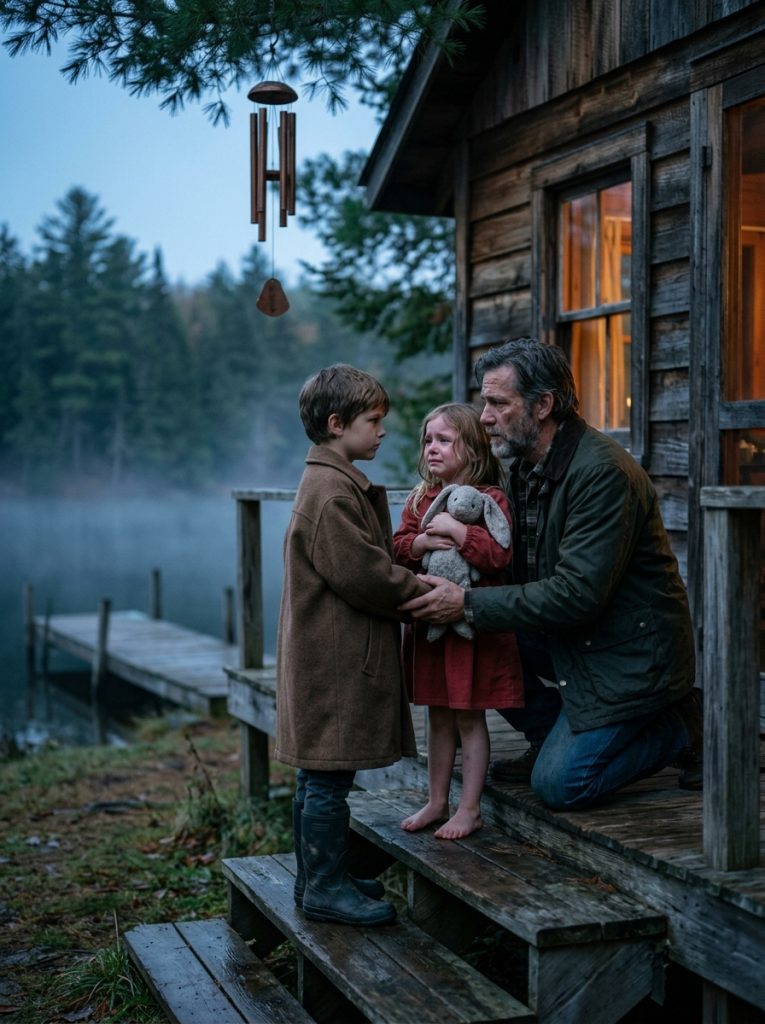
I got them inside before the cold did. That part wasn’t a decision. You don’t decide to pick up two freezing children; your arms just do it.
I lit the woodstove. I made cocoa from a dusty packet I found in the cupboard, and I wrapped them in the quilts Helen had stacked in the cedar chest, and I sat on the floor so I wouldn’t be tall.
Their names were Sam and June. Their mother was Cara.
It came out slowly, the way frightened things come out, in pieces between sips.
Cara had met my wife at the women’s shelter in Glens Falls. Helen volunteered there every Thursday for the last six years of her life. I knew that. What I never knew was how far past the front desk her volunteering went.
Helen had a soft spot for the ones the system kept failing. Cara was one of those — running from a man the courts kept handing second chances, moving from couch to motel to couch, two kids in tow. Helen couldn’t fix the law. So she did what Helen always did. She made a quiet promise and built a back door into it.
She gave Cara a key to the cabin.
“If it ever gets bad,” she’d told her, “if you ever have nowhere, you go to the lake. There’s a cabin on Loon Lake. My husband comes up Fridays in the fall to close it down. He’s a good man. He’ll help you. You wait for Friday.”
Helen never told me. I think she meant to. I think she was waiting until the day it mattered, and the day it mattered came two years after a stroke took her from me in our own kitchen, faster than any promise could outrun.
But the key stayed on Cara’s ring. And the promise stayed in her head. And the photograph — me and Helen on the porch, the one Helen had pressed into Cara’s hand so she’d know the face to trust — stayed folded in a diaper bag through every bad night.
Three weeks ago, it got bad.
Cara got the kids out in the dark and drove a car that barely ran until it didn’t run anymore, twenty miles from the lake. They walked the rest. She’d been sick for a while, longer than she let on, and the cold and the walking finished what the sickness started. She got them to the cabin. She kept her promise to a dead woman because it was the only solid thing she had left.
And then, two days before I drove up, Cara died on the cot in the back room, holding her children’s hands, telling them to wait for Friday. To wait for the man in the picture.
They wrapped her in a blanket the way she’d taught them. They rationed the crackers in the cupboard. Sam wound the copper wind chime by hand every few hours, because his mother had told them that’s how Helen used to call her husband home, and an eight-year-old will believe a thing like that with his whole chest if it’s all he’s got.
That was the ringing. No wind. Just a little boy, keeping a signal alive for a woman who couldn’t hear it anymore.
I have never in my life felt so completely, unbearably too late.
Too late for Cara, who I never met, who trusted my wife with the last of her hope. Too late for Helen, who built a rescue she didn’t live to finish. Too late to be the Friday those children were promised when it would have mattered most.
But I was not too late for the two kids in front of my woodstove.
That, it turned out, was the part still left to me.
I called the sheriff that night. There were hard weeks after — the county, the caseworkers, the search for any family Cara had, which turned up no one who wanted them. I learned the system Helen had spent six years fighting from the inside, and I fought it the same way, stubborn and quiet, with a folder that grew thick.
It helped, in the end, that I could prove the connection. The shelter had Helen’s volunteer records. A counselor there remembered Cara talking about “the lake and the man in the photograph.” It turns out the wildest part of the story was also the part that made the judge believe the rest of it.
The adoption went through last month.
Sam is nine now and still stands in front of his sister out of habit, though less every day. June sleeps with the gray rabbit and has started calling me something that isn’t quite “Dad” and isn’t quite anything else, a word that’s just ours.
I never took down the copper wind chime.
Some evenings, when the lake goes still and the chime hangs silent, June walks out and gives it one soft push, just to hear it.
She says it’s so the nice lady knows we made it.
And every time, on a windless porch where two women I’m still grieving once made an impossible promise, I let her believe that someone, somewhere, can hear it ringing.