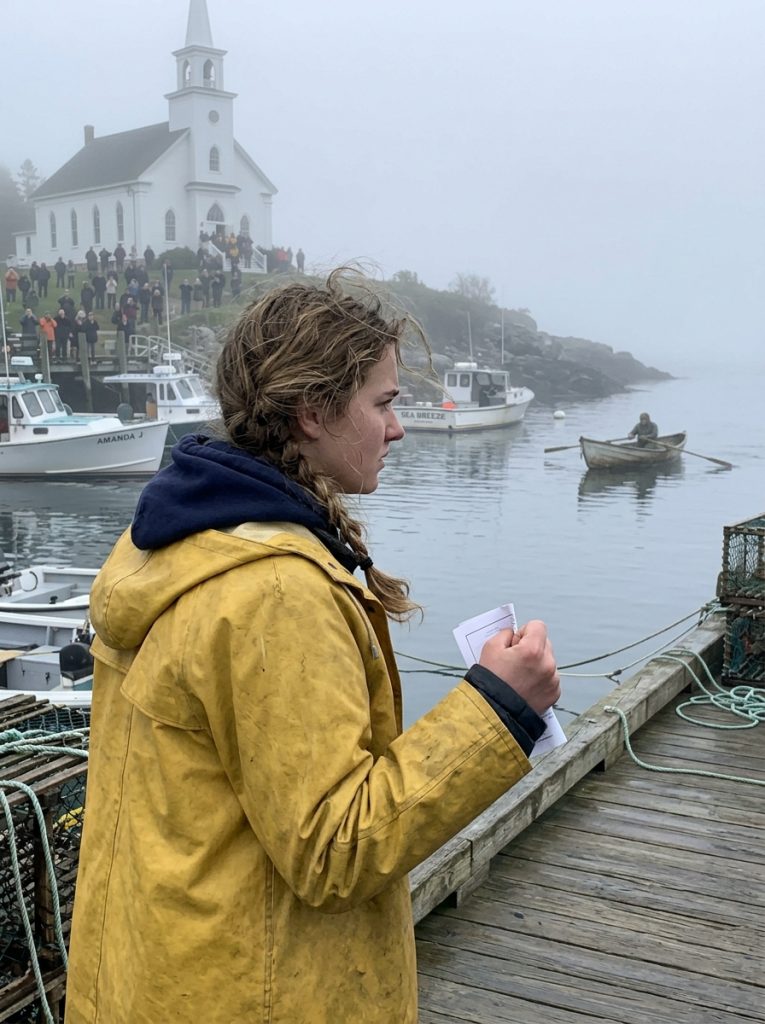
I reached the end of the dock just as the skiff bumped the pilings, and then I was down on my knees grabbing for him, and my father — my father — caught my arms with hands that were raw and blistered and shaking, and he said my name.
“Birdie.”
Just that. “Birdie.” Like it was the only word he’d been saving for three weeks.
I don’t remember pulling him onto the dock. I remember the whole town coming down off the church steps in a wave, the pastor still in his robes, my aunt screaming, grown fishermen who’d known my dad their whole lives just standing there with their hands over their mouths because the man they’d come to bury was kneeling on the dock soaking wet and breathing.
I don’t have good words for the next few minutes. The whole town came down off the church steps in a wave — the pastor still in his robes, my aunt screaming, old fishermen who’d known my father their whole lives just standing on the dock with their hands over their mouths, watching a dead man climb out of a skiff. Somebody was sobbing. Somebody was laughing. Both sounds at once. My father got his feet on the dock and his knees buckled and four men caught him before he hit the boards, and over all of it I could hear my own voice saying “Dad, Dad, Dad” like the word was the only thing keeping him there.
He was real. Sunburned and skeletal and shaking, but real. I had my hands fisted in his ruined oilskins and I would not let go, not for the EMTs, not for anyone, until he put his cracked lips against my hair and whispered, “I told you you’d know. I told you.”
It took a while to get the story out of him, because the first thing my father needed was water and a blanket and about sixteen hours of sleep. But here is what happened to Cal Vance.
When the Mary Jean went down, the storm threw him clear. He got an arm into a life ring and rode the swells in the dark, sure he was done. But the current — the same current that took the boat — carried him toward a scatter of small uninhabited islands a long way off the shipping lanes, the kind of rocky nothing places nobody goes. Sometime before dawn he washed up on one of them, half-drowned, with a broken hand and a gash in his leg.
And then he survived. For three weeks. On a rock in the North Atlantic.
He had rainwater that pooled in the rocks. He had mussels and the few things a lobsterman knows how to pull from tide pools. He had a busted hand he set himself with a stick and a strip of his own shirt. The Coast Guard search, he figured out later, had concentrated where the boat went down — they had no reason to look at islands the current shouldn’t have reached, except the storm had made the current do something strange.
He watched for boats. None came that close. He kept a signal fire ready but had nothing dry to light it most days. He told me, later, quietly, that the thing that kept him going was the rule. “I knew you wouldn’t believe I was gone,” he said. “I figured if I gave up, I’d be making a liar out of you. And I’d never make a liar out of my Birdie.”
The skiff was his own invention, and it’s the part that tells you everything about my father. Over those three weeks, debris kept washing onto his rock — pieces of the Mary Jean, yes, but also old fish-house junk, a couple of cracked oars, lengths of line, a hunk of dock foam. Most men would have stared at that wreckage and seen junk. My father, with one good hand and one he’d set himself with a stick, saw a boat. He lashed it together a little at a time, salt-cracked and bleeding, testing it in the shallows, rebuilding it when it failed.
He told me later he had no way to know which direction was home. So he waited for a clear morning, climbed as high as he could on the rock, and looked for the one thing that might guide him: the white steeple of our church, the tallest point on our shore, just barely visible across the water on a fogless day. He pointed his impossible little boat at God’s own steeple and he rowed.
The skiff was his own invention. Over those three weeks, pieces of wreckage washed up on his rock — and not just from the Mary Jean. Old debris, fish-house junk, a couple of busted oars, line, a hunk of foam. With one good hand and one bad one, my father lashed together a skiff that had no business floating. The morning the fog finally lifted and the water lay down flat, he pointed it at the only thing he could navigate by — the church steeple he could just make out on the far shore, the highest white point in our town — and he rowed.
He rowed for hours. He didn’t know it was his own memorial he was rowing toward. He just knew that steeple was home, and that his daughter was under it somewhere.
He came around the point at the exact moment the pastor was committing his soul to the sea.
The town doesn’t really have words for what that morning was. People still talk about it in church. The man we’d gathered to bury, rounding the point in a skiff he built on a rock, while we sang him into heaven. The pastor likes to say he’s preached a lot of resurrections but only attended one.
My dad’s hand healed crooked. He can’t grip a hauler the way he used to, so he doesn’t fish the deep water alone anymore — the town wouldn’t let him even if he tried. He runs the co-op now, and he teaches the young ones, and on calm days he takes me out and lets me run the boat while he watches the water with those eyes that have seen the other side of it.
We don’t talk about the three weeks very much. He told me once that the hardest part wasn’t the hunger or the cold or the broken hand — it was the boats. He’d see one, far off, and wave and shout until his voice gave out, and watch it shrink back over the horizon without ever turning. Three weeks of being almost found. He said the only thing that kept him from giving up after the third boat passed was the certainty that his daughter was on shore refusing to bury him. “I couldn’t quit,” he said, “knowing you hadn’t.”
The town never quite got over that morning. The pastor likes to say he’s preached a lot of resurrections but only attended one. For months afterward, fishermen would stop my father on the dock just to grip his shoulder, like they needed to feel that he was solid. The harbor takes people here. It almost never gives one back. It gave back mine.
But sometimes, on a gray morning, I catch him looking out past the point, and I know he’s back on that rock, and I put my hand on his arm and he comes back to me.
I kept the memorial program. The one I crushed in my fist on the dock. It’s got his face on it and the dates, except the second date is wrong, obviously, gloriously wrong. I framed it. He thinks it’s morbid. I think it’s the best thing I own — a piece of paper that swore my father was gone, hanging on the wall of a house he came home to.
People ask me how I knew. How I stood at the back of my own father’s funeral in a yellow slicker, refusing to grieve, when every adult in town had accepted he was lost.
I tell them about the rule. You’ll feel it. You’ll know.
I never felt it. So I never stopped watching the harbor.
And one foggy morning, in the middle of his own memorial, my father rowed home — because he wasn’t about to make a liar out of me, and because some part of him knew his Birdie would be standing on that dock in the brightest color she owned, so the sea could always, always find him.