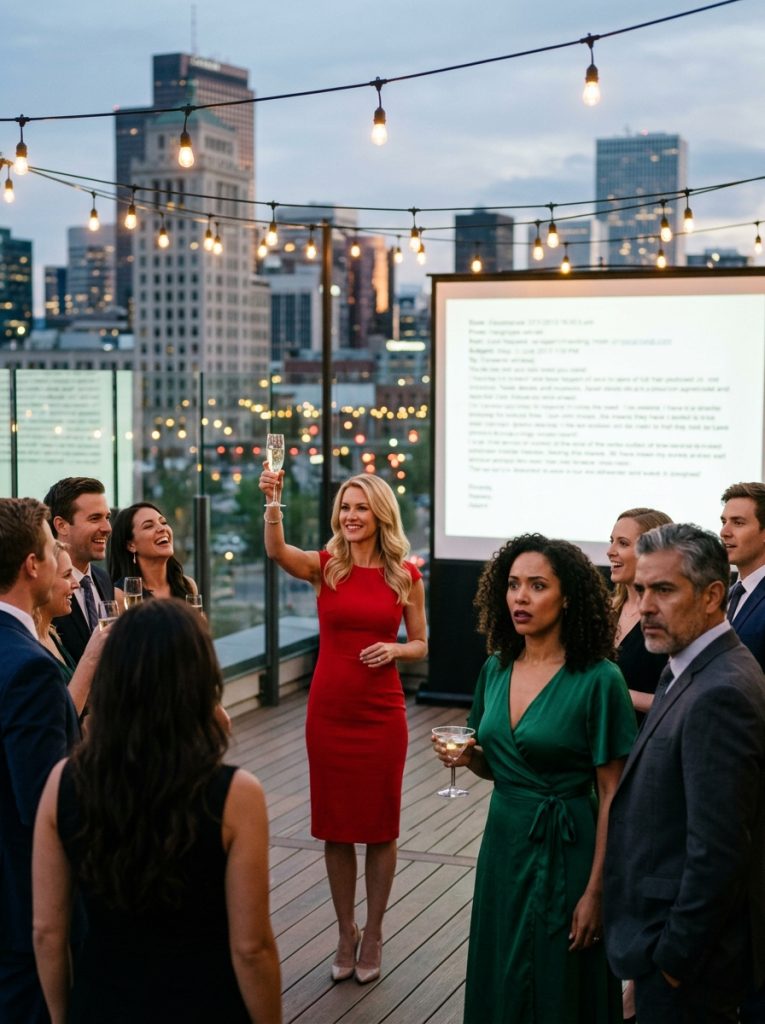
For a few seconds, nobody on that rooftop moved.
Then Geoffrey Ruiz walked over to the laptop, put on his reading glasses, and scrolled.
That was the part Camille hadn’t planned for. Tyler had only airdropped one email — the lockout request. But the thing about an email is that it comes with a thread. And the thread, projected ten feet tall over the Denver skyline, kept going.
Below the lockout request was Camille’s reply to herself, forwarding my entire Lumen deck to her personal drive the night before the pitch. The file name still had my initials on it. NB_Lumen_FINAL_v7.
Below that was a message to the junior designer, asking him to “clean up the title slide” — which is corporate for take her name off and put mine on.
And below that, the worst one. A message to a friend outside the firm, the kind of thing you only write when you’re sure no one will ever see it.
She did the work, sure. But she doesn’t have the killer instinct. I do. By the time anyone notices, the promotion’s signed and it’s my account. Sorry not sorry. 😂
Geoffrey read it twice. I watched him read it twice.
Then he took off his glasses and turned around, and the rooftop full of people who’d been toasting Camille thirty seconds ago suddenly found their drinks very interesting.
“Camille,” Geoffrey said. Quietly. “My office. Now.”
“Geoffrey, it’s a party, this is obviously someone’s idea of a—”
“It’s your email,” he said. “It’s your account. It’s your signature at the bottom. Now.”
She went.
I’d like to tell you I felt triumphant. I didn’t, not right then. Right then I just felt the string lights swimming and the champagne going sour in my mouth and four months of being told I “wasn’t ready” curdling into something I didn’t have a name for yet.
A colleague I barely knew touched my arm and said, “That was your deck? The Lumen deck was yours?”
And I realized that was the part that hurt most. Not that she’d taken it. That everyone had believed it was hers, because she’d said so with confidence, and I’d said nothing at all.
I went home. I didn’t sleep.
I sat at my kitchen table until three in the morning with the lights off. My sister called — I’d finally told her, weeks before, why I’d skipped her birthday, and she’d been quietly furious on my behalf ever since. “Tell me they got her,” she said.
I told her I didn’t know yet. I told her the truth was finally out, and I had no idea if it would actually matter.
“It matters,” she said. “It always mattered. You just stopped believing it did.”
The next morning, Geoffrey called me into the office I’d never been invited into before. The big one, with the corner windows.
He looked like he hadn’t slept either.
“I owe you an apology,” he said. “And not a small one. I made a decision four months ago based on who told the better story in the room. I should have looked at who did the work. That’s on me, Naomi, and I’m not going to pretend it isn’t.”
I waited.
“Camille is gone,” he said. “She resigned this morning, which is a kinder word than what should have happened. The promotion is void. And the Lumen account—” He slid a printed email across the desk. “Lumen got wind of it. Their CMO called me an hour ago. She said, and I’m quoting, ‘We want to work with the person who actually built that strategy. Put her on the account or we walk.'”
I looked at the email. My name was in it. Spelled right.
“So I’m asking you,” Geoffrey said. “Not offering. Asking. Will you take the director role and the Lumen account? You’d have said no to me a year ago and you’d have been right to. I’m hoping you’ll say yes anyway.”
Here’s the thing I’d learned in four months of swallowing it.
The truth doesn’t always win on its own. Sometimes it needs an intern with bad judgment and a party slideshow. Sometimes it needs a screen ten feet tall. Sometimes it sits in a locked drawer for months because the person it belongs to was too tired and too professional to fight for it.
I’d promised myself I’d never be that quiet again.
“I’ll take it,” I said. “On two conditions.”
He nodded for me to go on.
“First, the junior designer who ‘cleaned up the title slide’ — he was twenty-three and he did what a director told him to do. He doesn’t lose his job over her. He gets mentored. By me.”
“Done.”
“Second.” I leaned forward. “The next time someone in this building closes a deal, before you hand out the credit, you ask the room one question. You ask, ‘Whose drive did this come off of?’ Because the killer instinct everyone admires is usually just somebody else’s three weeks of midnights.”
Geoffrey almost smiled. “I’ll have it printed and framed.”
“Don’t,” I said. “Just ask the question.”
The Lumen relaunch I led that quarter became the firm’s case study for the year — the real one, with my name on the real title slide. The client renewed for three years. I hired two strategists who reminded me of me: brilliant, overlooked, one bad meeting away from going quiet forever. I made sure they never did.
One of them, a kid named Devon, came to me after his first big pitch, shaking, certain he’d blown it. I pulled the deck up on the screen and walked him through every single slide that had landed.
“This was you,” I kept saying. “And this. And this part they wrote down — that was you.”
I watched him start to believe it.
That’s the whole job, I’ve decided. Not the strategy. The believing. Making sure the person who did the work knows they did it, out loud, before someone else decides to say it for them.
I heard about Camille now and then, the way you hear about weather in a city you used to live in. She landed somewhere new, with a polished story about “a toxic former employer.” For a while it worked, the way it always worked for her. Confidence is a currency and she was rich in it.
But Denver is smaller than it looks, and our industry is one long hallway, and a ten-foot screen leaves an afterimage. People remember. The story followed her the way her stories used to follow other people.
I don’t take pleasure in that. I want to be honest. There’s no scoreboard in my chest that lights up when she loses.
What I feel instead is something quieter and harder won.
The people who steal credit aren’t strong. They’re frightened. Camille needed my work because she didn’t trust her own — and a person who can’t trust their own work will spend a whole career taking other people’s and calling it instinct.
I think about the version of me who clapped that night. Who raised a glass to the woman who took her work, because making a scene felt scarier than disappearing. I think about how close I came to letting the lie become the record, simply because I didn’t believe my own truth was worth defending out loud.
And then I think about the screen lighting up.
Some nights, walking out past those same glass railings, the skyline doing its glittering thing, I catch my reflection and I make myself a small promise, the only one that’s ever mattered.
Next time, I won’t wait for the screen. Next time, I’ll be the one who says it.