The water dripped from the crumpled edges of the paper, hitting the stainless steel sink with a steady, rhythmic tap. Tap. Tap.
Chief Inspector Miller stopped dead in his tracks. His eyes dropped from my face to the wet document in my blue-gloved hand. The harsh fluorescent lights caught the faded red wax seal at the bottom of the page.
Julian took a step forward, his polished oxfords squeaking on the wet floor. “Chief, don’t look at that,” he said, his voice tight, losing its smooth, arrogant purr. “It’s a forgery. He’s trying to fabricate a maritime charter to bypass the new zoning laws. I was just about to confiscate it.”
Marcus, my sous chef, finally looked up. His eyes were wide, fixed on the paper. “That’s not a forgery,” Marcus whispered. “That’s the original 1954 Port Authority Charter. David’s grandfather had it laminated.”
“Shut up, Marcus,” Julian snapped. He lunged toward me, his hand reaching for the document. “Give me that, David. You’re obstructing a city inspection. I’ll have your license revoked before the sun sets.”
I stepped back, pulling the paper out of his reach. The water splashed onto my black apron. “You can’t confiscate it, Julian. Because it’s not just a permit. It’s a deed.”
The room went dead silent. The hum of the exhaust fans seemed to roar in my ears. The smell of the sea salt outside felt suddenly sharp, cutting through the tension in the galley.
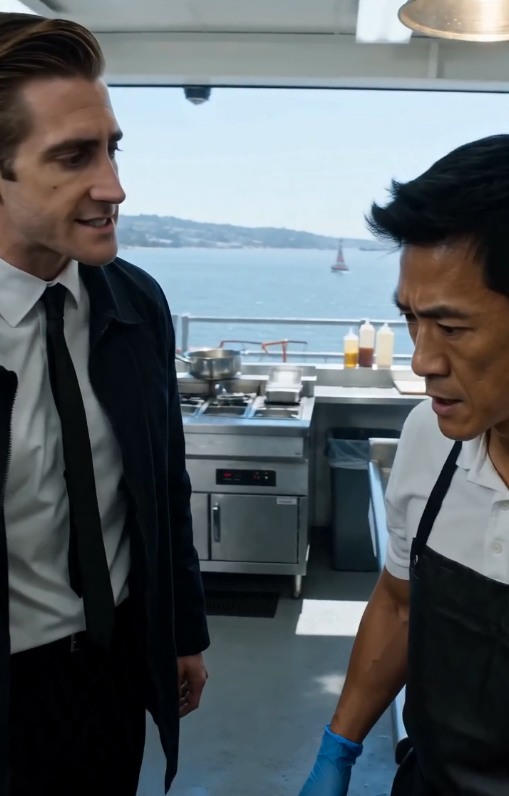
Miller stepped closer. He didn’t look at Julian. He looked at me. “Let me see it, Chef Chen.”
I handed him the wet paper. Miller took it carefully, his large hands gentle despite the rough texture of the soaked document. He squinted at the faded ink. He traced the red wax seal with his thumb.
Julian’s face went completely pale. The color drained from his cheeks, leaving him looking sickly under the harsh lights. “Chief, that document is invalid. The Port Authority dissolved those charters in 2010. I have the memo right here in my briefcase.”
“The Port Authority dissolved the commercial charters,” Miller said, his voice dangerously quiet. He looked up, his eyes locking onto Julian. “This is a historic preservation charter. It grants the Azure Coast sovereign culinary status. It means the city has no jurisdiction over this vessel’s operating hours, menu, or ownership structure. Ever.”
Julian’s jaw tightened. He took a half-step back, his hand instinctively dropping to his briefcase. “That’s… that’s a loophole. A technicality. I can appeal this to the zoning board. I have the backing of the Sterling Development Group. They want this dock for the new luxury marina.”
“You don’t have the backing of anyone, Julian,” Miller said coldly. He reached into his uniform pocket and pulled out a thick manila folder. “Because the Sterling Development Group fired you this morning. They found out you were using their letterhead to forge eviction notices for the other floating restaurants on the pier.”
The silence that followed wasn’t just quiet. It was a physical weight. It crushed the air out of the space between us.
Julian’s mouth opened, but no sound came out. He looked at the folder, then at the wet paper in Miller’s hand, then at me. The arrogance was completely gone. He looked like a trapped animal.
“You’re lying,” Julian stammered, his voice cracking. “I’m the Compliance Director. I built this department.”
“You embezzled three hundred thousand dollars from the inspection fund to pay off your gambling debts,” Miller said, his voice flat and absolute. “And you tried to extort Chef Chen into signing over a historic vessel worth four million dollars. That’s a felony, Julian.”
Miller nodded to the doorway. Two uniformed officers stepped into the galley. They didn’t rush. They just walked up to Julian and pulled his arms behind his back. The metallic click of the handcuffs was sharp and final. It echoed off the stainless steel counters, silencing the room completely.
“You’re under arrest for forgery, extortion, and grand larceny,” Miller said.
They marched him out of the galley. He didn’t look at me. He didn’t look at Marcus. He just stared at the floor, his shoulders slumped, entirely defeated. The heavy steel door swung shut behind them.
I looked down at my blue gloves. They were soaked, wrinkled, and trembling slightly. I peeled them off and dropped them into the trash bin.
Marcus walked over and placed a hand on my shoulder. “We’re open for dinner, Chef,” he said softly.
I nodded. I turned back to the prep station. The ocean breeze blew through the open window, carrying the smell of salt and freedom.
The heavy steel door clicked shut behind the officers, leaving only the sound of the ocean and the steady hum of the exhaust fans.