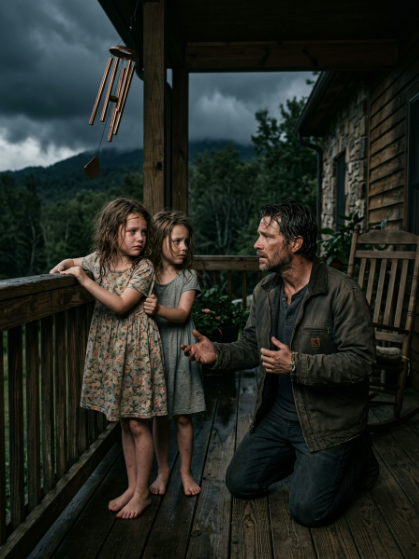
The promise they wanted was four words, and they nearly broke me.
“Promise you won’t take us to the gray house.”
Rain was coming sideways by then. I knelt on those boards and I said yes before I even understood what I was promising. “I won’t. I promise. Now please, come in.”
They came. Hand in hand, careful, like the porch might give way. Inside, I wrapped them in the dusty quilts off the bed and I built a fire with hands that wouldn’t stop shaking, and I started, slowly, to understand.
The “gray house” was the county group home two ridges over. They’d been told about it the way you tell children about a thing to be afraid of.
And the woman who’d been keeping them out of it, until three days ago, was a neighbor named Della Hawkins who lived a mile down the gravel and who I found pounding up my steps an hour later, soaked to the bone, having seen my truck from her window.
Della filled in what the girls couldn’t.
Their names were Nora and Posy. They were the daughters of Maeve — my late wife Olivia’s younger sister. The one Olivia “didn’t talk about.” The one I’d assumed was just a family rift, the kind every family has.
It wasn’t a rift. It was a rescue.
Maeve had married badly and then dangerously. Olivia, it turned out, had spent the last years of her life quietly pulling her sister and her sister’s twins out of that situation, a little at a time. The cottage was the safe place. The trail through the woods was the way in that the wrong people didn’t know about. The copper chime, Della said, was a signal — when it was hung, it meant safe to come up.
Olivia had been building all of it. A hiding place. A plan. A future where she’d bring the girls somewhere permanent.
And then she died on a wet road three years ago, and the plan died with her, because she’d never told me. To protect me, Della thought. Or to protect them, in case I was the kind of man who’d say no.
I will spend the rest of my life knowing my wife didn’t trust that I’d say yes.
Maeve held on after Olivia. Barely. Della checked on them, brought groceries, kept the secret because Maeve begged her to — terrified that any official paperwork would put the girls in a system the girls’ father could find.
Then this past winter, Maeve got sick and didn’t get better. She died in January.
For five months, two seven-year-old girls had been surviving in a half-empty mountain cottage on what a kind neighbor could carry up the gravel without being noticed. Rationing bread. Watching the trail. Waiting, because their mother had told them, before the end, the only comforting thing she had left to give:
“Your uncle Ethan will come. Olivia’s husband. He’ll come Friday.”
She didn’t know I’d come to sell the place.
She just knew the listing date, somehow — Della had mentioned it, not understanding what it would mean — and she’d turned it into a promise to two frightened children so they’d have a Friday to hold onto.
I found Olivia’s journal that night, the page Della said would be in the floorboards under the loose plank by the hearth. It was instructions, half-finished, in my wife’s handwriting. Names of lawyers. A note that said, if they come, follow the trail at dusk. A line near the bottom, written for no one, maybe for herself:
I have to tell Ethan. He has a good heart. I keep losing my nerve.
She ran out of nerve, and then she ran out of time, and I never got to be the man she was afraid to ask.
So I became him anyway. Three years too late for her to see it.
The promise came first. I called the right people — not the gray house; a lawyer Della knew, and a caseworker who turned out to be kind. There was a hard stretch. Emergency placement, then kinship paperwork, the girls’ father located and, mercifully, in no position to object and apparently uninterested besides. DNA confirmed what their faces already shouted: they were Olivia’s blood, my family by every measure that counts.
I adopted them this spring.
I’d love to tell you it’s been simple. It hasn’t. Nora flinches at raised voices. Posy hides bread in her pockets and I let her, because some fears you don’t argue with, you just outlast. There are nights the three of us sit up because someone heard the wind wrong.
But the cottage isn’t for sale anymore. I tore up the listing the morning after the storm. We kept it. We fixed the porch. The copper chime still hangs, and now it doesn’t mean danger. It just means home, and supper, and that the man they waited for finally showed.
I think about Olivia every day. About the plan she built alone because she couldn’t make herself ask me to share it. About how much sweeter all of this would be if she were here to see that her faith in my heart was right, just lonelier than it needed to be.
That’s the part that doesn’t heal clean. The love arrived. It just arrived after the one person who most deserved to see it was gone.
Last Friday, Posy tugged my sleeve on the porch and asked, very seriously, “Are you still going to come every Friday?”
I knelt down to her eye level, the way I did that first day in the rain.
“I never left,” I said. “I’m already here.”
And the chime turned slow in an easy wind, ringing for nobody, ringing for all of us, while two girls who’d waited too long finally stopped watching the trail.