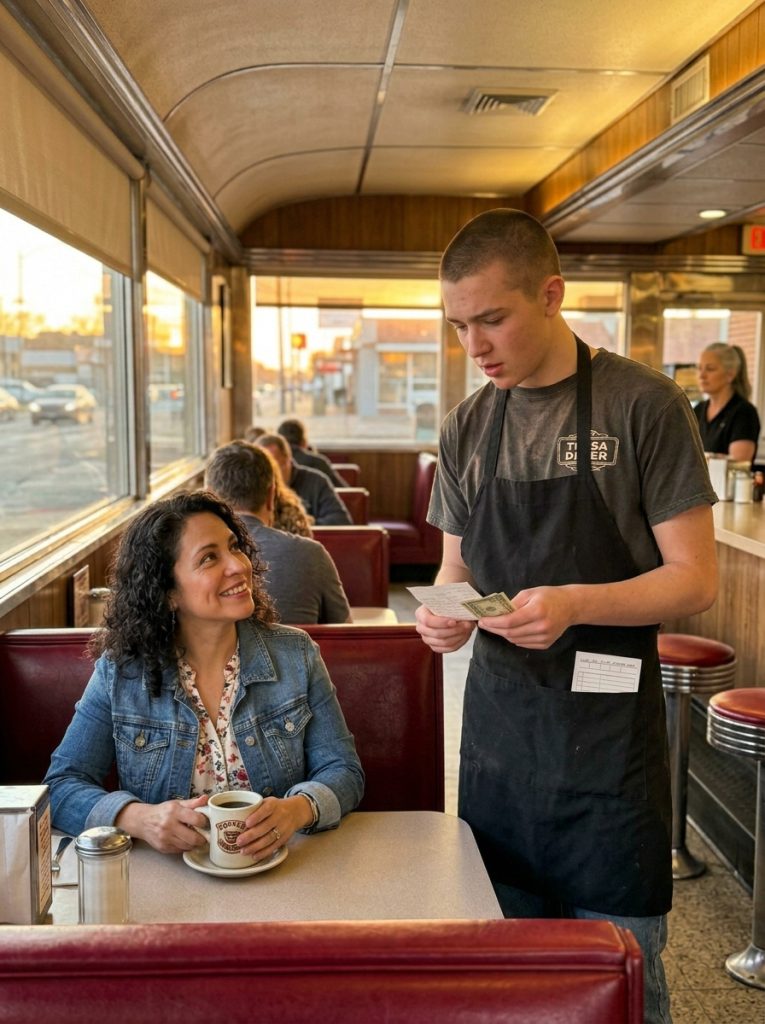
I didn’t call the number that night. Or the next. I carried that folded twenty in my apron for nine days, and I took it out maybe a hundred times.
You have to understand what hope does to a kid like me. Hope is the dangerous one. Anger I could live in for years. But hope — hope could get me hurt all over again, and I’d worked so hard to age out of the system without a single new bruise on the inside.
Diane noticed I was off. She’s like that. On the ninth day she caught me staring at the corner booth during a dead shift and she said, “You gonna tell me what’s eating you, or you gonna keep murdering that dish rag?”
So I showed her the bill. The seven words. The number.
Diane read it twice. Then she set down her coffee and said something I’ll never forget. “Marcus, I’ve watched you keep your whole heart in a backpack for two years. I’m not gonna tell you what to do. But that woman sat in my diner for two hours working up the nerve to write seven words. People who didn’t want you don’t do that.”
I called from the diner’s back office that afternoon, with Diane pretending to do inventory ten feet away so I wouldn’t be alone.
Her name is Renata. My birth mother. She answered on the first ring, like she’d been holding the phone for nine days, which it turns out she had.
We didn’t have a movie reunion. I want to be honest about that, because I think the honest version is better.
The first call was mostly silence and both of us breathing and her saying “Marcus” a few times like she was checking the word was real. We agreed to meet at the diner — neutral ground, Diane’s territory, where I felt safe — the next week. Renata drove three hours.
And over a lot of coffee, in the corner booth, she told me the part the careful social-worker sentences had left out.
She was nineteen when she had me. Alone, broke, no family that would help. She lost me to the system when I was six, during a stretch she described plainly, without excuses, as the worst years of her life — addiction, a bad man, no stable place to put a kid. She didn’t dress it up. “I wasn’t able to take care of you,” she said, “and that part they told you is true. But ‘out of the picture’ is not true. They made me out of the picture.”
She’d gotten clean when I was nine. By then I’d been moved twice and the paperwork was a maze. She petitioned. She got denied. She didn’t have a lawyer, didn’t know the words to say, and the system that’s so fast to take a kid is so slow to give one back. Placements changed. Files got sealed. Every time she found a thread, I’d been moved again and the thread went cold.
“I’ve been three steps behind you for eleven years,” she said. “I had a folder. I kept every address I ever found, every school, every county. I’m not proud of all the ways I looked. But I never stopped.” She pushed a worn folder across the booth. It was thick. It was real. My name was on the tab in handwriting I now recognized.
I looked at eleven years of a woman chasing a kid who’d been taught to believe she’d thrown him away.
Then she said the thing that undid me. “I found out you were here a month ago. I didn’t come right in. I came and I sat in the parking lot for three days first, just watching to make sure you were okay. To make sure you were safe and you were treated good.” Her voice broke. “You were so kind to that lonely woman who only ordered coffee. You kept her cup full and you didn’t rush her. I sat in your section because I wanted two more hours of watching you be a good man before I risked scaring you off forever.”
She showed me the folder, page by page, over weeks. There were letters she’d written to caseworkers and never gotten answers to. There were printouts of school directories she’d combed through. There was a photograph of me at maybe seven, gap-toothed, that some foster family had mailed to a county office that had eventually mailed it to her — the only picture she had of me past the age of six. She’d carried it in her wallet so long the edges had gone soft as cloth.
“I want to show you something,” she said one afternoon, and pulled up her sleeve. On the inside of her wrist was a small tattoo of a date. “That’s the last day I held you,” she said. “I got it so that even on my worst days, when I didn’t think I deserved to keep looking, I couldn’t forget I’d promised to.”
I didn’t know what to do with that. Seventeen years of believing I’d been thrown away, sitting across from a woman who’d tattooed the date of our separation onto her skin so she’d never stop searching. The anger I’d lived in for so long suddenly didn’t have anywhere to stand.
I’m not going to pretend everything got fixed in one booth. It didn’t. We’re still building it, slow, the way you build something you intend to keep. There’s a lot of years between us, and a lot I’m still angry about — not at her, mostly at a system that lets a clean, willing mother and her son lose each other in a filing cabinet for a decade.
But here’s where we are now.
I aged out in the spring. The day the State of Oklahoma was officially done with me, I wasn’t alone with a backpack. Renata and Diane were both there. I didn’t end up in the emergency apartment I’d been scared into saving for. I moved into Renata’s spare room — carefully, with a plan, both of us agreeing out loud that I could leave anytime and it wouldn’t break anything. We’re cautious people. We’ve earned the right to be.
There were hard conversations, too. I had a lot of questions that didn’t have gentle answers, and Renata never once flinched from them. She didn’t make excuses for the worst years. “I was the adult,” she said. “You were six. Whatever I was going through, you were the one who paid for it. I’m not going to ask you to carry that with me.” Hearing her take it square on the chin did more to rebuild my trust than any amount of comforting lies ever could have.
We went slow on purpose. A counselor at a youth center helped us — helped me figure out how to want a mother without being terrified of losing her again, and helped her understand that I’d protect myself by keeping one foot out the door for a long time, and that it wasn’t rejection, it was survival. She was patient with my one foot out the door. She’d had eleven years of practice in patience.
I still work at the diner. Diane gave me a raise and a hug she’ll deny if you ask her. The corner booth is mine now, in a way — I always seat the lonely ones there, the people who order one coffee and nurse it for two hours, because you never know what somebody’s working up the nerve to do.
And I kept the twenty. I never spent it. It’s in a frame on the wall of the room that’s mine now, in a house that’s becoming home at a pace I can trust.
Renata frames it differently than I do. She says the diner saved us both — that if I’d been working anywhere else, she might never have found the courage to sit in a stranger’s section for two hours. Maybe. I think the courage was always hers. I just finally let it reach me.
Seven words, in careful pen.
I never stopped looking for you.
It turns out the most dangerous thing I owned wasn’t my anger after all.
It was the hope I’d packed away. And I’m so glad I finally unfolded it.