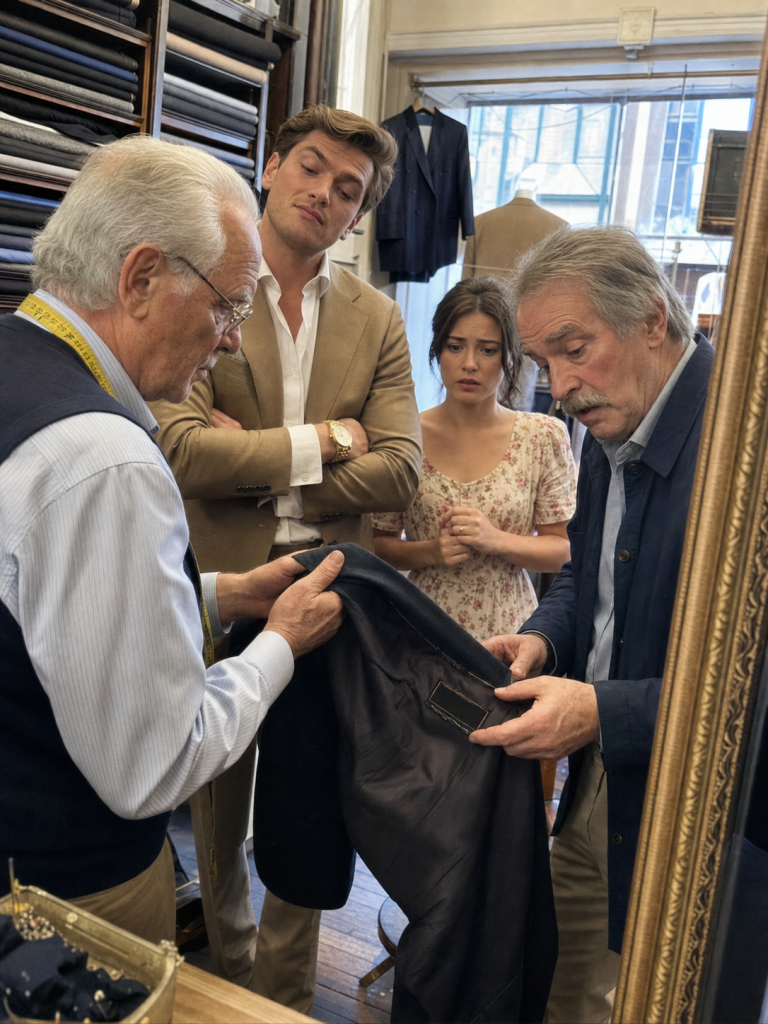
Parker gave the kind of laugh people use when they are hoping a serious moment will hurry up and turn unserious again.
“Dad, what are you talking about?”
Frank Wells did not look at his son. He was staring at the label inside the old jacket, his thumb moving over the pale stitching with a careful tenderness.
“This was your grandfather’s wedding suit,” he said.
Mr. Russo blinked. “Wells?”
Frank nodded. “Walter Wells. He married Anna in 1968. Queens courthouse first, because that was what they could afford. A church blessing came years later, when there was finally a little money.”
The tailor’s whole face began to change, slowly, like a lamp warming up in a dim room. “Walter,” he said. “Walter with the bakery truck?”
Frank laughed once, but his eyes had gone wet. “Yes. That’s him. He always smelled like flour. Right to the end.”
Parker shifted his weight beside the mirror. “Okay. Small world. Can we finish the fitting?”
Mia whispered, sharp, “Parker. Stop.”
Frank turned and looked at his son. “No,” he said. “You are going to stand there and hear this.”
I should have looked away. It was not my family. But by then everyone in that little shop had become part of the same held silence. Even the young assistant behind the counter had stopped sorting his thread.
Frank told it in pieces, the way you tell a thing you have not said out loud in years. His father, Walter, had arrived in New York with one good shirt and a bakery job that paid mostly in promises. When he wanted to marry Anna, he had no money at all for a suit. Every shop he walked into either laughed him back out onto the sidewalk or demanded full payment up front, before a single measurement.
Then someone on his block sent him to a young tailor named Salvatore Russo, who had just opened a narrow shop with a borrowed machine and more nerve than money.
“My father told him the truth,” Frank said. “That he could only pay five dollars a week. And Mr. Russo made the suit anyway. Shook his hand and started measuring.”
Mr. Russo waved one trembling hand. “Many people paid slowly in those days. It was nothing.”
“It was not nothing,” Frank said, and his voice cracked. “Two weeks after the wedding, Dad lost the bakery job. You told him to come sweep your floors here until he found work. You paid him in coins and scraps of fabric so my mother could take in mending. Years later, when their oven broke, you knew a man selling a used one cheap. That bakery is why we have anything. It put me through school. It became this whole family.”
Parker was looking at the floor now.
The expensive watch on his wrist seemed very loud.
Frank touched the old jacket again. “Your grandfather kept this suit his entire life. Wore it to every wedding, every funeral. We thought it was lost for good when the basement flooded back in the nineties.”
Mr. Russo smiled, but it was a sad kind of smile. “He brought it to me for a repair, not long before he passed. The lining had torn. He said he would come back for it the following week.” He paused. “He did not come back.”
Frank closed his eyes.
Mia reached over and tried to take Parker’s hand, but he did not take hers back. Not out of cruelty. More like shame had pinned his arms flat to his sides.
Mr. Russo, kind man that he was, tried to give the boy a way out. “The young man only wants his suit to be right,” he said softly. “Weddings make everyone nervous. I understand.”
Frank shook his head slowly. “Nervous is one thing. Nervous is not the same as rude.”
And there it was. Plain as a single dark pin dropped on a white cloth.
Parker swallowed hard. “Mr. Russo,” he said. “I’m sorry. I really am.”
The old tailor looked at him a moment. Then he simply said, “Stand up straight for me, please.”
It was such a perfect answer that Mia laughed through her tears. Even Frank cracked a smile. Parker stepped back up onto the fitting block, quieter now. And when Mr. Russo knelt to adjust the hem, Parker did not reach for his phone once. He watched the old man’s careful, shaking hands do their work.
“Did you really make my grandfather’s suit?” he asked. His voice was different now.
“Yes,” Mr. Russo said, not looking up from the pins. “He was thinner than you. And far more nervous. He shook so hard I could barely measure him.”
That broke the last of the tension in the room. Parker laughed, and this time it reached his eyes.
The fitting took another forty minutes, and not one person complained about the time. Frank told stories about the bakery at four in the morning. Mr. Russo remembered Anna bringing him a tin of cookies the day the first weekly payment was made in full. Mia asked, shy about it, whether a small piece of the old suit might be sewn inside Parker’s jacket. Something borrowed. Something older than all of them.
Mr. Russo considered the question with the seriousness of a surgeon. He said he would take a tiny piece from the inner seam, where it would never be missed and would never harm the shape of the original.
On the wedding day, I saw Parker again. He looked handsome, of course. But more than that, he looked humbled, in the way a person does when he has learned that the clothes are not the most important thing he is wearing.
During the reception, Frank raised a toast. Not only to the bride and groom, but to “the hands that helped our whole family learn to stand up straight.” Mr. Russo was there in a dark suit of his own, near the aisle beside Mia’s grandmother, both beaming. After the toast, Parker crossed the room and wrapped the old man in an embrace in front of every guest there.
Later that night, Mia pulled me aside and showed me the inside of Parker’s jacket. Under the lining, tucked close over the heart, was a small square of old, dark fabric, stitched down cleanly by hand.
You could not see it at all from the outside. Not a stitch of it.
That was the whole beauty of the thing. Some of what holds a family upright is never meant to show. It is only meant to last.