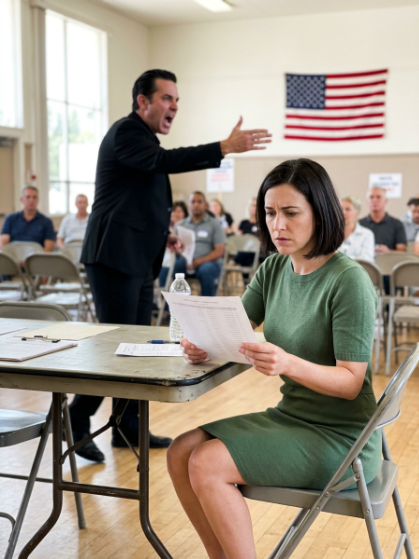
“Our unit faced constant mortar fire in Helmand, ladies,” Douglas shouted, waving a plaque in the air. “We lost good men, and I spent eighteen months leading patrols while my family waited at home. This community support group is vital for our recovery, and we need your corporate donations to fund our veteran retreat program. I want the contribution checks signed by the end of this meeting. If we don’t hit our target, the retreat will be canceled.”
My name is Julia Sterling. At thirty-five years old, with a dark bob and wearing a simple green dress, I sat at a folding table in the community hall in San Diego, California. The hall was sparsely decorated, with rows of metal folding chairs, a coffee station in the back, and a large American flag hanging on the wall behind the small stage. The afternoon sun filtered through the high, high windows, lighting up dust motes dancing in the air. But the atmosphere inside the hall was heavy with a forced intensity. Douglas Hall, forty-five, stood at the front of the room. His slick dark hair caught the bright lights, and his black suit looked tailored and expensive, his posture aggressive and dominant as he waved the plaque in the air to emphasize his words.
I sat at the folding table, keeping my worried expression locked on the folder in my lap. I had spent two years attending this support group, listening to Douglas boast about his deployments, his purple heart, and his heroic deeds. The other spouses looked at him with reverence, writing checks and organizing charity drives. But when my husband’s former commander visited us last week, he looked at Douglas’s photo in our newsletter and frowned. I spent the last three days coordinating with the Department of Defense registry and requesting official service records. I knew that exposing him in front of the community he had manipulated would be difficult, but I couldn’t sit in silence while he took money under false pretenses.
“I won’t be writing a check today, Douglas,” I said quietly, my voice carrying over the murmurs.
Douglas stopped gesturing, his slick dark hair catching the light as he glared at me. “Julia, you’ve always been hesitant to support our causes. Your husband was only in support logistics. You don’t understand the sacrifices of combat units. If you don’t want to contribute, you are welcome to leave. We only want dedicated families here.”
Without saying another word, I stood up and slid the official military unit roster sheet across the folding table right in front of him.
“I suggest you check this active roster before you ask for another dollar, Douglas,” I said, my voice steady.
Douglas scoffed, adjusting his jacket. “What is this? A list of local veterans? I know everyone in this sector.” He leaned down to scan the document.
I watched his face. The loud, confident smirk on his lips slowly began to twitch, then froze completely. His chest stopped moving, and his dark eyes widened in sudden, absolute panic. His face turned a pasty, sickly white under the hall lights, and his hand began to tremble, the plaque slipping from his fingers and clattering against the metal chair.
The official unit roster proved that Douglas Hall had never been deployed. In fact, he had been discharged from basic training for administrative fraud twenty years ago, and his medals were nothing but cheap replicas he had purchased online.
“This… this is restricted data,” Douglas stammered, his voice rising in panic. “Your husband… he must have falsified these files. I have my discharge papers at home. This is a federal offense!”
“The document is a certified copy from the National Archives, Douglas,” I replied calmly. “And the military police are standing in the lobby. You’ve spent two years taking money from military families who actually sacrificed everything. Now, the roster is public.”
Douglas stood frozen by the folding table, the paper shaking in his hand, looking pale and panicked in the San Diego hall as he realized his stolen valor had just been exposed.
The room erupted into shocked whispers. The spouses who had been holding their pens over their checkbooks slowly set them down. Mrs. Reynolds, a widow whose husband had died in Fallujah, stood up, her eyes flashing with anger.
“Is this true, Douglas?” she demanded, her voice shaking. “We trusted you with our donations. We gave you thousands of dollars for the veteran retreat! My family raised five thousand dollars last month alone!”
Douglas tried to regain his composure, adjusting his tie with a trembling hand. “Mrs. Reynolds, please, don’t listen to her. This is a personal attack. Julia is bitter because her husband didn’t receive a promotion. The records are flawed. There was a fire at the archives in St. Louis; many files were lost or corrupted. My service was classified. I was under special operations command.”
“The St. Louis archives fire was in 1973, Douglas,” I said, my voice carrying clearly through the room. “You were only five years old. And special operations command doesn’t issue administrative discharge records for basic training failure. You never even completed the first six weeks at Fort Benning.”
Just then, the double doors at the back of the hall opened, and two military police officers in uniform entered, accompanied by a civilian detective from the San Diego Police Department.
“Douglas Hall?” the detective asked, walking up the center aisle. “We have a warrant for your arrest for grand theft, charity fraud, and criminal impersonation. Under the Stolen Valor Act, you have illegally represented yourself as a decorated combat veteran to solicit over fifty thousand dollars in donations.”
Douglas looked around the room, his eyes darting to the emergency exit behind the stage. But one of the military police officers had already stepped around to block his path.
“This is a mistake!” Douglas yelled, his voice cracking as the detective grabbed his arm. “I served my country! You can’t do this to me!”
“You served yourself, Douglas,” I said, watching as the officers pulled his hands behind his back and clicked the handcuffs into place.
The other spouses watched in stunned silence as the man who had styled himself a community leader was led out of the hall in disgrace. The plaque he had used to swindle them lay forgotten on the floor.
Once the doors closed, a heavy silence settled over the room. Several spouses were in tears, shocked by the betrayal. Mrs. Reynolds walked over to my table, her face pale.
“Thank you, Julia,” she whispered, taking my hand. “If you hadn’t spoken up, we would have given him the rest of our savings. We wanted so badly to believe someone was helping our veterans.”
“We can still help them,” I said, opening my folder and sliding out a list of verified, legitimate veteran charities. “But we will do it the right way. No more fakes.”
A year later, the support group is thriving under a new board of directors, and the funds we raised are finally going to real veterans who need them. Douglas was sentenced to three years in federal prison. My husband, who served honorably in support logistics, is now home with us. Every time I see the flag in the community hall, I am reminded that real service doesn’t need a fake plaque—it only needs the truth.