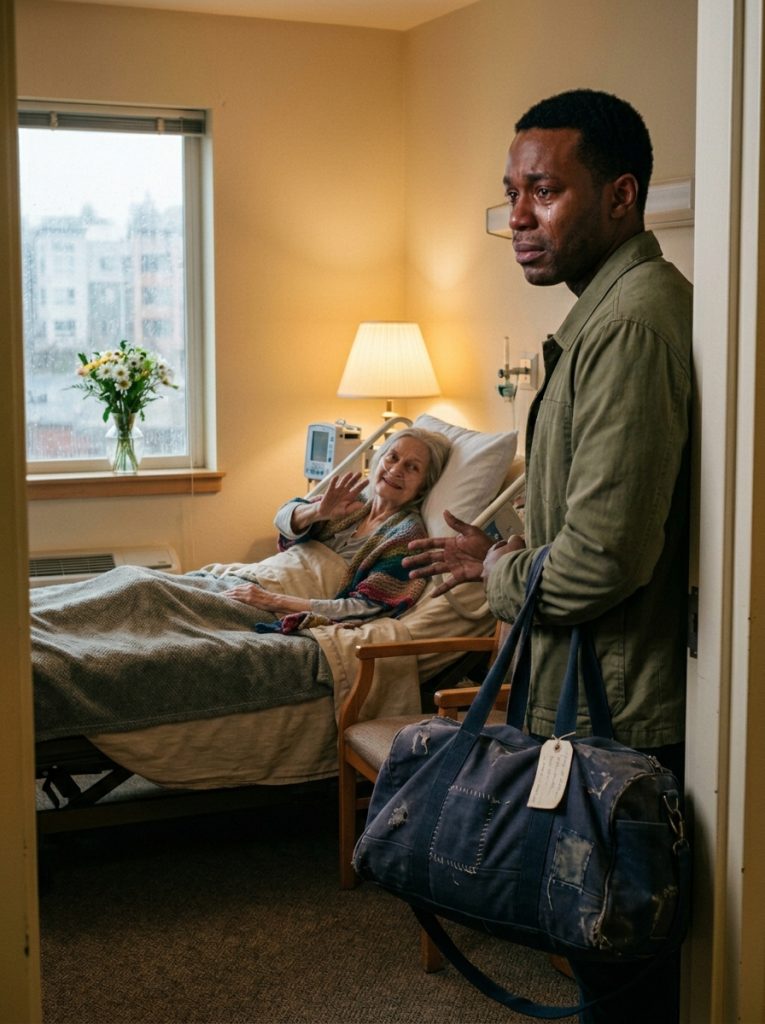
She was smaller than I remembered. The bed made everybody small.
But when I stepped into that doorway with the duffel against my side, Coral opened her eyes, and she smiled like she’d been expecting me on exactly this afternoon, and she said, in a voice worn down to a whisper, “You brought the bag.”
“I brought the bag,” I said.
I set it on the chair and I sat on the edge of her mattress, careful of the tubing, and I unzipped it.
The “Hello” card was still on top, after all these years. Faded now. Her handwriting, from the morning a tired temporary foster kid woke up to find that the newest card in his bag of goodbyes said the opposite for once.
“You kept it,” she breathed.
“You’re the one who taught me which cards to keep.”
I have to back up, so you understand what she did for me.
By fifteen I’d been moved twelve times. I didn’t unpack, ever. I kept my whole life in that navy duffel so it would always be ready by the door, because in foster care the door is the only thing you can count on. And I kept the goodbye cards because they were proof that I’d at least been real enough, in each house, for someone to write my name before they let me go.
Coral was supposed to be number thirteen and temporary. Six weeks, the agency said.
She found the cards the first week. She didn’t lecture me. She just put a “Hello” on top of the stack and said, “Everybody’s been packing you to leave, baby. I’m going to teach you how to stay.”
And she did. I didn’t get moved out of Coral’s house. I aged out of it, at eighteen, from a bedroom with my name on the door — which almost never happens, which is its own kind of miracle. She came to my GED ceremony and my community college graduation in a church hat and cried louder than was strictly dignified.
Then life happened. Distance. My own stubbornness, the particular pride of a kid who learned too early that wanting people is dangerous. Three years went by. I told myself I’d visit. You always tell yourself you’ll visit.
The call came on a Tuesday.
So now I was on the edge of her bed, and I reached back into the duffel, under the old goodbye cards, and I pulled out the newest one. The one I’d come to give her before it was too late.
It was a child’s drawing. Crayon. A stick-figure man and a smaller stick figure holding hands in front of a square house.
“His name is DeShawn,” I told her. “He’s seven. He’s my foster son. I got my license last year.” My voice went somewhere I couldn’t control. “His first week, Coral, he wouldn’t unpack his bag. Kept it by the door. So I—”
“You put a ‘Hello’ on top,” she said.
“I put a ‘Hello’ on top. He drew this for me. That’s — that’s supposed to be us, in front of the house. I told him he can stay as long as he wants. I told him what you told me.”
Coral put her thin hand flat on that crayon drawing like she was warming it.
“I tried to adopt you,” she said. “Did you know that? When you were sixteen. The timing, the paperwork, your age — the system said no, it was too late, you’d age out before it cleared.” Her eyes were wet and steady. “But I want you to hear me. I never once thought of you as temporary. Not from the first week. You were mine, Marcus. The state just never caught up to the truth of it.”
I put my head down on the blanket beside her, a grown man, a father now, and she stroked my hair the way she had when I was fifteen and pretending I didn’t need it.
Coral passed four days later, in the early morning, with the daisies on the sill and that crayon drawing taped where she could see it.
She left me the house. She left me a letter that said the part she’d never gotten the state’s permission to make official. And she left me the duffel bag, which she’d asked me to leave with her those last days, and which I carried back out into the rain.
It’s by my front door right now.
DeShawn’s bag doesn’t sit by the door anymore. He unpacked it months ago, into the dresser in the room with his name on it.
But we keep the duffel. It’s where we put the “Hello” cards now — his, and the one for the next kid, when there is one, because there’s going to be a next kid. Coral taught me that too.
Everybody had packed me to leave.
She taught me how to stay. And now I get to teach it forward, one “Hello” at a time, for as long as I’ve got a door and a spare room and a bag that finally, finally only holds the beginning of things.