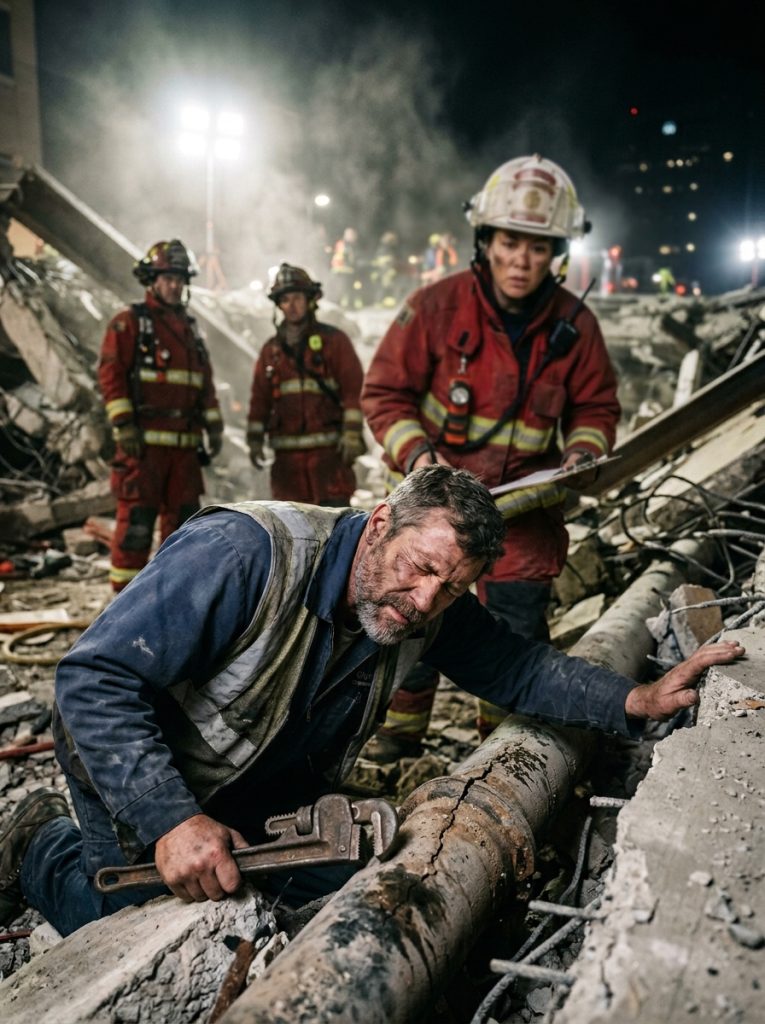
In the silence, with forty people holding their breath, the pipe spoke.
Tap. Tap. Tap. A pause, exactly long enough to be a pause and not an accident. Then tap-tap-tap again. Captain Reyes was crouched beside me now, her ear a few inches from the cast iron, and I watched her face go from professional patience to something else entirely — the look of a person who has just heard a thing they cannot un-hear.
“That’s deliberate,” she said. Quiet. Like saying it loud might scare it off.
“That’s a person,” I said. “And they’re being smart about it. Hear the pattern? Three and three. Whoever it is, they’re not just banging — they’re conserving. They know they might be at this a while.”
Here’s the thing the thermal cameras and the dogs couldn’t account for, the thing nineteen years gave me for free. Sound travels through a building’s plumbing like a nervous system. A tap on the main drain stack down in the sub-level carries up through the cast iron to wherever that stack runs, which in this particular ugly 1960s structure was nowhere near where the collapse looked worst. The search had concentrated on the visible damage, on the pancaked north corner, because that’s where a reasonable person looks. But I knew where that stack went, and I knew about the utility chase beside it, that little forgotten void space I’d cursed a hundred times for being too tight to get a wrench into.
If someone had been near that chase when the deck came down, the chase might have done the one useful thing it had ever done: held a pocket of space open while everything around it folded.
I told the captain exactly that. I drew it for her in the concrete dust with my finger — here’s the stack, here’s where it runs, here’s the chase, here’s where a person would be if they were alive and tapping. She didn’t ask me for credentials. She’d stopped seeing the laid-off plumber about thirty seconds earlier. She got on her radio and redirected the whole operation to a spot the search grid had written off, and I heard a couple of the other crew hesitate, because it didn’t match the playbook, and I heard her cut them off with four words: “The plumber knows the building.”
The plumber knows the building. Nineteen years, and that was the sentence. I’ll take it to my grave.
We tapped back, first. That was my idea and I’m prouder of it than almost anything. I took my wrench and rang the stack — three taps, pause, three taps — the exact rhythm back at them, so whoever was down there would know, in the worst moment of their life, that the tapping had stopped being a prayer and started being a conversation. And after a second, the pipe answered. Faster now. Frantic. Alive.
You want to know what that does to a rescue crew? It lit them up like a current. A “possible” became a “confirmed,” and confirmed is a different animal. They moved.
It took two hours and forty minutes to reach her. I say “her” now because I know now. Her name is Sofia, she’s nineteen, and she was three weeks into an overnight cleaning job — the kind of job a kid takes when they’re trying to put themselves through school, the kind nobody notices is in a building until the building comes down on top of them. She’d been emptying bins on the sub-level when she felt the structure shift, and she’d done the single thing that saved her life: she’d dived into that miserable, too-tight utility chase, the one I’d cursed for two decades, and it had held just enough room.
And she’d tapped on the pipe. When I asked her later why the pipe, why not just scream, she said, “I yelled for a while. Then I figured nobody could hear yelling through all that. But my dad’s a mechanic, and he always said sound goes through metal better than through air. So I found the biggest pipe I could reach and I just kept tapping, and I told myself somebody who knew about pipes would be up there.” She paused. “Was I crazy to think that?”
No, Sofia. You were exactly right. There was somebody up there who knew about pipes. There was, by the grace of a layoff and a forgotten locker, exactly one person on that whole scene whose entire job had been the guts of that building, and he came back at the worst possible moment, which turned out to be the only right one.
When they brought her out, the whole site did the thing you’ve seen in videos — the cheer, the helmets coming off, the grown firefighters wiping their faces and pretending it was dust. She was dehydrated and her arm was broken and she was going to be completely fine. She grabbed my sleeve on the way to the ambulance, this kid I’d never met, and she didn’t say thank you. She said, “You heard me.” Like she still couldn’t believe the gamble had paid off. “I knew somebody would hear me.”
Now here’s the part that makes this a feel-good story and not just a rescue.
The city that eliminated my position at noon called me at home the next morning. The same office, the same kind of voice that had handed me a box the day before, except now it was full of a respect that hadn’t been there twenty-four hours earlier. There was a lot of language about “reconsidering the consolidation” and “the clear value of institutional knowledge,” which is bureaucrat for we made a mistake and a teenager almost paid for it. They offered me my job back. Then they offered me a better one — a citywide role, the guy who knows the old buildings, the one they call before they write off a wing.
I took it. Not because I needed the vindication, though I won’t pretend it didn’t taste good. I took it because there are forty more ugly 1960s structures in this city, and every one of them has a stack and a chase and a forgotten void, and somebody should know where they go before the next deck comes down.
Captain Reyes put me on a list, too. The department keeps a roster of civilian specialists they can call to a scene — people whose ordinary jobs become extraordinary when a building fails. Plumbers. Electricians. The folks who know the invisible insides of things. She told me most departments have learned the hard way that the playbook is written for the building as it’s drawn, not the building as it actually is, and the people who know the difference are usually the ones holding a wrench, not a clipboard.
I think about the version of that day where I didn’t come back for my locker. Where the layoff landed clean and I went home and started updating my résumé, and the search got suspended at dusk like the math said it should, and a nineteen-year-old kept tapping a rhythm into a pipe that nobody left on the surface knew how to hear.
That version exists somewhere. It’s about ninety minutes and one stubborn old plumber away from the one I got to live.
They laid me off at noon. By dusk I was on my knees in the rubble, the only one who believed.
Turns out the most important thing I owned wasn’t in that locker after all. It was nineteen years of knowing exactly where the pipes run — the kind of knowing a budget can erase from a payroll but never from a man — and on the one evening it mattered more than anything, it was the only thing in the whole city that could hear a girl tapping for her life.