The vet visit was supposed to be routine.
Two weeks after that night — after the ambulance, the hospital, the pediatrician’s explanation about apneic episodes and infant monitors — Sam brought Bruno in for his annual checkup. Shots. Teeth. The usual.
Dr. Chen had been Bruno’s vet since the adoption. She knew him well — his gentle temperament, his patience with the exam, the way he always tried to lick her stethoscope.
She started with the physical. Ears. Eyes. Heart.
Then she paused.
“Sam, has Bruno been losing weight?”
“Maybe a little. We figured it was stress — the baby, less exercise.”
“How much would you say?”
“I don’t know. Five, six pounds?”
Dr. Chen didn’t respond immediately. She ran her hands along Bruno’s abdomen. Pressed gently. Pressed again.
Bruno didn’t flinch.
“I want to run some bloodwork,” she said. “And I’d like to do an ultrasound today if you can wait.”
Sam’s stomach dropped.
“Is something wrong?”
“Let me look first. Okay?”
He waited in the lobby for forty minutes. The longest forty minutes of his life since the ambulance ride.
Dr. Chen came out with a folder.
Her face was the kind of calm that professionals use when the news requires sitting down.
“Sam. Let’s go into my office.”
They sat.
“Bruno has a mass in his spleen. It’s significant. Based on the ultrasound and bloodwork, I’m fairly confident this is hemangiosarcoma.”
Sam stared at her.
“What does that mean?”
“It’s an aggressive cancer. Common in certain breeds. Based on the size and the blood values I’m seeing, it’s likely been growing for several months.”
Several months.
“He’s been — he’s been guarding the crib every night. Running up the stairs. He seems fine.”
“Dogs hide pain, Sam. Especially dogs like Bruno. They push through because their drive to protect is stronger than their discomfort.”
Sam’s eyes burned.
“How long?”
“Without surgery — weeks to a couple of months. With surgery, maybe four to six months. But with this tumor size and location, it’s palliative. It’s not a cure.”
Sam sat in that office chair and felt the ground open beneath him.
This dog.
This dog he’d almost surrendered three weeks ago.
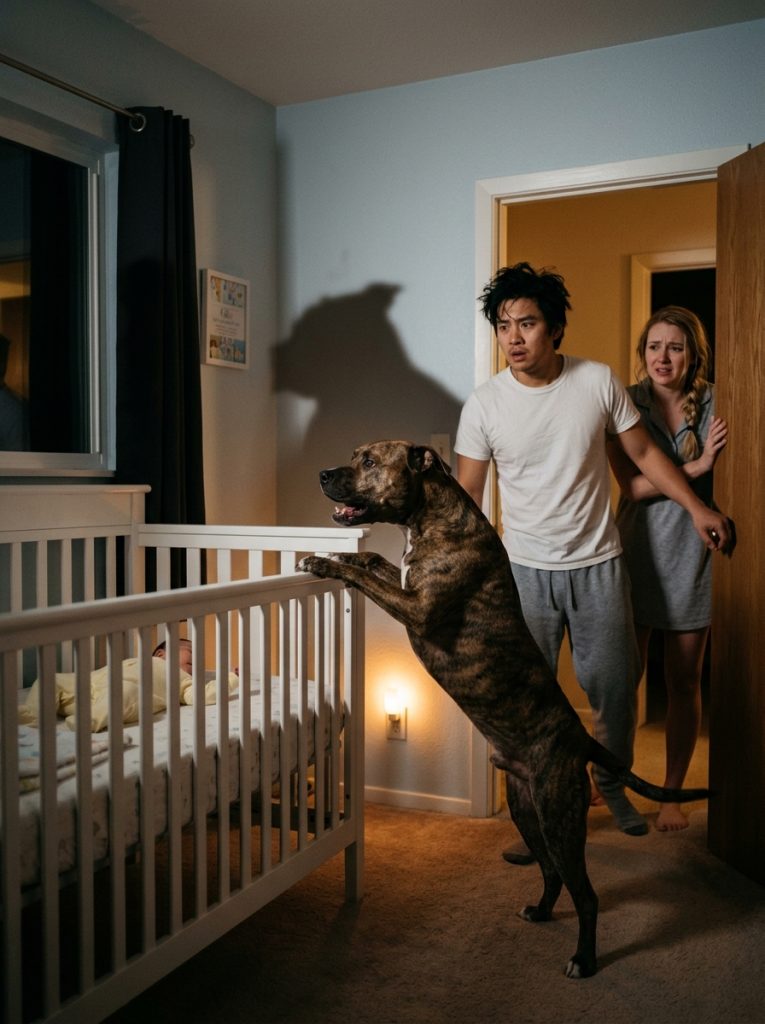
This dog who stood on his hind legs at 2 a.m. and barked until his family woke up and saved their daughter.
This dog was dying.
Had been dying.
Was dying the night he saved Lily.
Was dying every night he lay on that nursery floor, breathing when the baby breathed, guarding something he loved with a body that was already failing him.
Sam drove home in silence.
The radio was off. The windows were up. He took the long way — past the park where he used to run with Bruno before the baby came, past the shelter where they’d first met him four years ago.
Four years.
He remembered that day clearly. The shelter volunteer had warned them. “He’s been returned twice. People think he looks scary. He’s not. He’s the gentlest dog in this building. But nobody gives him long enough to see it.”
Claire had knelt down. Bruno had pressed his forehead against her knee and stayed there.
That was it. That was the whole decision.
And now this.
When he walked through the door, Bruno was in his usual spot — lying in the hallway outside the nursery. Tail wagging once when he saw Sam. Those gentle brown eyes.
Sam knelt down.
Put his face against Bruno’s warm neck.
And stayed there for a long time.
Claire found them like that twenty minutes later. She knew from Sam’s face before he said a word.
“How long?”
“Months. Maybe less.”
She sat on the floor beside them. Put her hand on Bruno’s back.
“He knew,” she whispered.
Sam looked at her.
“He knew he was running out of time. And he spent it watching over her.”
They made the decision together that night.
No surgery. The vet had been honest — it wouldn’t save him. It would buy time at the cost of pain, confusion, and recovery that would keep him away from the nursery.
And they wouldn’t do that to him.
Instead, they gave him everything.
Advertisement
They gave him the couch. The bed. The treats he’d always been rationed. The walks he loved even when they got shorter. The mornings in the yard where he lay in the sun and watched squirrels he no longer had the energy to chase.
They gave him Lily.
Every day, Claire placed the baby on a blanket on the living room floor. And Bruno would lie beside her — close but never too close, always gentle, always watching.
He stopped sleeping in the hallway.
He slept beside the crib.
Inside the nursery now. On a dog bed Claire bought him — orthopedic foam, heated, the most expensive one the store carried.
Sam caught himself watching them through the baby monitor at night. The dog curled on his bed. The baby in her crib. Both breathing.
Both still here.
The weeks passed.
Bruno got thinner. Slower. His walks became short shuffles to the backyard and back. He stopped taking the stairs — Sam carried him up at night and down in the morning. Sixty-two pounds that felt lighter every week.
But he never stopped watching the crib.
Even at the end — even when he could barely stand — he’d lift his head when Lily cried. His ears would perk. His eyes would find her. And he’d exhale only when she settled.
Like he was counting her breaths.
Like that was his job, and he wasn’t done yet.
The last day was a Thursday.
Bruno couldn’t stand that morning. His breathing was labored. Dr. Chen came to the house.
Sam carried him to the living room. Claire brought Lily.
They sat on the floor together. All four of them.
Lily was five months old now. She’d grown. She reached for Bruno’s ear — the way babies reach for everything — and he let her. He always let her.
Dr. Chen gave them time.
Then she gave Bruno peace.
He exhaled one last time with his head on Sam’s lap, Claire’s hand on his back, and Lily’s small fingers still wrapped around his ear.
Sam didn’t cry immediately.
He cried later. In the shower. In the truck. In the nursery at 2 a.m. when he woke to check on Lily and the floor beside the crib was empty.
The silence was unbearable.
They got a new monitor — a medical-grade one this time. It worked perfectly. Never missed a beat.
But it wasn’t the same.
Because a monitor doesn’t love your daughter.
A monitor doesn’t choose to guard her with the last months of its life.
A monitor doesn’t bark at 2 a.m. because it knows — the way only a loyal heart can know — that something is wrong.
Linda never mentioned Bruno again.
But six months later, she sent Sam a package.
Inside was a small oil painting. Custom-commissioned. Bruno lying beside a white crib, head up, eyes alert.
The card said: “I was wrong. I’m sorry.”
Sam hung it in the nursery.
Above the spot where Bruno used to sleep.
Lily is three now.
She doesn’t remember Bruno.
But she will.
Because Sam tells her about him every night.
Not the cancer. Not the diagnosis. Not the end.
He tells her about the dog who loved her enough to stay awake when his body wanted to sleep.
Who protected her when no machine could.
Who gave her his last good months without ever asking for anything in return.
And who — on one cold Montana night — refused to let her go quietly.
Because that’s what loyalty sounds like.
Not obedience.
Not training.
Just love. Stubborn, impossible, undying love.
Even when the body carrying it is already saying goodbye.