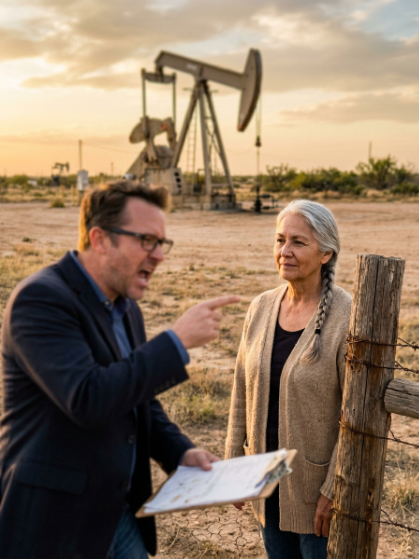
The metallic pumpjack silhouetted against the dawn on my neighbor’s property was supposed to mark the end of my family’s legacy, until a young geologist handed me a report that revealed the oil ran directly under my fence line.
My name is Clara Jenkins. At sixty-two years old, with my silver hair kept in a neat braid and wearing a worn beige cardigan, I stood next to a wooden fence post in my dusty field in Midland, Texas. The warm morning sun illuminated the dry ground and the metallic pumpjack in the background, but my focus was entirely on the developer standing in front of me, clutching a clipboard and looking incredibly smug.
Donald Miller, forty-five, was a landman representing a major drilling syndicate. He wore a tailored blazer and glasses, his posture arrogant and dismissive as he looked at my worn cardigan and my dusty, dry pasture. He had spent the last three months trying to pressure me into selling my family’s remaining forty acres, claiming it was worthless scrub land.
“You’re sitting on nothing but dust and scrub grass, Clara,” Donald mocked, pointing at the massive metallic pumpjack working on the neighbor’s side of the fence. “The active reserve ends right there at the survey stake. There is zero oil on your side of the line. Sign this release dossier and take the ten thousand dollars. By next month, the rigs will be gone, and you’ll be left with a dry field and no buyers.”
I looked at him, keeping my hands resting calmly on the wooden fence post. For three generations, my family had run cattle on this dry Texas soil, and I knew every ridge and dry creek bed. When the drilling started next door, Donald had tried to block me from accessing the survey logs, claiming the data was proprietary. He thought I was just a simple, uneducated woman who would panic and sell the land for pennies.
“I won’t be signing the release, Donald,” I said quietly, my voice steady.
Donald sighed, adjusting his glasses and shaking his head. “Clara, be realistic. You’re sixty-two, you live alone, and you’re struggling to pay the property taxes. This is a generous offer for a field that has no mineral value. Don’t let your stubbornness ruin your retirement.”
Just then, a white pickup truck pulled up on the dirt road next to the fence line.
A young man in mud-spattered boots and safety glasses stepped out. He was an independent geologist I had hired last month to do a full seismic analysis of my forty acres, paying him with the last of my savings. He walked over, carrying a certified geology report, and placed it flat on the hood of his truck.
“Excuse me, Mrs. Jenkins,” the geologist said, his voice loud and clear in the quiet field. “I just finalized the core sample analysis. The results are certified.”
Donald sneered, barely looking at him. “We’ve already run the seismic lines in this block, son. The formation terminates at the county road. There’s nothing here.”
“Actually, Mr. Miller,” the geologist replied, pointing to the colorful seismic map in the report. “Your drillers missed the fault line. The oil formation doesn’t terminate. It curves directly under Mrs. Jenkins’s pasture. In fact, the thickest part of the shale oil reserve is situated right here, three hundred yards inside her fence line.”
Donald’s smirk vanished. His face turned a pasty, ash-grey color, and he snatched the geology report off the truck hood, his eyes wide in sudden shock as he stared at the certified data.
“This… this has to be a mistake,” Donald whispered, his voice cracking as his fingers trembled against the paper. “Our survey crew said this sector was dry.”
“Your survey crew only scanned the surface, Donald,” I said, looking at him with a calm, resolute expression. “You thought you could buy my heritage for a pittance because you saw a woman in a beige cardigan and assumed I was foolish. But I know my land. And now that this report is filed with the state commission, I think you’ll find the leasing rights to my ‘dusty field’ are worth millions.”
Donald stood frozen next to the fence post, the geology report shaking in his hand, looking pale and panicked in the warm Midland sun as he realized his attempt to cheat me had just handed me the largest oil strike in the county.
“Clara, wait,” Donald said, his voice rising as he stepped closer to the fence post, his arrogant posture completely gone. “We can renegotiate. I can call the syndicate right now. We’ll offer you a leasing bonus of one hundred thousand dollars, plus a ten percent royalty. That’s a massive increase! You can sign the contract today, and we can start drilling next week.”
“One hundred thousand, Donald?” I asked, looking at him with a faint smile. “When your own company’s internal reports—the ones you hid from me—showed that this reserve has a projected yield of over fifty million dollars? You wanted to pay me ten thousand dollars to sign away my mineral rights so you could pocket a massive promotion.”
“I was just representing the syndicate’s interests,” Donald stammered, his glasses slipping down his nose as sweat beaded on his forehead. “Business is business. But we can make this right. One hundred and fifty thousand! Plus twelve percent! That’s the best deal you’ll get in Midland!”
Just as Donald finished speaking, a dusty black SUV pulled up behind the geologist’s pickup truck. The door opened, and a tall man in a Stetson hat and cowboy boots stepped out. He was Sam Houston, the senior land manager for Lone Star Drilling, one of the most respected independent operators in Texas.
“Actually, Donald, it’s not the best deal,” Sam Houston said, his deep Texan voice carrying across the field. He walked over to the fence post, tipped his hat to me, and smiled. “Mrs. Jenkins, I saw the seismic report uploaded to the Texas Railroad Commission registry ten minutes ago. Our engineers confirmed the fault line curve. Lone Star Drilling wants to offer you a formal lease agreement.”
Donald glared at him. “Houston, this is our block! We have the neighboring leases!”
“You have the neighbor’s lease, Donald, but you don’t have Clara’s,” Sam replied, turning his back on him. “Mrs. Jenkins, Lone Star is prepared to offer you a five-hundred-thousand-dollar signing bonus, along with a twenty-two percent royalty on all production from your acreage. And we’ll pay for the installation of a new water well for your pasture.”
Donald’s mouth fell open. He looked at the geology report in his hand, then at Sam, and finally at me. He knew his syndicate couldn’t match those terms, not after they had spent months insulting me and trying to cheat me out of my land.
“I think I’ll sign with Lone Star, Donald,” I said quietly. “You can take your release dossier and your ten-thousand-dollar offer back to your syndicate. And you can tell them that the widow in the beige cardigan knows how to read a map.”
Donald stood frozen, his face a mask of pure humiliation as I shook Sam Houston’s hand to finalize the agreement. The man who had mocked my dusty pasture was now forced to watch as the largest oil lease in the sector was signed right in front of him. He slowly turned, got into his car, and drove away, leaving a cloud of dust behind him.
A few months later, a modern pumpjack was installed in my pasture, working steadily against the Midland sky. But the cattle still graze on the dry grass, and I still walk along the fence line in my worn beige cardigan. The money has changed my bank account, allowing me to build a new community library and clear the debts of several local families. But it hasn’t changed who I am. I am still Clara Jenkins, and my family’s legacy remains safe on the land we built.