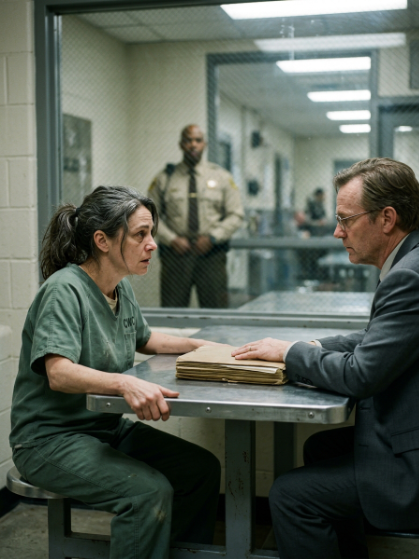
The DNA report on top of the folder had a name on it that wasn’t mine.
It was my brother-in-law’s. Wayne.
Marcus Lindqvist sat across from me in that cinderblock room and walked me through eleven years of my life like a man doing penance, because that’s exactly what he was doing.
In 2014, a woman was attacked in the parking garage where I worked nights. I found her. I called 911. I held her hand until the ambulance came. And then, because my keycard was the last one logged in the stairwell and because a witness “thought” they saw a woman matching my build, I went from the person who called for help to the person on trial.
The toxicology report would have helped me. I’d told them, over and over, that I’d felt strange that night, dizzy, wrong, like I’d been drugged. There’d been a coffee on my desk I didn’t remember pouring. They ran my blood. And then the report disappeared into a lab that, it turned out, employed Wayne as a technician.
My sister’s husband. Wayne.
He’d been skimming from the garage’s parking revenue for two years. The woman who was attacked had figured it out and confronted him that night. He panicked. And he had access — to the lab, to the evidence chain, to a sister-in-law with a keycard and no alibi and a public defender carrying ninety other cases.
He didn’t just let me go to prison. He built the road I walked there. He suppressed the tox screen that would have shown the sedative he put in my coffee. He let his own wife — my sister — believe I’d done it, so thoroughly that she stopped visiting by year two.
“I prosecuted you,” Marcus said. His voice was flat, careful, the voice of a man who’d practiced this. “I believed the file in front of me. That’s the job, and that’s the excuse, and I’ve stopped letting myself use it. Something about your face in that courtroom never left me. You kept saying the same thing. Innocent people and guilty people both say it. But you said it the same way every single time, for years, in every appeal. Guilty people’s stories drift. Yours never moved an inch.”
He left the DA’s office in 2020. Joined the Innocence Project. And the first cold case file he pulled from his own career was mine.
The new DNA testing — technology that didn’t exist in 2014 — matched the physical evidence to Wayne. The lab’s own access logs, finally subpoenaed, showed him handling my toxicology sample the night it vanished. A retired tech, dying and unburdening, confirmed the rest.
My conviction was vacated on a Thursday.
I had imagined that day for eleven years. I thought there’d be a band playing. There wasn’t. There was a paper to sign and a set of clothes that didn’t fit and a door, and then the outside, which was too big and too loud and smelled like rain in a way I’d forgotten.
My mother wasn’t at the gate. She’d died in year six, still believing in me, still writing the parole board letters they never answered. That’s the part no exoneration fixes. I walked out at forty-seven into a world that had buried my mother without me, where my sister was divorcing the man who’d framed me, where my nieces were teenagers I’d missed becoming people.
Eleven years. You don’t get them back. Anyone who tells you the truth setting you free feels like flying has never lost eleven years to a lie.
Wayne was arrested. He’ll stand trial. Marcus is consulting on the case, from the other side of the table now.
I asked Marcus, before I left that visitation room for the last time as an inmate, why he came himself. He could have sent a junior attorney. He could have mailed me the good news and slept fine.
“Because I’m the one who told a jury you were a liar,” he said. “I should be the one to stand up and say I was wrong. You’re owed a face, not a letter.”
I live in a small apartment now. I work for the project that freed me, talking to women inside who say the same sentence the same way every time. I know how to listen for it now.
My mother kept every letter she ever wrote on my behalf. My sister gave me the box.
I read one a night. It’s the closest I get to the years they took.
Some nights it’s enough.