The melody was “Autumn Leaves.” But it was the French version. “Les feuilles mortes.”
My mother’s voice was raspy, thin as tissue paper, but the pitch was perfect. She closed her eyes. She swayed slightly in the wheelchair. The other residents in the hallway stopped. Nurses poked their heads out of the doors.
Sterling’s face went pale. He picked up his clipboard. His hands were shaking.
“This is… this is just a reflex,” Sterling stammered. “Savant syndrome. It doesn’t mean he’s lucid, David. It’s just neural pathways firing. Sign the papers. We need to move him to the transport van by noon.”
I looked at the pen in my hand. The black ink glistened under the fluorescent lights. If I signed, my father would go to the state ward in Queens. My mother would go to a separate memory care unit in Jersey. They would die in different zip codes.
I looked back at the piano. My father’s hands were still moving, dancing over the black and white keys. He wasn’t looking at the keys. He was looking at my mother.
The song swelled. The final chord hung in the air, vibrating through the floorboards.
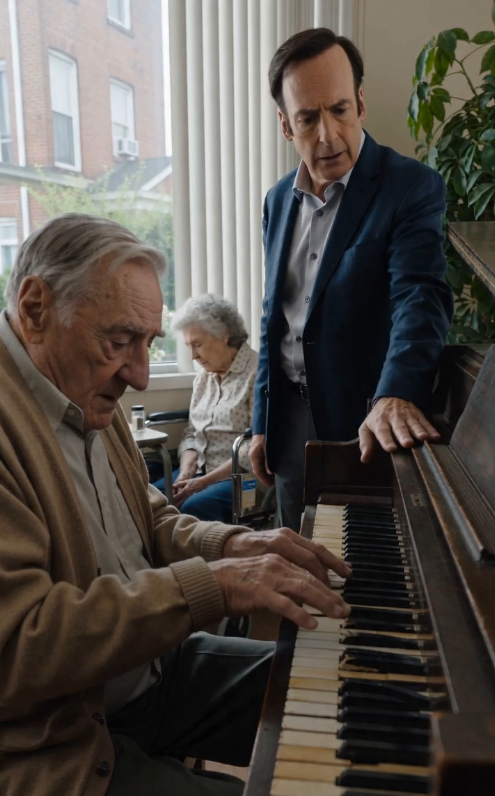
My mother stopped singing. She opened her eyes. She looked at Arthur.
“You missed the bridge, Artie,” she whispered. Her voice was clear. Sharp.
Arthur smiled. It was a small, crooked smile, but it reached his eyes. “I was waiting for you, Marty,” he said. His voice was deep, resonant. The gravelly baritone I remembered from my childhood.
Sterling dropped the clipboard again. “He… he spoke. He hasn’t spoken in six months.”
I walked over to the piano. I stood next to my father. I smelled his old wool cardigan and the faint scent of peppermint.
“Dad,” I said. “Can you understand me?”
Arthur looked up at me. His eyes were bright, clear, and entirely present. “I understand you perfectly, David,” he said. “I just didn’t have anything to say to the man who wanted to put me in a warehouse.”
The words hit me like a physical blow. My stomach dropped. I looked at Sterling. “He’s been faking the dementia?”
“No,” Arthur said softly. “I have early-stage dementia. The doctor told me two years ago. I knew the fog was coming. So I stopped talking to the staff. I stopped eating their food. I conserved my energy. Because I knew if I fought them, they’d sedate me. And if they sedated me, I couldn’t play the piano. And if I couldn’t play the piano, Martha would forget the song.”
He looked back at my mother. “She has aphasia. The stroke took her words. But the music is still in there. I just had to play the right key to unlock it.”
Sterling stepped forward. “Mr. Vance, this is highly irregular. The medical board requires a psychiatric evaluation before we can halt the transfer. I need you to sign the consent form for the evaluation.”
I looked at the clipboard. I looked at the pen. I uncapped it. I pressed the tip to the paper.
And then I drove the pen straight through the center of the consent form.
The metal tip pierced the paper and scratched the plastic backing. Sterling gasped.
“What are you doing?”
“I’m firing you,” I said. I pulled out my phone. I dialed the number for the state health department’s elder abuse hotline. “I’m reporting this facility for medical neglect and coercive transfer practices. And then I’m calling my lawyer to sue you for emotional distress.”
Sterling’s mouth opened and closed. He looked at the ruined clipboard, then at my parents. He turned and walked out of the room, his shoes squeaking on the linoleum.
The room was quiet again. Just the hum of the refrigerator in the corner.
I knelt beside my mother’s wheelchair. I took her frail hand. “Mom,” I said. “We’re going home.”
She squeezed my hand. “Home,” she repeated. The word was soft, but it was there.
Arthur stood up from the piano bench. He walked over to us. He put his hand on my shoulder. His grip was weak, but it was steady.
We walked out of the Oakwood Care Facility together. The afternoon sun was hitting the brick buildings across the street. I pushed my mother’s wheelchair down the ramp, my father walking beside me, the sun catching the silver in his hair.