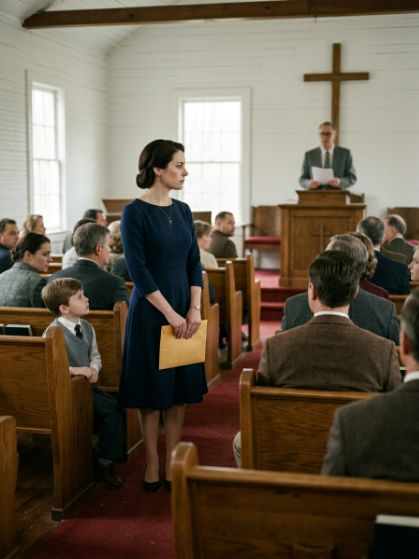
I stood in that pew with the envelope raised, and for the length of one held breath, the whole church belonged to me instead of to the whisper.
“Pastor Glen,” I said, “would you come down here and open this? I want it to be your hands, not mine. So nobody can say I switched a page.”
He came down off the pulpit. He’s a good man; he’d been used, and he knew it. His hands shook a little as he broke the seal.
Inside were three things.
The first was the lab report. He read the header out loud — an accredited paternity lab in Knoxville — and then the line that mattered: probability of paternity, 99.99 percent. Daniel Calloway, father. Micah Calloway, son.
A sound went through the congregation. Not a gasp. More like a whole room exhaling something it had been holding for two years.
My boy looked up at me. He didn’t understand the words. He understood my face, and he leaned into my side, and I put my arm around him.
“My husband is Micah’s father,” I said. “He always was. Anyone who whispered otherwise was whispering a lie. I just never thought I’d have to prove my dead husband’s love to the people who buried him.”
But I wasn’t finished, and Pastor Glen knew it, because there were two more things in the envelope.
The second was the anonymous letter itself — the one he’d read off the pulpit. Or rather, a copy. The original had been slipped to him before the service.
“Pastor,” I said, “who handed you that letter this morning?”
He hesitated. Then, because he is honest: “It was left on the lectern. With a note.”
“Was the note typed or written?”
“Written.”
I held up the third thing. “This is a permit application to subdivide the Calloway farm. Filed six weeks ago at the county office. It’s a public record; anyone can pull it. Read the signature.”
He read it. And his face changed.
“Wade Calloway,” he said.
Every head in that church turned to the front pew, where Wade sat in his brown sport coat, calm as Sunday.
Not calm anymore.
“The handwriting on your note,” I said, “and the handwriting on that permit are the same hand. I’m no expert. But the county will have one, and so will the lawyer I’ve already hired.”
Here is the part the town still talks about.
Wade didn’t deny it. He stood up, and for a second I thought he might say something cruel, something that would let everyone go back to comfortable doubt.
Instead he just walked out. Down the red runner, past the pews, out the front doors into the Tennessee morning. The doors banged shut behind him and that was his confession, plain as any signature.
Daniel left the farm to me and Micah. Wade had spent two years trying to take it the way some men take things — not with a fight, but with a whisper campaign designed to make a widow look guilty enough that handing the land over would feel like justice. He’d nearly done it. A town that knows everyone’s business is a town where a rumor does the work of a crowbar.
The lawyer made short work of the rest. The handwriting matched. The permit was withdrawn. Wade signed a statement renouncing any claim to the property rather than face the fraud question in open court, and he moved to his daughter’s place over in Cleveland by spring.
I’d love to tell you the town apologized. Towns don’t, really. They just adjust.
But Sue Ann from the diner started saving me the corner booth. The men who’d gone quiet when I walked in started nodding instead. Pastor Glen drove out to the farm himself, hat in his hands, and asked my forgiveness for reading something he should have questioned. I gave it. He’d been a tool, not the hand.
The whisper died the way a fire dies when you finally cut off its air.
Micah’s eight now. He’s got Daniel’s stubborn cowlick and Daniel’s way of squinting at a fence line like it owes him money. Last fall he asked me why his great-uncle Wade doesn’t come around, and I told him the truth in a size that fit a child: that some people want what isn’t theirs, and that the best answer to a lie is to stand up in the light and tell it no.
He thought about that.
“Is that why you stood up in church?” he asked.
“That’s why,” I said.
We were on the porch of the farm his father left him. The fields ran out gold to the tree line, and they were ours, free and clear, every acre.
“Good,” he said, and went back to his fence.
And I sat there in the last of the light, on land no whisper could take, and I let myself, finally, breathe all the way down.